In Himachal Pradesh, managing a forest is rarely just about deciding which trees can be cut and which must be protected. It is about understanding when a forest needs intervention, when nature needs to be left alone, and how a public resource can generate revenue without compromising its future.
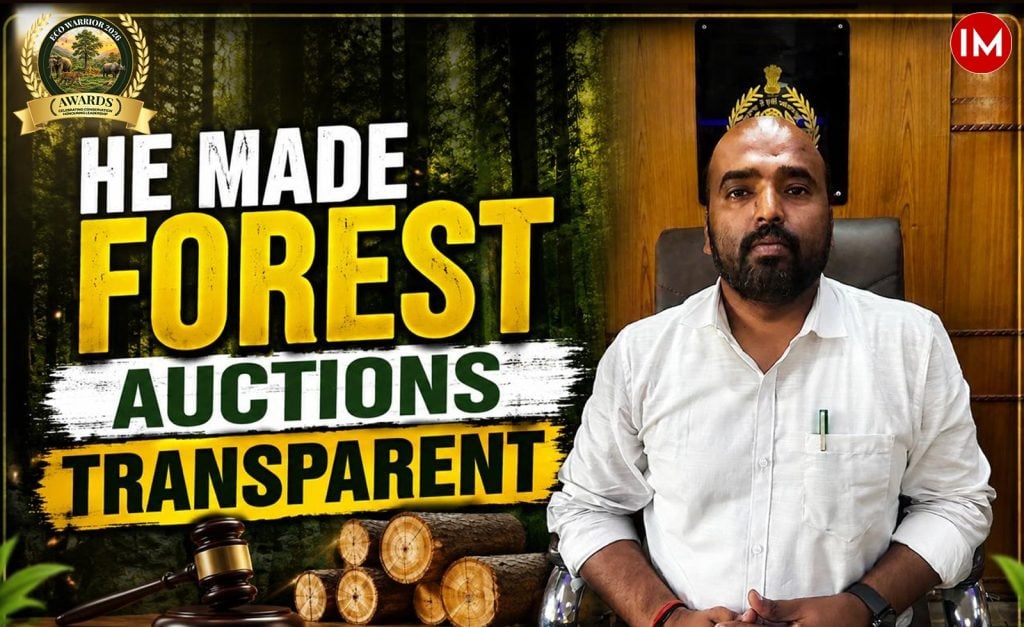
Few officers have had to balance these competing demands as closely as Dr. Patil Nitin Kundalik, IFS (HP:2013), Director, North Dharamshala.
During 2024–25 and 2025–26, his work brought together scientific silviculture, forest regeneration, transparent timber sales, climate-conscious plantation and new opportunities for local livelihoods. The results were visible not only on the forest floor, but also in government revenues and the functioning of the Himachal Pradesh State Forest Development Corporation Limited (HPSFDCL) North Zone.
Also read: How IFS Sandeep Sharma Is Restoring the Beas River and Building a Climate-Smart Model for Kullu
Bringing Khair Forests Back Into Scientific Management
For years, green felling had remained banned in Himachal Pradesh following the 1996 restrictions. But Khair presented a particular challenge.
The species has a defined economic and biological cycle. If mature Khair trees are left standing beyond their useful period, they can deteriorate from within, reducing their economic value while also affecting forest management.
The issue eventually reached the Supreme Court, following which the Central Empowered Committee examined the matter. Experimental Khair felling was first undertaken in Nurpur Forest Division, where the results showed that controlled felling, combined with coppice growth and artificial regeneration, could work.
The approach was subsequently permitted in other divisions covered by approved working plans.
Under Dr. Kundalik’s supervision, scientific Khair operations were taken forward in low-lying forest divisions including Una, Hamirpur and Bilaspur, with operations also extending to other eligible areas. But the objective was never indiscriminate extraction.
“Khair was scattered across these forests, so the approach had to be conservative. We ensured that only those trees that were scientifically available for felling were marked, while mother trees were retained and special retention was maintained in riverine areas,” Dr. Kundalik shared in an exclusive conversation with Indian Masterminds.
Marking was undertaken to strengthen scrutiny. The felling operations were subsequently carried out through the Forest Corporation, with an approved annuity felling programme supporting the process.
The economics were significant. Sustainable Khair silviculture generated nearly ₹42 crore in royalty for the Government of Himachal Pradesh, while around ₹22 crore went as direct revenue to HPSFDCL, with another ₹6 crore generated through optimised tender processes.
Planting for the Forests of Tomorrow
The same scientific approach extended beyond timber. Through the KfW-funded project, climate-suitable species were planted using a site-specific model rather than applying one standard plantation estimate across different landscapes.
Species selection, plantation models and estimates were tailored to individual sites. The results were closely monitored because reimbursement under the project depended on achieving at least 80 per cent survival after third-year monitoring.
The fact that the micro-plans qualified for reimbursement after successive first-, second- and third-year survival assessments offered strong evidence that the plantations had performed well.
“We did not want to impose one plantation model everywhere. Species selection, plantation design and estimates were prepared according to the site, because the conditions of one landscape may be very different from another,” says Dr. Kundalik.
The focus was therefore not simply on planting trees, but on establishing plantations capable of surviving the conditions in which they were created.
When Timber Sales Became a Lesson in Transparency
The numbers from HPSFDCL North Zone tell another part of the story.
The zone recorded timber sales of approximately ₹105 crore in 2024 and ₹90 crore in 2025, an exceptional performance across a diverse portfolio of forest produce including deodar, kail, fir, spruce, chir pine, khair, tun, shisham, bamboo and other species.
A major change came with the shift towards e-auctions from 2025–26. Instead of relying solely on physical auctions, timber lots were placed on an online platform accessible to buyers from across the state. Two auctions were conducted every month, while photographs of the timber stacks were uploaded and upset prices were locked before bidding.
The system also recorded bidders’ IP addresses, making collusion considerably harder.
“In a physical auction, there can be room for discretion and even informal coordination among bidders. With e-auction, once a lot, its photographs and upset price are uploaded and locked, every buyer has to quote above that price through the system, which makes the process much more transparent,” Dr. Kundalik told Indian Masterminds.
The result was not merely procedural reform. The wider pool of buyers and a more transparent bidding environment helped improve sale proceeds.
Turning Working Plans Into Working Forest Governance
Dr. Kundalik’s responsibilities have extended well beyond timber operations. As Conservator of Forests (Working Plan), he was additionally responsible for areas covering 17 forest divisions.
Working plans are effectively the blueprint for how forests are managed over time. His role involved pushing forward plans that had lapsed, providing technical assistance, scrutinising proposals and guiding divisional teams through the process.
During this period, the Government of India approved 12 Ecotourism Plans, six Draft Working Plans and five Preliminary Working Plan Reports, strengthening the planning framework for scientific forest management and conservation across multiple divisions.
The ecotourism component was particularly significant for Himachal Pradesh, where forests also hold enormous potential for trekking, nature trails and community-based tourism.
Eco-trails, walking trails and trekking routes were incorporated into planning, while forest resources and booking facilities were digitised. Provision was also made for temporary facilities such as tents and small cottages, in accordance with applicable guidelines.
The idea was simple: allow forests to create livelihood opportunities without turning them into conventional commercial spaces.
A Forester Asked to Do Something Completely Different
There was another unusual assignment.
To challenge private cartelisation in liquor vending, the state government entrusted government undertakings with running selected liquor outlets. HPSFDCL took up 42 liquor vends for three months.
It was far removed from conventional forestry work, but the exercise served a larger purpose. Once the corporation demonstrated that government entities could operate the outlets, private bidders were encouraged to participate more seriously in subsequent auctions.
For Dr. Kundalik, it was an unusual chapter in a career centred on forests, but also a reminder that public institutions can sometimes be asked to solve problems far beyond their traditional mandates.
From Khair regeneration and climate-conscious plantations to ₹105 crore in timber sales, digital auctions, working plans and community-oriented ecotourism, Dr. Kundalik’s work reflects a broader shift in the way forests are being managed in Himachal Pradesh: science on the ground, transparency in the marketplace and economic value that does not come at the cost of the forest’s future.
Also read: The Bridge That Rose From the Ruins: How IFS Gurharsh Singh United a Village After the Samej Disaster