Wildlife conservation was once largely understood through the protection of forests, protected areas and a few flagship species. India had two major species-focused programmes that shaped much of its conservation effort — Project Tiger and Project Elephant. These programmes remain important, but the conservation landscape has expanded significantly over the last decade.
Over the last 12 years, a wider species-centric approach has emerged. Lion, River Dolphin, Great Indian Bustard, Cheetah, Gharial, Sloth Bear, Snow Leopard, Wild Water Buffalo and the one-horned rhinoceros have increasingly received focused attention through dedicated projects, recovery programmes and scientific assessments.
The idea is also changing. Saving one species is no longer seen only as protecting that animal. When a species receives focused conservation attention, its habitat, prey base, water sources, landscape and surrounding communities also come into focus. In other words, when we focus on a species, we ultimately focus on the ecosystem in which it survives.
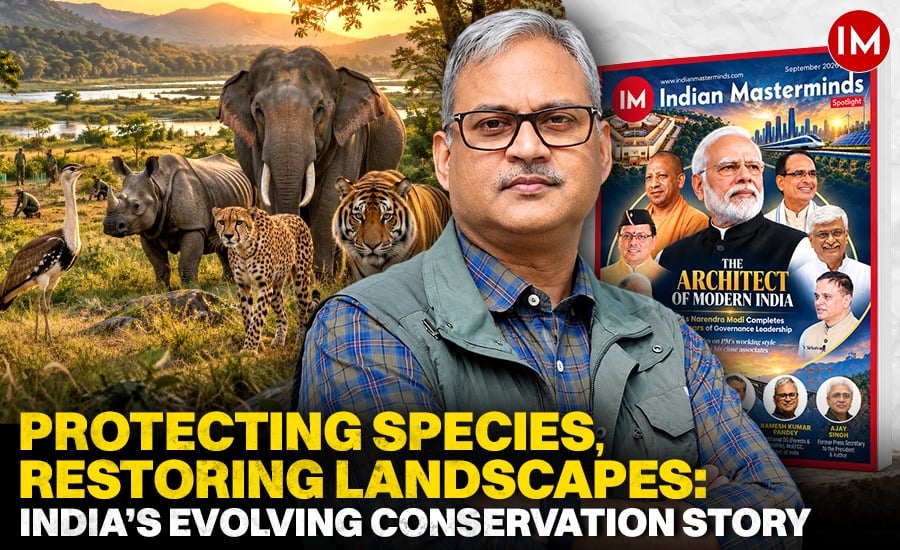
This article is based on a discussion between senior Indian Forest Officer Mr. Ramesh Pandey and Pallavi from Indian Masterminds, on the changing approach to wildlife, forests and climate conservation in India.
EXPANSION OF SPECIES-SPECIFIC CONSERVATION PROGRAMMES
One of the most visible changes has been the move towards a broader species-centric approach.
For decades, Project Tiger and Project Elephant were the two major species-specific conservation programmes in India. They created strong institutional systems around two iconic animals and helped develop approaches such as protected habitats, population monitoring, anti-poaching measures and community participation.
The approach has now expanded.
Dedicated conservation efforts have been strengthened for species such as the Asiatic Lion, Gangetic River Dolphin, Great Indian Bustard, Snow Leopard and Cheetah. More recently, programmes for the Gharial and Sloth Bear have also been added. Conservation action plans have also been developed for the Wild Water Buffalo and Great One-Horned Rhinoceros.
This is an important shift because each species faces a different set of threats.
A tiger needs large connected landscapes and a healthy prey base. An elephant needs extensive movement corridors because it travels across large areas. A river dolphin depends on the health and flow of river systems. The Great Indian Bustard depends on open grassland and desert landscapes. Snow leopards survive in fragile high-altitude ecosystems.
A single conservation formula cannot work for all of them.
The Species Recovery Programme under the Integrated Development of Wildlife Habitats scheme has therefore become an important instrument. It now covers 24 critically endangered species, with the Gharial and Sloth Bear added in 2025.
The results in some species also show why sustained conservation matters.
The Asiatic Lion population increased from 674 in 2020 to 891 in 2025. India also carried out its first-ever scientific estimation of the Gangetic River Dolphin population. The exercise estimated 6,327 dolphins in the Ganga and Brahmaputra river systems.
The Great Indian Bustard has received another highly specialised conservation effort. Eggs collected from the wild are artificially incubated and hatched at conservation breeding centres in Rajasthan, where the programme has successfully reared birds in captivity and is now moving towards rewilding. The first successful inter-state jump-start execution of the Great Indian Bustard in Naliya, Kutch, Gujarat, coupled with the progress of soft releases in Rajasthan, marks a significant leap forward in Great Indian Bustard conservation. A soft-release facility at Sam in the Desert National Park has also been operationalised.
The return of the Cheetah is another major example of this species-focused approach. Project Cheetah has gone beyond simply bringing the animal back to India. Kuno is being developed as the primary landscape, while Gandhi Sagar and Banni are also being developed as future cheetah sites.
Similarly, Barda is being promoted as a second home for the Asiatic Lion. These initiatives point towards a larger change. Conservation is increasingly being designed around the ecological requirements of individual species while also looking at the larger landscape. That is important because species cannot survive in isolation.
A tiger reserve cannot be healthy if its surrounding landscape is degraded. An elephant population cannot thrive if its traditional movement corridors disappear. A river dolphin cannot survive if the river ecosystem is polluted or fragmented. Species conservation, therefore, becomes ecosystem conservation.
IMPETUS TO SCIENTIFIC POPULATION ESTIMATION AND MANAGEMENT EFFECTIVENESS EVALUATION
The second major change is the increasing emphasis on scientific assessment. Knowing how many animals exist is fundamental to conservation. But simply counting animals is not enough. Modern conservation increasingly asks deeper questions: Where are the animals? What is their population structure? Are populations increasing or declining? What is happening to their habitats? Are protected areas being managed effectively?
India has taken several important steps in this direction. The first-ever synchronised estimation of Gangetic River Dolphins was completed and the findings were released in 2025. This created a baseline for future monitoring of the species and its riverine habitat.
Snow leopard conservation has also entered a new phase. India conducted its first nationwide scientific assessment of the species, estimating 718 snow leopards. Such an exercise is important because snow leopards live in difficult and remote mountain landscapes, making conventional wildlife counting extremely challenging.
India has also undertaken the first DNA-based elephant population estimation. Instead of relying only on traditional counting methods, DNA-based approaches can provide deeper information about population structure and individual animals. These are not short-term exercises.
Scientific population estimation creates a baseline. Future assessments can then tell conservation managers whether a population is stable, increasing or declining. It also allows policy and funding decisions to be based on evidence rather than assumptions. This is particularly important for large-ranging species such as elephants, which move across forests, agricultural areas and human settlements.
The same scientific approach is being extended to the management of protected areas.
The Management Effectiveness Evaluation (MEE) system provides a structured assessment of how well protected areas are being managed. The second cycle of MEE covering 438 national parks and wildlife sanctuaries recorded an average score of 64.41 per cent, compared with 60.52 per cent in the earlier assessment. This shows a gradual improvement in management effectiveness.
The exercise is also expanding beyond conventional protected areas. Management effectiveness assessments are being taken forward for Elephant Reserves and Marine Protected Areas as well. This is important because conservation does not end at the boundary of a national park. Animals move. Rivers flow. Birds migrate. Elephants cross forests and farms. Marine species move across large stretches of ocean.
Therefore, conservation planning also needs to move beyond administrative boundaries.
India’s work on migratory species provides another example. The country has played an important role in the conservation of birds along the Central Asian Flyway, which connects 29 countries. India’s proposal for a coordination mechanism for migratory bird conservation was adopted at CMS COP-14 in Samarkand in 2024, and India received the Champions Award from the Convention on Migratory Species.
The larger lesson is clear. Conservation is increasingly being supported by data, scientific monitoring, technology and regular evaluation. This also changes how success is measured. The question is no longer simply whether a protected area exists. The question is whether it is functioning effectively.
PROMOTING HUMAN-ELEPHANT COEXISTENCE WHILE SUPPORTING COMMUNITIES
Perhaps the most difficult conservation challenge in India is also one of the most important: how do we protect wildlife while ensuring that communities living alongside it are able to live safely and securely? Human-wildlife conflict has increased in many landscapes because of habitat fragmentation, expanding settlements, agriculture and the movement of animals beyond protected areas.
Elephants are one of the clearest examples. They need large landscapes and traditional movement routes. But these routes often pass through agricultural fields and villages. When elephants enter farms, crops can be damaged. People can be injured or killed. Elephants can also face retaliation. The answer cannot simply be to keep wildlife inside protected areas.
This is where the idea of conservation through coexistence becomes important. India has strengthened measures to reduce negative human-wildlife interactions. These include animal-proof fencing, trenches, electric fencing, rapid response teams and radio-collaring of problematic animals. Compensation has also been strengthened. Since December 2023, enhanced ex-gratia assistance provides ₹10 lakh in cases of death or permanent incapacitation, ₹2 lakh for grievous injuries and up to ₹25,000 for minor injuries, subject to applicable norms.
But financial compensation alone cannot solve the problem. Long-term coexistence requires better landscape planning and community participation. One example is the launch of Project Tiger outside Tiger Reserves (ToTR). Tigers do not always remain within reserve boundaries. As their populations recover and individuals disperse, they increasingly use surrounding territorial forest divisions.
Instead of treating such movement as an exception, the new approach recognises that conservation has to work across the wider landscape. The objective is to reduce negative human-tiger interactions while supporting the forest divisions around tiger reserves.
A similar regional approach is being developed for elephants. A Regional Action Plan for elephants seeks to address human-elephant conflict at the landscape level, with financial support planned through CAMPA. This recognises that elephant conservation cannot be handled by one protected area or one forest division alone.
The focus has to be on corridors, agriculture, communities and movement patterns across entire landscapes. At the same time, conservation must create opportunities for local people. This is where nature-based tourism and eco-tourism become relevant.
If local communities can earn from tourism, guiding, homestays, handicrafts, transport and other conservation-linked activities, wildlife can become an economic asset rather than being seen only as a source of conflict. The idea is to create a positive connection between conservation and livelihoods.
The establishment of a Centre of Excellence for Human-Wildlife Conflict at SACON, Coimbatore, is another step towards building stronger scientific and institutional capacity in this area. The larger objective is not to eliminate every interaction between humans and wildlife. That would neither be possible nor desirable. The objective is to reduce negative interactions and create conditions in which people and wildlife can share landscapes with fewer risks.
CONSERVATION THAT LOOKS BEYOND THE ANIMAL
The changes of the last decade point towards a wider understanding of wildlife conservation in India. It is no longer only about protecting a tiger in a tiger reserve or an elephant in an elephant reserve. It is about understanding the entire system.
That system includes forests, grasslands, rivers, wetlands, mountains and coastal ecosystems. It includes prey species, migratory routes and wildlife corridors. And it also includes the people who live around these landscapes. This broader approach can be seen in initiatives such as the expansion of protected areas, the increase in Ramsar sites, mangrove restoration under MISHTI, forest and tree cover improvement and the strengthening of wildlife health infrastructure.
India’s protected area network has expanded from 745 protected areas in 2014 to 1,134 by February 2025, covering more than 1.87 lakh square kilometres. The number of tiger reserves has also increased from 47 to 58, while elephant reserves have grown to 33. The number of Ramsar sites has also increased significantly, from 26 in 2014 to 101, reflecting the growing focus on conserving wetlands and their ecological importance.
At the international level, India has also strengthened its role in global wildlife conservation. The International Big Cat Alliance, announced on the occasion of 50 years of Project Tiger, has now brought together 30 range countries as members or observers. The creation of the National Referral Centre for Wildlife at Junagadh is another step towards strengthening wildlife health management.
Together, these developments point towards a conservation model that is increasingly species-specific, science-driven and community-oriented. The most important change, however, may be the understanding that these three elements cannot work separately. A species needs a healthy ecosystem. A healthy ecosystem needs effective management. And conservation in a human-dominated landscape needs the support of communities.
That is why the evolution of India’s wildlife conservation approach over the last 12 years is significant. The focus has moved from protecting a few iconic species to managing entire ecological systems. From counting animals to scientifically understanding populations. And from treating human-wildlife conflict only as a problem to actively building coexistence.
Wildlife conservation, ultimately, is not about choosing between people and animals. It is about creating landscapes where both can survive. And when a country begins to protect species, measure populations scientifically, improve protected-area management, secure habitats and support communities living alongside wildlife, conservation becomes more than a programme. It becomes a long-term investment in the ecological security of the country.