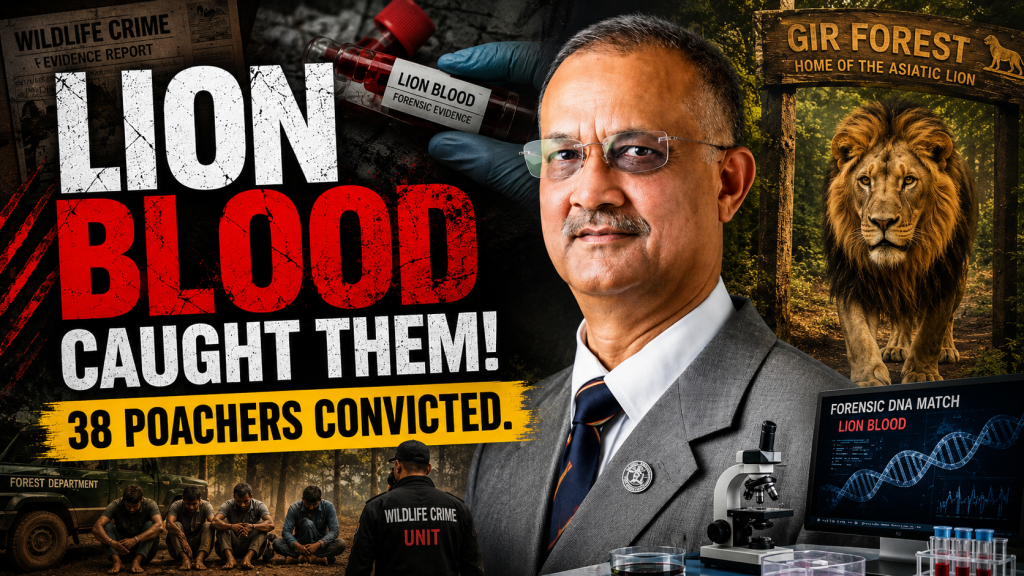
A wildlife crime can disappear into the forest almost as easily as the animal itself. There may be no eyewitness, no conventional crime scene, no obvious suspect and little hope of reconstructing what happened months after the offence. But when IPS officer Dr Keshav Kumar walked into Gujarat’s Gir landscape to investigate the poaching of Asiatic lions, he saw the absence of witnesses not as a weakness, but as an opportunity.
A 1986-batch Gujarat cadre IPS officer, Dr Keshav Kumar spent nearly 35 years in policing before retiring in 2021. Throughout his career, he developed a deep interest in forensic science and used it extensively in serious criminal investigations. His work eventually helped secure convictions in dozens of criminal cases, with around 68 serious cases resulting in conviction where forensic evidence played a decisive role.
But perhaps his most unusual investigation began in 2007, when he was asked to investigate the poaching of Asiatic lions in Gir Sanctuary. At the time, lion poaching was relatively unheard of, and even experienced wildlife investigators had little precedent to follow.
What followed became one of the most significant wildlife crime investigations in India.
Also Read – How IFS Dhawan Kumar Rawat is Connecting Tribal Livelihoods With Wildlife Conservation
WHEN THE FOREST BECAME THE CRIME SCENE
At the time, Kumar was serving as DIG, CID Crime in Gujarat. The Gir investigation involved 10 Asiatic lions that had been poached in three spells of 3, 3 and 4 animals.
The case presented an immediate problem. The sanctuary was nearly 600 kilometres from his office in Gandhinagar, and the investigation could not realistically be conducted by sitting in an air-conditioned office and relying on reports from the field.
Kumar decided to do something that would shape the entire investigation.
He moved into the jungle.
For about two-and-a-half months, he camped near the scene of the crime and worked on reconstructing what had happened. He formed a special investigation team and brought in officers with investigative experience, including a police officer who had earlier worked with the CBI.
The conventional approach, however, seemed difficult.
There were practically no eyewitnesses. Access to the sanctuary was restricted. The possibility of finding someone who had actually seen the lions being killed was extremely low.
For Kumar, that was precisely why forensic science had to become central to the investigation.
“I was very happy that there were no eyewitnesses because that gave me the opportunity to use forensic science and build the case on physical evidence. In a wildlife crime, you cannot depend on witnesses who may not even exist,” Dr Keshav Kumar told Indian Masterminds.
Watch the interview here :
FROM POLICING TO FORENSIC INVESTIGATION
Kumar’s confidence in forensic science had been built over decades.
After joining the Gujarat cadre in 1986, he worked closely with forensic experts and developed practical knowledge of scientific investigation. He specifically credits Dr J. M. Vyas, who later became Vice-Chancellor of the National Forensic Sciences University, with helping him understand forensic science not merely as theory but as an investigative tool.
That expertise eventually changed the course of his career.
When he was considered for induction into the CBI in 2009, he faced an unusual disadvantage. He had never worked in the CBI and had never been posted in an Anti-Corruption Bureau—two conventional credentials often considered important for senior-level induction.
Instead, he presented his forensic track record.
Two of his investigations had been featured among well-investigated cases in The Week, while India Today had carried a detailed story on how one of his cases had been solved using forensic science.
The CBI Director, impressed by his forensic expertise, eventually selected him. Kumar joined the CBI as Joint Director on January 4, 2010. A dedicated forensic branch was also created for him—the first such branch in the CBI devoted specifically to forensic investigation.
He subsequently handled or advised on several major cases, including the Gyaneshwari Express train accident in West Bengal, in which 149 people died, as well as the Bhanwari Devi and Shehla Masood murder cases. These cases ultimately resulted in convictions.
THE UNUSUAL MYSTERY OF LION POACHING
The Gir case, however, posed another question: why were lions being killed when tiger poaching was far more widely known?
The answer emerged during the investigation.
At that time, tiger bones were in high demand in China and other markets for purported medicinal purposes. But to the naked eye, tiger bones and lion bones are difficult to distinguish.
DNA fingerprinting could establish the difference.
According to Kumar’s investigation, lion bones could therefore be passed off as tiger bones in the illegal wildlife trade.
This explained why an animal that was not traditionally associated with large-scale poaching had become a target.
But knowing the possible motive was only the beginning. Kumar still had to establish who had actually committed the crime.
THE FORENSIC TRAIL BEGINS
During the investigation, Kumar sought assistance from wildlife experts and conservation networks. He contacted the Wildlife Protection Society of India and spoke to its then head, Belinda Wright, who provided important inputs about the possible involvement of the Baheliya community, traditionally associated with hunting.
The information gave investigators a profile to work with.
Teams were alerted in neighbouring districts to look for people matching the profile. Within days, investigators in Bhavnagar reported a group of around 45 people whose characteristics appeared to match the information.
Kumar travelled to Bhavnagar and began examining the group.
Freshly cut lion claws were recovered.
But possession of lion claws did not, by itself, establish that these people had killed the lions. The investigation needed a forensic bridge connecting the suspects to the actual crime.
That was where Kumar’s investigative reasoning became crucial.
BLOOD ON CLOTHES AND UNDER FINGERNAILS
Kumar reconstructed the crime.
If the suspects had killed and skinned a lion, the process would have involved direct physical contact with the animal. Blood could therefore have remained on their clothes and under their fingernails.
The possibility became even more significant because the investigators had information that the suspects did not frequently change their clothes.
Samples of their clothing and material from beneath their fingernails were collected and sent for forensic examination.
The first report showed that the blood was animal blood.
That was not enough.
Kumar pushed further.
The report established that the blood belonged to the cat family. But a cat-family identification still could not distinguish between a lion, tiger, leopard or cheetah.
The investigation needed one more scientific step.
Finally, the forensic examination established that the blood belonged to Asiatic lions.
The evidence provided the missing link.
“The theory was in my mind that lion blood should be present on their clothes and under their fingernails. But the real challenge was connecting that scientific evidence with the crime. That is where I say forensic science is the science, but its application is an art,” Dr Keshav Kumar told Indian Masterminds.
WHY HE CALLS FORENSICS AN ART
For Kumar, forensic science does not end with obtaining a laboratory report.
The real investigative skill lies in knowing what evidence to look for, where to look for it and how apparently unrelated pieces of information can be connected.
He compares an investigation to a jigsaw puzzle—or even filmmaking.
An investigator begins with incomplete information and has to reconstruct what might have happened. Thousands of possibilities may exist, but only one ultimately corresponds to reality.
He experienced the same principle in a much earlier murder case in Jamnagar.
A victim had been shot with a country-made pistol. The post-mortem report indicated an entry wound but no exit wound, yet investigators had not recovered the bullet.
Kumar reasoned that if there was an entry wound without an exit wound, the bullet should still be inside the body. Since the body had already been cremated, he considered the possibility that the bullet might remain at the cremation site.
Instead of searching manually over a large area, he proposed using a metal detector.
The approach worked.
For him, that case demonstrated the difference between knowing forensic science and applying it creatively.
A LANDMARK WILDLIFE CONVICTION
The same philosophy transformed the Gir investigation.
The forensic evidence became a crucial piece of the prosecution’s case. When the accused sought bail, the forensic report showing Asiatic lion blood on their clothes and beneath their fingernails became a significant piece of evidence.
The court did not accept the argument that such evidence could be explained away easily.
Eventually, 38 poachers were convicted in the case in 2009.
For Kumar, the significance went beyond the number.
It demonstrated that wildlife crimes could be investigated using the same scientific rigour applied to serious conventional crimes.
The case also established the potential of forensic science in wildlife crime investigation, an area that Kumar would continue to promote.
FROM POLICE OFFICER TO FORENSIC MENTOR
After retiring in 2021, Kumar did not step away from investigation.
He completed a PhD in forensic psychology from the National Forensic Sciences University and continued training police officers across India and abroad. He has delivered hundreds of lectures and trained police personnel from around 22 countries in wildlife crime investigation.
He has also advised governments and worked on forensic investigation, wildlife crime and medicine-related investigations.
His journey from a Gujarat police officer to a senior CBI officer and forensic specialist has therefore been shaped by one consistent belief: evidence must be discovered scientifically, but investigators must know how to think beyond the obvious.
The Gir lion poaching investigation remains perhaps the clearest example.
In a forest where witnesses were scarce and conventional investigation seemed almost impossible, Kumar found the story hidden in blood, fingernails and clothing.
The forest had no eyewitness to offer.
But the evidence could still speak.