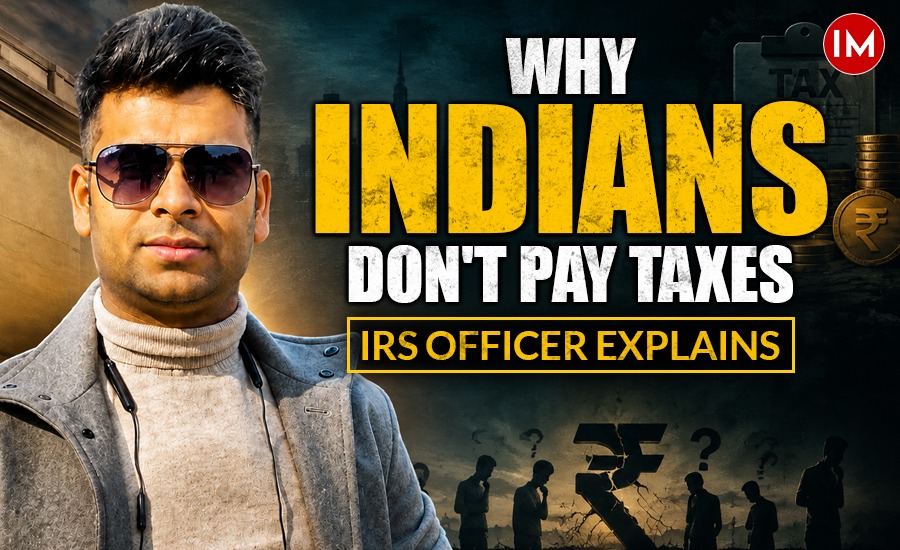
For some, the journey to the civil services begins with a childhood dream. For Shakeel Ahmad Ganie, IRS, 2016 batch, it was far less predictable. He first studied Chemistry, then pursued an MBA, worked for three years in a bank and only later decided to prepare for the UPSC examination.
Today, he serves as Joint Commissioner of Income Tax in Ahmedabad. Before this posting, he spent three years as Deputy Commissioner of Income Tax in Srinagar, where he worked closely with citizens, businesses and students to improve tax awareness and build greater trust in the Income Tax Department.
His journey is not only about clearing UPSC. It is also about finding purpose in public service, understanding the changing role of a tax officer and using administration to connect citizens with the larger process of national development.
A JOURNEY THAT WAS NEVER STRAIGHT
Ganie grew up in Ganderbal and completed his education in Kashmir. Civil services, however, was not always part of his plan. His academic journey began with Chemistry because he was initially considering a career in the field.
His thinking changed during his MBA. Conversations with friends and the influence of his elder brother introduced him to the idea of the UPSC and civil services. But even then, he did not immediately leave everything to prepare for the examination.
Read & Watch Also: How NAFED is Strengthening Farmers, Markets and Food Security
After completing his MBA, he joined J&K Gramin Bank and worked there for three years. The experience gave him an understanding of the banking sector and everyday economic life in Kashmir. Over time, however, he felt he needed a more intellectually challenging career with a wider opportunity to contribute to society.
“My path has not been that straight. It has been a little curly,” Ganie recalls.
He first explored the UPSC in 2011 and spent about 23 months preparing. He then returned to banking. In 2014, he resigned from his job and decided to make another serious attempt. This time, the journey moved quickly. He cleared the preliminary examination, reached the interview stage and eventually entered the Indian Revenue Service.
FINDING PURPOSE IN THE IRS
After several years in the service, Ganie says he is satisfied with the path he chose. He believes one of the biggest mistakes young officers can make is comparing one civil service with another.
For him, every service has a different role. The important thing is understanding one’s responsibility and contributing effectively within that role.
“You cannot compare services with each other because they have different roles. You have to understand that your role is going to be different from other services or other people,” he says.
He sees the IRS as an important part of India’s administrative and economic system. Taxes collected by the department support the functioning of the government and help finance public services and development.
In his view, that makes tax administration much more than a question of collecting revenue.
“We are the breadwinners of the nation. We earn, we collect the taxes, and those taxes fuel the whole administrative and political machinery,” he explains.
INCOME TAX IS MORE THAN RAIDS
For many citizens, the image of an Income Tax officer is associated with searches, raids and investigations. Ganie says this is only one part of a much larger system.
The Income Tax Department has several verticals, including assessment, investigation and international taxation. A significant amount of work takes place away from public view.
One such area is intelligence gathering. Officers analyse information and identify possible discrepancies before deciding what action is required.
Assessment work is another important responsibility. Officers examine tax matters and pass assessment orders. Ganie describes this as a responsibility that involves delivering justice while ensuring that the law is correctly applied.
“When you are making assessment orders, you are sitting in the chair with a responsibility to deliver justice,” he says.
The department’s work has also expanded beyond India’s borders. With globalisation, international taxation has become increasingly important. Tax officers now have to understand cross-border transactions, multinational companies and how profits generated across countries should be taxed.
SERVING HIS HOME REGION
Ganie’s posting in Srinagar had a special meaning. He was not simply returning to a familiar place. He was returning as a public servant after years of education, work and training.
He describes it as a feeling of returning to the people with greater knowledge and responsibility.
During his tenure in Srinagar, one of his key priorities was tax awareness. He wanted citizens and businesses to understand the benefits of formalisation, maintaining proper accounts and filing income tax returns.
He also reached out to students. One such initiative involved interaction with students at the Central University of Kashmir. The idea was to explain the importance of direct taxes to young people who would eventually become professionals, entrepreneurs, officers and leaders.
The larger message was simple. Roads, bridges, hospitals and other public infrastructure require money. A strong tax system is one of the foundations that makes such development possible.
“Without a robust taxation system, all these things cannot happen,” Ganie says.
CONNECTING TAXES WITH DEVELOPMENT
Ganie believes that India’s tax system depends heavily on voluntary compliance. The department cannot scrutinise every return manually. Citizens therefore need to understand why paying taxes matters.
He believes that tax consciousness must grow alongside economic growth.
“There is a direct connection between paying taxes, being an income tax filer and development,” he says.
For him, the challenge is not only enforcement. It is also communication.
The department is increasingly using social media and other digital platforms to reach different sections of society. At the same time, businesses are being encouraged to enter the formal economy through proper bookkeeping, return filing and compliance.
TECHNOLOGY IS CHANGING TAX ADMINISTRATION
Technology, according to Ganie, has already transformed the Income Tax Department.
Earlier, information was largely stored in physical files. Processing large volumes of information was difficult. Today, digital data and automated systems have changed the scale at which the department can operate.
When a person files an income tax return, it goes through the department’s central processing system. Much of the initial processing is automated. Discrepancies can be identified and communicated without extensive manual intervention.
Artificial intelligence and data analytics are further expanding these capabilities. Information relating to cash deposits, real estate transactions and other financial activities can be processed to identify patterns and possible discrepancies.
“Information is a currency. Data is the new oil,” Ganie says while explaining the growing importance of data-driven taxation.
He believes the future will involve a stronger partnership between people and machines.
“It is going to be a synergy between the machine and the man,” he says.
At the same time, he warns that tax officers must learn to work with technology. Criminals and tax evaders are also becoming more sophisticated and increasingly use digital systems.
A CHANGING KASHMIR
Ganie’s years in Srinagar also gave him an opportunity to observe economic changes in Kashmir closely.
He says the business ecosystem has become more diverse. Restaurants, homestays, tourism businesses, tour and travel companies and small industrial units have expanded. More young people and individuals from non-business families are entering entrepreneurship.
He is particularly encouraged by the growth of new businesses and young entrepreneurs.
Horticulture and handicrafts remain important pillars of the regional economy. At the same time, better infrastructure and cold-storage facilities are helping farmers and horticulture businesses reduce losses and plan their businesses more effectively.
Improved road, railway and air connectivity has also strengthened Kashmir’s links with the rest of the country.
“The geographical linkage with the rest of the country has increased. Simultaneously, with the movement of human beings, trade activity has also increased,” he observes.
For Ganie, the biggest reason for optimism is Kashmir’s young population.
“The young generation holds the key to the success and prosperity of the region, and I see hope in their eyes. I see that spark in their eyes,” he says.
FROM SRINAGAR TO AHMEDABAD
His move to Ahmedabad marks another chapter in his career. Having worked in places such as Jalandhar, Amritsar and Srinagar, the new posting takes him into a different social, cultural and economic environment.
But Ganie sees that movement as an essential part of central service.
“This is the spirit of the central service. This is what you sign for when you take that employment offer,” he says.
Rather than viewing the transition as a challenge, he sees it as an opportunity to learn.
He is looking forward to understanding Gujarat, experiencing a different culture and gaining a new perspective on administration and society.
“I am looking forward to it with hope that I learn more things and evolve as a person, as an officer and intellectually also,” he says.
For Shakeel Ahmad Ganie, the journey from Ganderbal to the Indian Revenue Service has never been a straight line. It has been shaped by changes in plans, professional experience, public service and a continuing desire to learn.
His story also reflects how the role of a tax officer is changing. It is no longer limited to files, assessments and raids. It increasingly involves public awareness, technology, data, international taxation and building voluntary compliance.
And perhaps that is the larger lesson from his journey: public service does not always begin with a clear destination. Sometimes, it is the willingness to change direction, keep learning and find purpose along the way that eventually leads an officer to the right place.
Read & watch Also: IFS Piyusha Jagtap Turning Forest Stories into People’s Movement