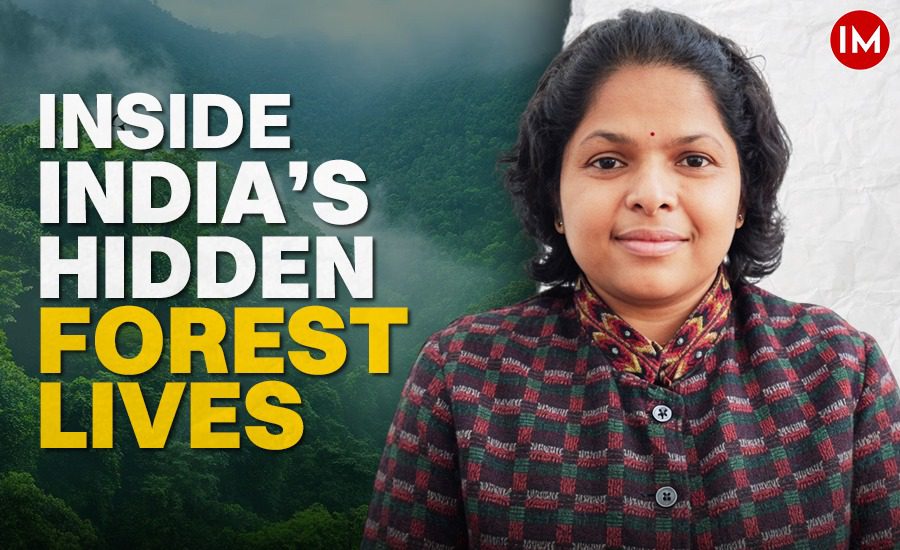
For Piyusha Jagtap, the journey into forests was not accidental; it was deeply personal. An outdoor person at heart, she chose the Indian Forest Service after a stint in central services, driven by a desire to stay close to nature. But alongside her official role, there was always another side to her: an artist who painted and wrote, quietly observing the world around her.
“I always loved to paint and write… I wanted something that would keep me close to nature,” she shared in an exclusive conversation with Indian Masterminds, recalling how both passions found a common ground in her work.
That intersection would soon give birth to an initiative that would take forest stories far beyond the trees.
WHEN SILENCE OF FORESTS FOUND A VOICE
During the COVID-19 lockdown, when official movement slowed and time stretched in unusual ways, Jagtap turned inward and then outward. She began sketching. One drawing a day. Straight from her office desk.
But these weren’t just drawings. They were windows into a world most people never see.
“There are so many things being done inside the forest, but people are not aware,” she explains. “Forest staff work incredibly hard, but nobody really knows.”
Inspired by the idea that unseen work often goes unnoticed, she created 50 sketches over 50 days. These were later compiled into simple, powerful leaflets and eventually a small book that reached audiences far beyond the forest department.
What began as a personal exercise soon became a bridge, connecting citizens to the lives of forest personnel.
STORIES FROM MELGHAT TO TADOBA
Her canvas wasn’t limited to paper. It stretched across landscapes, from Melghat Tiger Reserve to Tadoba Andhari Tiger Reserve.
In Melghat, where she served as Deputy Director, she created a mascot named Bana, inspired by the Korku tribe. Bana, meaning “bear” in Korku, became the storyteller of the jungle. Through illustrated narratives, she translated complex ecological ideas into relatable stories for local communities and visitors at the Nature Interpretation Centre.
Later, in Tadoba, she paired photographs with short reflective notes: capturing fleeting moments and deeper meanings of life in the wild.
Her writings, mostly in Marathi, remain deeply personal: journals of lived experiences rather than published works. “I write for my own enjoyment… it’s about my journey,” she shares.
CREATING LIVELIHOODS
While storytelling shaped perception, her on-ground work focused on changing realities.
In Melghat, she and her team worked closely with communities that voluntarily relocated from core forest areas. Instead of limiting the approach to relocation, they focused on what comes next: livelihood.
Homestays became the answer.
Starting from scratch, families with little income and small, unproductive landholdings were trained in hospitality. With minimal resources and immense effort, they built homestays with their own hands.
Years later, the impact continues.
“People who had one homestay now have five,” she told Indian Masterminds, with visible satisfaction. “That gives me immense happiness.”
Alongside, initiatives like birdwatching and community-based tourism helped reduce dependency on forests while creating sustainable income streams.
FIGHTING FIRES, ONE VILLAGE AT A TIME
If there’s one challenge that defines her work, it is forest fires.
In central Indian landscapes, most fires are manmade, set for activities like mahua flower collection. Controlling them is physically exhausting and dangerous.
“Day and night, we are in the field, beating fire with twigs… it is very risky,” she explains.
Her approach focuses on prevention through community participation. The “fire-free village” model encouraged villages to take ownership by planning controlled burning, cleaning forest floors, and committing to zero forest fires, with incentives reaching up to ₹5 lakh.
It’s a simple idea with powerful results: when communities lead, forests stand a better chance.
REIMAGINING NATURE EDUCATION
For Jagtap, conservation doesn’t end in forests; it begins in classrooms.
Currently serving as Field Director at Nagarahole Tiger Reserve, she is experimenting with a long-term nature education model. Unlike one-day safari visits, this initiative engages students of Classes 6 to 8 over 10 months, with structured monthly sessions.
Named Chitampallinchi Nisarga Shala, the program trains forest staff as educators, creating a consistent learning environment for children.
“It’s my moral responsibility… if we want change, we need to start early,” she says.
The goal is simple yet ambitious: not just awareness, but a shift in how young minds perceive forests.
A LIFE BETWEEN LINES AND LANDSCAPES
From Gadchiroli to Nandurbar, from Melghat to Nagarahole, Jagtap’s journey reflects both movement and meaning. Whether she’s sketching a quiet jungle scene or designing a livelihood model, the intent remains constant: bringing people closer to forests.
In her world, conservation is not just about protecting wildlife. It is about telling stories, building trust, and ensuring that those who guard the forests are finally seen.