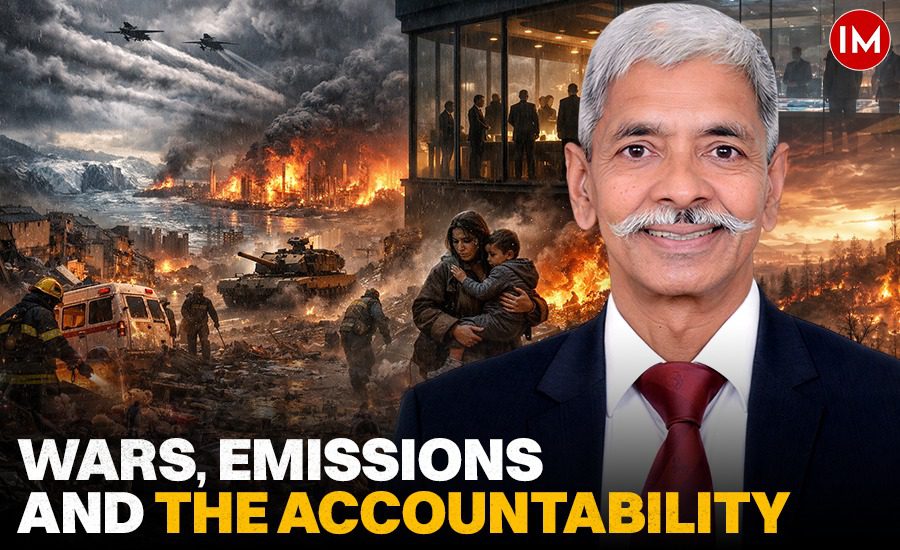
The world measures corporate carbon footprints, pressures citizens to reduce emissions, and increasingly links ESG to investment and governance. Yet when nations go to war- unleashing destruction at an industrial scale, climate accountability mysteriously disappears.
Wars are usually debated in terms of geopolitics, national security, territorial ambitions, humanitarian tragedy, and economic disruption. Rarely do policymakers or climate advocates discuss one uncomfortable truth: modern warfare has become one of the least-accounted climate changers of our times.
As nations pledge net-zero ambitions and industries face increasing environmental scrutiny, military conflicts continue to devastate ecosystems, burn fossil fuels at massive scale, disrupt global supply chains, and trigger emissions with virtually no climate audit. The contradiction is glaring. Companies disclose. Citizens are monitored. Governments make climate promises. But wars remain largely exempt.
From the prolonged Russia–Ukraine war to the recurring violence in Gaza, escalating tensions involving Iran, and wider instability in West Asia, conflict today has become a significant yet invisible climate multiplier.
The question is no longer whether war affects climate. It undoubtedly does. The real question is- Why does the world still refuse to account for it?
Modern warfare is extraordinarily energy-intensive. Combat aircraft, tanks, naval fleets, missile systems, logistics chains, military transport, satellite networks, and reconstruction efforts together create a carbon footprint that often escapes mainstream climate accounting.
Recent studies estimate global militaries and defence supply chains together contribute nearly 5–6% of global greenhouse gas emissions; a footprint larger than many industrial economies.
The Russia–Ukraine war offers a sobering example. Beyond battlefield destruction, emissions stem from burning fuel, damaged industrial infrastructure, urban fires, destroyed energy facilities, and the enormous reconstruction requirements of cities and transport systems. Cement, steel, logistics, and rebuilding activities create environmental costs that may last decades.
West Asia presents another case. The Israel–Palestine conflict, recurring Iran-linked tensions, maritime insecurity in the Red Sea, and large-scale military mobilisations have triggered energy shocks and disrupted shipping routes. Every military deployment, aircraft carriers, missile defence systems, long-range sorties, and emergency logistics carries hidden climate consequences.
Wars do not merely release carbon.
They destroy forests, contaminate water systems, poison agricultural land, and damage ecological resilience. Fires from bombings release black carbon, one of the most dangerous short-term climate pollutants. Destroyed urban ecosystems weaken natural carbon absorption systems. The environmental impact often survives long after ceasefires are signed.
Military emissions remain one of climate diplomacy’s biggest blind spots.
Why There Is No Climate Audit for War
The answer lies largely in geopolitics and sovereignty.
International climate agreements, including the Kyoto Protocol and later climate frameworks, left military emissions weakly regulated or inconsistently reported. Nations argued that mandatory disclosure of military fuel consumption and operational emissions could compromise national security.
The result is a dangerous loophole.
Also Read – Abu Salem’s Extradition, UN Missions & Prison Reform — One IPS Officer Did It All
Climate accountability stops where military operations begin.
Even under the Paris Agreement, military emissions reporting remains uneven and often voluntary. Governments continue to prioritise strategic secrecy over environmental transparency.
The contradiction becomes sharper as the planet edges closer to climate tipping points.
The world has already witnessed temperatures periodically crossing the 1.5°C warming threshold, once viewed as a red line under the Paris Agreement. Scientists increasingly warn that a 2°C world is becoming alarmingly plausible if emissions continue unchecked.
At that level, climate disruption becomes far more dangerous intensifying extreme weather, food insecurity, water stress, migration pressures, and geopolitical instability.
Ironically, climate stress itself may become a future trigger for conflict.
Water scarcity, agricultural collapse, access to minerals, energy insecurity, and displacement could increasingly become catalysts for instability. In effect, climate change may fuel wars, while wars accelerate climate change.
That feedback loop is already emerging.
What More Needs to Be Done?
The world needs a new climate-security doctrine.
First, military emissions should become part of mandatory national reporting frameworks under future climate agreements. National security concerns are legitimate, but aggregated reporting mechanisms can be developed without compromising strategic and operational secrecy.
Second, major conflicts should trigger independent environmental damage assessments under UN oversight. Just as war crimes investigations examine humanitarian costs, climate destruction must also become measurable.
Third, reconstruction after war must include mandatory green rebuilding principles. Post-conflict rebuilding driven entirely by carbon-intensive industrial activity risks worsening climate damage.
Fourth, global institutions should consider establishing an independent Climate Conflict Accountability Mechanism, modelled conceptually though not structurally on the lines of nuclear oversight agencies. Its role would not be to police sovereignty, but to provide neutral assessments of emissions, environmental destruction, and long-term reconstruction liabilities arising from conflict.
Will such mechanisms prevent war?
Probably not.
Nations ultimately go to war over sovereignty, survival, deterrence, resources, ideology, or security imperatives. No international climate mechanism can override existential national interests.
But transparency matters.
When countries know that military campaigns carry internationally visible climate costs, supply chain disruptions, reconstruction burdens, and reputational consequences, strategic calculations may become more restrained.
The economic dimension cannot be ignored.
Recent tensions involving Iran and wider West Asian instability demonstrated how quickly regional conflict can disrupt global shipping, oil prices, insurance costs, inflation, and supply chains. What begins as a regional military event rapidly becomes a global economic shock.
In an interconnected world, climate risk, conflict risk, and economic risk are no longer isolated conversations.
What Summit Diplomacy Must Deliver
Global summits often produce declarations, frameworks, and diplomatic signalling. Yet implementation remains uneven.
Security platforms like NATO and QUAD increasingly discuss climate resilience. Economic groupings such as BRICS and the European Union have expanded sustainability conversations. ASEAN has emphasised regional resilience and disaster preparedness.
But climate consequences of warfare remain inadequately integrated into strategic frameworks.
Future summit diplomacy must move beyond rhetoric and focus on practical outcomes:
- agreed standards for military emissions reporting
- post-conflict environmental restoration frameworks
- climate-risk assessments linked to conflict zones
- supply chain resilience mechanisms during regional wars
- green reconstruction financing models
Declarations alone are insufficient. What matters is ratification, implementation, and accountability.
India’s Strategic Lesson
India is uniquely positioned to lead this conversation. Why so?
As a nation balancing development, security threats, energy transition, and climate vulnerability, India understands the difficult equilibrium between preparedness and sustainability.
India cannot compromise military readiness in an uncertain neighbourhood. Yet it also cannot ignore climate vulnerability, given rising heat stress, water insecurity, and ecological pressures.
This demands a new strategic framing:
Security with sustainability not security versus sustainability.
India should advocate a doctrine of “Climate Accountability Without Strategic Vulnerability” at global forums including the G20, Global South partnerships, and multilateral climate negotiations.
Three areas deserve priority.
First, greener military logistics and energy efficiency without compromising operational capability.
Second, climate-conscious defence infrastructure and procurement, particularly in transport, energy systems, and reconstruction planning.
Third, global leadership on climate-security diplomacy, positioning India as a bridge between developed and developing nations.
The world cannot continue measuring emissions selectively.
If industries are audited and citizens held accountable, warfare perhaps the largest unaudited emitter of all can no longer remain outside scrutiny.
History may one day be judged by conflicts not only by the lives lost or territories contested, but by the irreversible climate damage they left behind.
This is a two-part series by the author, who is also an ESG advocate. Part Two will cover the AI Era of Digital Transformation and the next climate contradiction.
Also Read – The Man Who Wrote the Book Forest Guards Still Carry Into the Jungle