There are police officers who chase criminals.
And then there are officers who try to change the system itself.
For over three decades, IPS officer Rupin Sharma has done both.
He helped track and extradite one of India’s most wanted gangsters, Abu Salem. He served in conflict-sensitive regions. He worked with the United Nations Peacekeeping Mission in Bosnia. And years later, while leading Nagaland’s prison system, he began asking a different question: what happens after punishment?
That question would shape one of the most unusual prison reform efforts in the Northeast.
Today, the 1992-batch IPS officer from the Nagaland cadre serves as Director General of Police (DGP), Nagaland. But his journey is far bigger than ranks and postings. It is the story of an officer who moved from hunting fugitives to rebuilding lives inside prisons.
FROM HIMACHAL TO THE IPS
Born in Dharamshala, Himachal Pradesh, Mr. Sharma entered the Indian Police Service through the UPSC Civil Services Examination in 1992. He joined the IPS on October 11, 1992, and was allotted the Nagaland cadre.
Academically, he built an unusually diverse foundation. He holds degrees in BSc, M.Ed, MBA, and LLB. Over the years, that mix of education shaped both his administrative style and his wider understanding of society.
His career would eventually span policing, border affairs, prison reforms, disaster response, and international peacekeeping.
By 2020, he was serving as DGP (Border Affairs). In January 2023, the Home Department of the Government of Nagaland appointed him as the state’s Director General of Police. Since then, he has continued to lead the state police at the highest level, while also handling responsibilities linked to prisons, civil defence, and emergency response systems.
THE OFFICER WHO HELPED BRING BACK ABU SALEM
One of the defining chapters of Mr. Sharma’s career came during his stint with the Central Bureau of Investigation (CBI).
The 1993 Mumbai serial blasts had shaken the nation. More than 250 people were killed and hundreds injured. Several accused linked to Dawood Ibrahim’s D-Company fled the country. Among them was gangster Abu Salem.
For years, Indian agencies tried to trace him.
Around 2001, Mr. Sharma was posted with the CBI and became part of the effort to track Salem down. Investigators had leads, but nothing concrete. One tip suggested Salem was in the UAE with a female companion. The team pursued the lead aggressively, only to discover it was false.
Also read – From Missing Cut-Offs to AIR 11: The Inspiring Journey of Aakash Singhal in UPSC IFS 2025
Then came another clue.
In 2002, the CBI received an email claiming Abu Salem was in Portugal. Most officers were skeptical. Earlier leads had failed. But Mr. Sharma believed the information deserved attention.
The team traced the source of the email. It had indeed originated from Portugal.
That changed everything.
Soon, the CBI coordinated with Interpol-Lisbon and Interpol headquarters in Lyon. Portuguese authorities located Salem, arrested him, and began extradition proceedings.
But locating him was only half the battle.
Portugal’s Constitution prohibited extradition if the accused faced the possibility of a death sentence. Salem was wanted in multiple cases involving murder and terrorism-related charges. India had to provide assurances that the death penalty would not be carried out.
The legal and diplomatic process stretched for nearly two years before Abu Salem was finally extradited to India.
For Mr. Sharma, it became one of the biggest successes of his policing career.
SERVING BEYOND INDIA
Apart from domestic policing, Mr. Sharma also served with the United Nations Peacekeeping Mission in Bosnia.
The assignment exposed him to post-conflict recovery, humanitarian policing, and international coordination. Officers who have worked in such environments often return with a broader understanding of law enforcement — one that goes beyond crime control and focuses equally on rebuilding institutions and restoring public trust.
That thinking would later become visible in his prison reforms in Nagaland.
TURNING JAILS INTO CORRECTIONAL INSTITUTIONS
When Mr. Sharma took charge of prisons in Nagaland, he began pushing a simple but powerful idea: prisons should reform people, not merely isolate them.
He repeatedly described jails as “correctional institutions” rather than centres of punishment.
According to him, the real purpose of imprisonment is defeated if inmates return to crime after release. Rehabilitation, therefore, becomes essential.
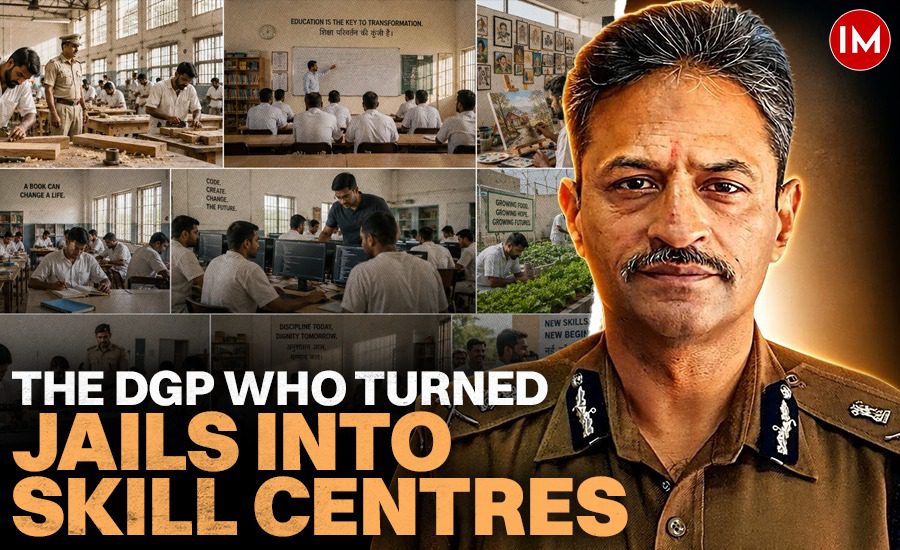
Under his leadership, Nagaland prisons started several skill-development and rehabilitation programmes aimed at helping inmates rebuild their lives.
One of the most innovative partnerships came with the company USHA under its “Kushalta Ke Kadam” initiative.
The programme trained jail inmates in stitching and vocational skills. Initially, USHA had worked mainly with civilians and women outside prisons. Convincing the company to work inside jails required persistent efforts and coordination.
Eventually, the partnership was launched at Dimapur Jail.
The programme began with 15 trainees, including prison staff who could later train others. The long-term goal was bigger — to help former inmates become self-employed and financially independent after release.
SKILLS, DIGNITY, AND SECOND CHANCES
The reforms did not stop there.
Nagaland prisons also began working on projects involving tailoring, confectionery production, sanitary napkin manufacturing, food processing, and local handicrafts.
Inmates were trained in repairing LED bulbs and preparing snacks and food products. Discussions were also initiated for training programmes in plumbing, carpentry, masonry, barbering, and electrical work.
Two confectionery units were supported by NHIDCL and Hindustan Petroleum.
Mr. Sharma believed prisoners represented an untapped manpower resource. With nearly five lakh inmates across Indian prisons, he argued that industries and institutions should partner with jails to create rehabilitation opportunities.
His larger message remained consistent: people may commit mistakes, but many deserve a second chance.
A CAREER BUILT ON SERVICE
Over more than 34 years in service, Mr. Sharma has held several important positions and earned national recognition for his work.
He received the Police Medal for Meritorious Service in 2009. In 2024, he was awarded the President’s Police Medal for Distinguished Service.
Today, as DGP of Nagaland, he continues to lead one of India’s most sensitive policing systems.
But what makes Rupin Sharma stand out is not only the operations he handled or the criminals he chased.
It is the balance he tried to maintain between firmness and reform.
From tracking fugitives across borders to teaching inmates skills inside prison walls, his career reflects a rare belief — that policing is not only about enforcing the law, but also about giving society a chance to heal itself.
Also Read – How IPS Vineet Kapoor Helped Spark a Statewide Awakening Against Drugs in Madhya Pradesh