Every year, Pune transforms into a sea of devotion during Ganeshotsav. Streets overflow with devotees, processions continue through the night, and managing the movement of millions becomes one of the biggest policing challenges in Maharashtra. Amid this enormous responsibility, a young IPS officer turned to technology to ensure that faith and safety moved hand in hand.
For Krushikesh Rawale, a 2019-batch Maharashtra cadre IPS officer currently posted as DCP, Zone-I, Pune City, the 2025 Ganpati celebrations were not merely about maintaining law and order. They were an opportunity to reimagine crowd management through innovation.
The scale of the challenge was staggering. According to AI-based estimates, nearly 16 lakh people participated in the festivities within his jurisdiction alone. Yet, despite the unprecedented crowds, the celebrations remained orderly and safe, thanks to a carefully planned technology-driven strategy that combined artificial intelligence, smart infrastructure, surveillance systems, and data-based decision-making.
Speaking to Indian Masterminds, Rawale explained how modern policing is increasingly becoming inseparable from technology.
“Policing today is very different from what it used to be. There is hardly any crime or law enforcement challenge that does not involve technology in some form. Whether it is mobile forensics, financial transactions, digital communication, AI or surveillance systems, technology has become central to policing,” he said.
MANAGING A CROWD OF 16 LAKH PEOPLE
Ganeshotsav in Pune is widely regarded as one of the largest crowd-management exercises in Maharashtra. The immersion processions attract devotees from across the city and neighbouring districts, creating immense pressure on roads, public spaces, and security personnel.
Traditional crowd-control methods often struggle under such conditions. Recognising this, Rawale and his team introduced several innovations aimed at reducing congestion while improving crowd movement.
One of the most significant interventions was the deployment of what he calls “permeable barricading.”
Also Read – How an IRS Officer Spent Five Years Decoding 4,000 Years of Indian Culture
THE INNOVATION OF PERMEABLE BARRICADES
Conventionally, barricades act as fixed barriers, restricting movement in both directions. While effective for controlling crowds, they can also trap people within densely packed areas, increasing discomfort and the risk of panic.
To address this issue, Pune Police introduced turnstile-based one-way exits as part of their crowd-management strategy.
The idea was simple yet effective. People who felt uncomfortable, suffocated, or needed to leave crowded areas could exit easily through designated routes, while entry through those same points remained restricted.
This ensured a continuous outward flow of people without disrupting the movement of incoming devotees.
The innovation proved particularly beneficial for elderly citizens, women, children, and individuals experiencing discomfort in dense crowds.
By creating controlled escape routes, the police significantly reduced the possibility of crowd pressure building up at critical points.
BOOM BARRIERS FOR DYNAMIC CROWD CONTROL
Another major innovation was the deployment of boom-barrier systems across key routes.
Unlike traditional barricades that require manual placement and removal, boom barriers can be activated instantly. These systems consist of strong metallic ropes mounted between fixed poles and can be lowered or raised depending on crowd conditions.
The barriers enabled police teams to dynamically regulate pedestrian movement and create temporary stoppages whenever required.
This flexibility proved invaluable during peak hours when crowd density changed rapidly across different parts of the city.
The system allowed officers on the ground to respond in real time instead of relying solely on static traffic and crowd-control measures.
AI-POWERED SURVEILLANCE ON THE STREETS
Technology was not limited to crowd movement alone.
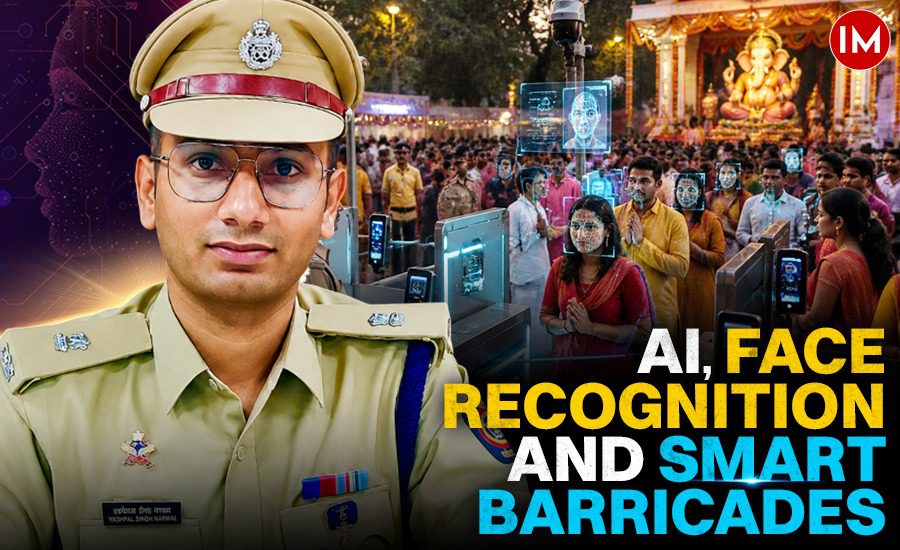
Pune Police also deployed AI-enabled surveillance systems and face-recognition cameras to strengthen security during the celebrations.
Mobile surveillance units continuously monitored key locations, transmitting real-time information to control rooms and field officers.
The AI-based cameras helped estimate crowd density and movement patterns, allowing police teams to identify potential congestion points before they became problematic.
Although Rawale acknowledges that AI-based headcounts are not always perfectly accurate, the technology provided valuable insights into crowd behaviour.
The recorded estimates indicated that around 16 lakh people participated in the celebrations, highlighting the enormous scale of the operation.
The surveillance systems also enhanced law enforcement capabilities by assisting in the identification of suspicious individuals and enabling faster responses to emerging situations.
TECHNOLOGY AS THE FUTURE OF POLICING
Rawale’s belief in technology-driven governance extends well beyond festival management.
Earlier in his career, he led an initiative that transformed a district into what he describes as India’s first AI-driven district, reflecting his commitment to integrating innovation into public administration.
His engineering background, he says, has played a crucial role in shaping this approach.
“Engineering develops an analytical mindset. In engineering, everything has a root cause and every problem can be broken down into smaller components before finding a solution. That way of thinking helps immensely in law enforcement because every crime and every challenge has a source that needs to be identified and addressed,” he told Indian Masterminds.
For Rawale, technology is not a replacement for traditional policing. Instead, it serves as a force multiplier that enables officers to make better decisions, respond more quickly, and allocate resources more effectively.
A MODEL FOR MODERN FESTIVAL POLICING
The successful management of Pune’s Ganeshotsav demonstrates how technology can transform large-scale public event policing.
From AI-assisted surveillance and face-recognition systems to smart barricades and dynamic crowd-control infrastructure, the initiative showcased a modern approach to handling one of the country’s largest religious gatherings.
At a time when cities are witnessing increasing population densities and larger public congregations, Pune’s experience offers valuable lessons for law enforcement agencies across India.
For Krushikesh Rawale, the objective remains clear: harness technology not merely to enforce law and order, but to create safer public spaces where citizens can celebrate, worship, and participate without fear.
In a festival known for its devotion and grandeur, technology quietly worked behind the scenes—ensuring that millions could celebrate Lord Ganesha safely while setting a new benchmark for smart policing in India.
Also Read – Mission Maidan: How Haryana Police Is Taking the Fight Against Drugs From the Streets to the Grassroots