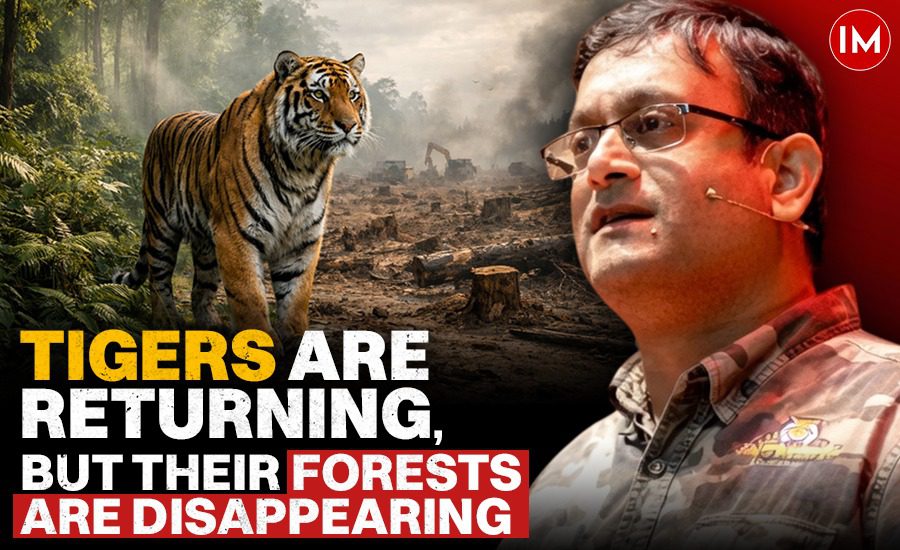
India’s tiger numbers are rising. Conservationists celebrate every new estimate, policymakers cite them as evidence of successful wildlife management, and the country proudly points to the fact that it now harbours nearly 70 percent of the world’s wild tiger population.
But beneath the encouraging headlines lies a more complex reality.
For Dr P.S. Harsha, a 2004-batch Karnataka cadre IPS officer, tiger biologist, researcher, and currently Inspector General of Police, Ballari Range, the increase in tiger numbers should not distract attention from the vulnerabilities that continue to threaten the species. While population growth is undoubtedly a conservation achievement, he believes the real challenge lies in ensuring that tigers can survive over the long term in landscapes that are becoming increasingly fragmented and pressured by development.
“Rising tiger numbers are certainly encouraging, but conservation success cannot be measured only through population estimates. We must pay equal attention to habitat loss, fragmentation, connectivity and the long-term genetic health of tiger populations,” Dr Harsha told Indian Masterminds.
His concern comes not merely from observation but from years of scientific research in some of India’s most important tiger landscapes.
A POLICE OFFICER WHO BECAME A TIGER RESEARCHER
Hailing from Karnataka’s historic fort city of Chitradurga, Dr Harsha chose public service immediately after completing his medical education. Over the past two decades, he has built a distinguished career in policing, serving in important positions including Additional SP Gulbarga, SP Tumakuru, DCP Bengaluru City, Commissioner of Police Mangaluru City, Commissioner of Information and Public Relations, and IGP Ballari Range.
Alongside his administrative responsibilities, however, another passion was quietly shaping his career—wildlife conservation.
Over the years, Dr Harsha developed extensive field experience across Nagarahole, Bandipur and BRT Tiger Reserves. His interest eventually led him into serious scientific research, culminating in a Ph.D. in Wildlife Management and Tiger Biology from Kuvempu University.
His research has focused on tiger population stability, habitat use, conservation challenges and human-tiger conflict in fragmented landscapes. Using field observations, GIS mapping, remote sensing tools and ecological analysis, he has examined conflict hotspots, livestock depredation patterns and mitigation strategies across Karnataka’s tiger reserves.
His work has been published in leading journals, including studies on the spatial and temporal dynamics of human-tiger conflict in Nagarahole Tiger Reserve and the use of GIS and remote sensing for adaptive forest resource management.
Also Read – From AI Cameras to Boom Barriers: The Policing Innovations That Transformed Pune’s Ganeshotsav
THE REAL STORY BEHIND INDIA’S TIGER RECOVERY
India’s tiger recovery is often described as one of the world’s greatest conservation successes.
The latest estimate places the country’s tiger population at approximately 3,682. Yet Dr Harsha believes historical perspective is essential.
Around the beginning of the twentieth century, India is estimated to have supported nearly one lakh tigers. The decline since then has been dramatic, and according to him, one factor stands above all others.
“Tigers have already lost around ninety-three percent of their historic habitat. Habitat degradation and habitat loss remain the greatest threats facing the species even today,” he said.
The challenge, therefore, is not simply increasing tiger numbers but securing the landscapes necessary for their future survival.
HOW DEVELOPMENT HAS FRAGMENTED TIGER LANDSCAPES
Much of Dr Harsha’s research has focused on understanding how changing land use patterns affect wildlife.
His work in the Nilgiri Biosphere landscape revealed the extent to which development has transformed once-continuous forests.
The Western Ghats once stretched as an interconnected ecological system across vast areas of peninsular India. Today, highways, roads, dams, mining operations, transmission lines and expanding human settlements have broken many of these forests into isolated habitat patches.
The impact extends far beyond the loss of forest cover.
“Even within the habitat that remains, continuity has become a major challenge. When habitats become disconnected, tigers find it difficult to move between populations, which affects gene flow and long-term survival,” Dr Harsha explained to Indian Masterminds.
WHY TIGER NUMBERS ALONE CAN BE MISLEADING
One of the key lessons emerging from Dr Harsha’s research is that conservation cannot be reduced to population statistics.
A reserve may show increasing tiger numbers, but that does not automatically guarantee ecological security.
Healthy tiger populations require sufficient prey, adequate space, genetic diversity and the ability to disperse between habitats. Without these conditions, population gains can become fragile and temporary.
According to him, the future of conservation lies in strengthening ecological connectivity rather than simply increasing tiger densities inside protected areas.
CAN INDIA EVER RETURN TO ONE LAKH TIGERS?
The question frequently arises whenever tiger numbers are discussed.
Could India ever return to the estimated one lakh tigers that once roamed its forests?
Dr Harsha’s answer is clear.
“That is not possible now because the habitats that supported those numbers no longer exist,” he said.
Many reserves have already reached their ecological carrying capacity. He points to Bandipur Tiger Reserve as an example. Scientific assessments indicate that the reserve can support around 160 to 170 tigers and currently holds approximately 151.
The limitation is largely ecological. A single tiger consumes roughly fifty to fifty-five deer-sized prey animals every year. Sustaining tiger populations therefore requires enormous prey abundance.
Future gains, he believes, will come through better-connected landscapes rather than higher densities within individual reserves.
THE IMPORTANCE OF META-POPULATIONS
A concept central to Dr Harsha’s research is that of a “meta-population.”
Rather than viewing tiger reserves as isolated units, conservationists increasingly see them as interconnected populations linked through wildlife corridors.
Long-term survival depends on animals moving between reserves and exchanging genes. When reserves become isolated islands, the risk of inbreeding increases significantly.
For this reason, protecting corridors has become just as important as protecting reserves themselves.
In many ways, connectivity may determine the future of tiger conservation in India.
WHY PEOPLE MUST BENEFIT FROM CONSERVATION
Dr Harsha’s research also highlights an important social dimension.
Conservation cannot succeed unless local communities see tangible benefits.
When residents participate in ecotourism, conservation-linked livelihoods and wildlife management initiatives, coexistence becomes easier and support for conservation grows.
If economic benefits are captured primarily by outsiders, local communities may begin viewing wildlife as a burden rather than a shared asset.
For him, successful conservation must work for both people and wildlife.
INDIA’S CULTURAL RELATIONSHIP WITH TIGERS
Beyond science and economics, Dr Harsha believes India’s cultural traditions offer a powerful foundation for conservation.
Across the country, tigers have long occupied a special place in folklore, spirituality and local identity.
Communities in Maharashtra worship Waghoba. In Karnataka, the tiger is revered as Huliraya. Traditional performances such as the Pili dance celebrate the animal’s strength and significance.
These traditions, he believes, can inspire future generations to value and protect wildlife.
THE FUTURE OF CONSERVATION IS TECHNOLOGY-DRIVEN
Looking ahead, Dr Harsha sees tremendous potential in emerging technologies.
Artificial intelligence, drone-based monitoring, camera analytics, satellite tracking and digital surveillance systems are already transforming wildlife management.
These tools can identify conflict-prone animals, track habitat changes, improve early-warning systems and support more informed conservation decisions.
Government initiatives incorporating video analytics and digital monitoring are already demonstrating how technology can strengthen conservation outcomes.
REASONS FOR HOPE
Despite the challenges, Dr Harsha remains optimistic.
India today safeguards nearly seventy percent of the world’s wild tiger population and around seventy-five percent of the global tiger gene pool. The country has established fifty-eight tiger reserves and continues to lead global conservation efforts through initiatives such as the International Big Cat Alliance.
For Dr Harsha, the future of tiger conservation will depend on balancing development with ecological connectivity, scientific research with community participation, and technology with traditional conservation values.
Because ultimately, the tiger’s future will not be secured by numbers alone.
It will be secured by ensuring that the forests, corridors, communities and ecosystems that sustain tigers continue to survive alongside them.
Also Read – How an IRS Officer Spent Five Years Decoding 4,000 Years of Indian Culture