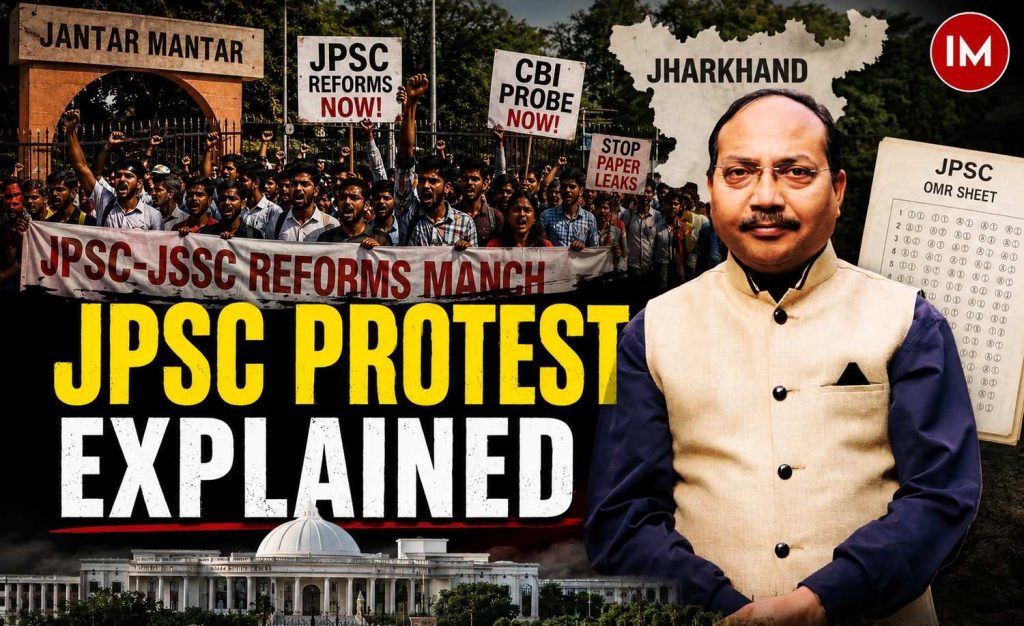
Students marching towards the legislative headquarter are water-cannoned and lathi-charged. The entire area has been converted into a fortress with barrages of barricades and razor fencing besides imposition of prohibitory orders. One of the leaders having lost 10 Kgs due to fasting, is being carried on a stretcher. It is a re-enactment of Jantar Mantar protest in Ranchi.
What began as a protest by government-job aspirants over alleged irregularities in recruitment examinations has turned into one of Jharkhand’s most sustained student agitations in recent years. On Monday, August 10, thousands of protesters marched towards the state Assembly, taking the agitation into its 17th day, despite six rounds of talks with the Hemant Soren government.
The Trust Issues
At the heart of the confrontation is a simple but deeply consequential question for thousands of young people: can they trust the state’s recruitment system?
The immediate trigger was the controversy surrounding the 14th Jharkhand Public Service Commission (JPSC) Combined Civil Services Preliminary Examination, held in April for 103 posts. After the results, candidates raised questions over the absence of category-wise cut-offs, the manner in which the merit list was published and the absence of signatures of constitutional members of the Commission.
Alleged OMR answer sheets subsequently surfaced on social media, adding fuel to suspicions of malpractice. Their authenticity has not been independently established, but the allegations prompted a CID investigation.
Read Also: Who Is Ex-IAS L Khiangte? Former JPSC Chairman Arrested Amid Protests Over Exam Paper Leak
The controversy acquired greater seriousness after investigators arrested people linked to the private agency handling examination-related work. The agency, TDPL, had reportedly been blacklisted by the Jharkhand government in 2025 but was subsequently given examination work. The CID is examining alleged links between the agency, government officials and candidates.
An old Problem
For aspirants, however, the problem is much older than the 14th JPSC examination. JPSC examinations have repeatedly been hit by allegations of irregularities, revised results, evaluation disputes, litigation and long delays.
The JSSC Combined Graduate Level examination has become another major flashpoint. Its January 2024 examination was cancelled following allegations of a paper leak; a re-examination in September 2024 too generated allegations of malpractice. The matter eventually reached the High Court and Supreme Court, creating a complicated legal backdrop to the students’ present demand for cancellation.
Students’ Demands
The JPSC-JSSC Reforms Manch, which has spearheaded the agitation, wants cancellation of several examinations, including the controversial 14th JPSC examination and Jharkhand Staff Selection Commission – Combined Graduate Level (JSSC-CGL), besides examinations conducted by agencies and individuals allegedly connected with irregularities. The protesters want category-wise cut-offs, disclosure of OMR sheets and response sheets, action against officials and agencies found guilty, and, above all, a CBI investigation into the entire recruitment-examination controversy.
The CBI demand has become the principal sticking point. Students argue that a central agency is necessary to ensure an impartial investigation, while the government maintains that several investigations are already under way and that the JSSC-CGL examination was conducted under judicial directions.
The government Response
The government has made substantial concessions. It has agreed to cancel the 14th JPSC preliminary examination and two backlog JPSC examinations. It has also proposed an Enforcement Directorate probe into alleged financial irregularities, fast-track courts for examination-related cases, a 90-day deadline for filing charge sheets and an expert panel involving IIT-ISM Dhanbad, IIM Ranchi and XLRI Jamshedpur to recommend reforms. A separate committee headed by a retired High Court judge has been proposed to examine the JSSC-CGL controversy.
The government says these steps amount to acceptance of 98 per cent of the students’ demands. The protesters strongly dispute that figure, saying only three of the 13 examinations they want cancelled have actually been scrapped. They also reject a retired-judge inquiry as a substitute for a CBI probe.
The Resignations Post-Summons
The standoff has been intensified by the resignation of all three remaining JPSC members after the Commission’s chairperson had already stepped down after the CID summoned as part of its investigation.
The agitation has also acquired a political dimension, with opposition parties backing the students. But the student leaders insist that the movement is fundamentally about recruitment transparency and their future.
For Jharkhand’s young aspirants, therefore, the protest is no longer merely about one examination. It is about years of delays, repeated controversies and the fear that after spending years preparing for scarce government jobs, the selection process itself may prove unreliable. Until the government and students bridge the gap over the CBI inquiry and JSSC-CGL, the streets of Ranchi are likely to remain the principal battleground.
The key current flashpoint is therefore not whether the government has made concessions—it clearly has—but whether those concessions address the students’ core demand for an independent CBI investigation and cancellation of JSSC-CGL. That is why the government’s “98% demands accepted” claim has not ended the agitation.
Read Also: Does Every Issue Needs a Janata Party?