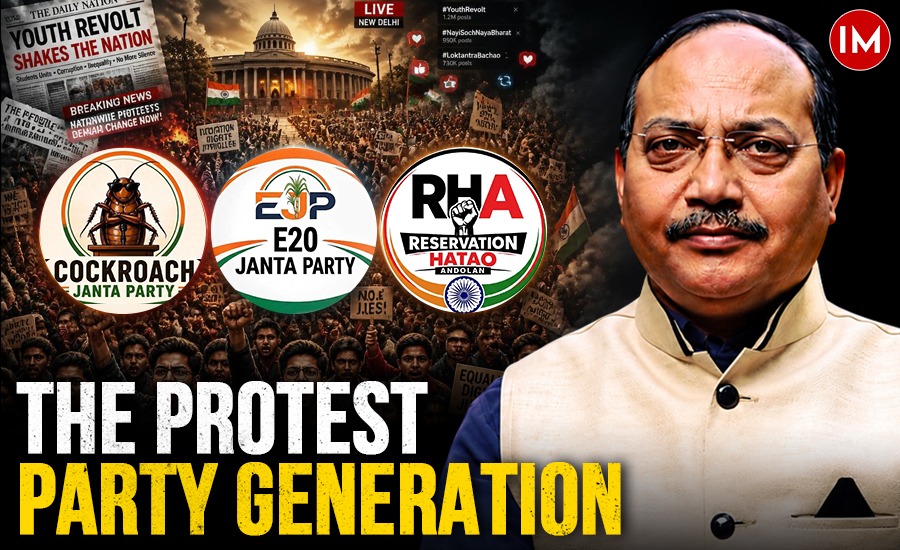
Should every unresolved issue now require a political party before the government begins to listen? If students are angry, form the Cockroach Janata Party (CJP). If reservation is the issue, launch the Reservation Hatao Andolan (RHA). If motorists dislike ethanol-blended fuel, float the E20 Janata Party (EJP). Tomorrow, will frustrated commuters launch the Stop Call Drop Party? Will residents choking on overflowing drains create the Clean Our Drains Party? Could the next viral movement be a Save Our Footpaths Front or a No More Potholes Party?
It sounds like a satire. Except it isn’t. After CJP succeeded in extracting Union Education Minister Dharmendra Pradhan’s resignation and prompting government to announce a high-powered Task Force to suggest education reforms, India is witnessing mushrooming of such public-spirited movements. The Cockroach Janata Party (CJP) commands nearly 27 million followers on Instagram. RHA and EJP are the new phenomenon to hit the social media. While RHA has already clocked 4.8 million followers on Instagram, E20 Janata Party too is growing fast. Delhi Taxi and Tourist Transporters and Tour Operators Association involving thousands of cab drivers, tourist operators and truckers, has announced a Gaadi March to the Parliament on August 4.
Is street protest is the new norm of governance. Is governance going to flow from the streets instead of Secretariate, Parliament and State Assemblies?
Within weeks, India has witnessed the emergence of a completely new form of democratic expression. These are not conventional political parties contesting elections. They have no offices, district committees or manifestos. They are digital pressure groups masquerading as political parties, using humour as their weapon, memes as their campaign material and Instagram as their headquarters.
And they are attracting followers at a speed that most established political parties can only envy. Reservation Hatao Andolan (RHA) is gaining a lakh followers almost every hour. For comparison, many mainstream political organisations have spent decades building such public reach. The obvious question is not whether these movements will survive. The real question is why they are emerging at all.
Also Read – Politics Without Politicians? How Retired IRS Officer Sanjay Gahlot Wants to Reimagine Democracy
Their rise tells us something profound about contemporary India—that a growing number of young citizens believe elections alone are no longer sufficient to make governments respond. Between one election and the next, they want a mechanism to force accountability. Social media has become that mechanism.
Ironically, none of these movements may have existed had the first one not succeeded. When lakhs of students protesting examination irregularities rallied under the banner of the Cockroach Janata Party, many dismissed the campaign as another social media fad. Few expected it to influence national policy. Yet sustained public pressure eventually culminated in sweeping examination reforms and the resignation of Union Education Minister Dharmendra Pradhan.
For India’s digital generation, that single episode delivered a powerful message: Instagram protests can work. That may well prove to be the defining political lesson of 2026.
The Birth of the ‘Janata Party Model’
Until recently, public grievances followed a familiar path. Write representations. Meet officials. Approach ministers. Wait. If nothing happened, hope the issue became an election talking point.
The new generation has rewritten that playbook. Instead of knocking on bureaucratic doors, it creates a viral campaign. Instead of holding press conferences, it uploads reels. Instead of waiting for television debates, it dominates Instagram feeds. And instead of asking political parties to champion their cause, it creates one of its own. The success of CJP appears to have become the template.
Reservation Hatao Andolan is questioning one of India’s most politically sensitive policies. The E20 Janata Party is demanding consumer choice in fuel policy and greater accountability over ethanol blending. Tomorrow, another issue could inspire another movement.
The issue may change. The method probably won’t.
Why Are Young Indians Joining?
This is not merely about social media. It is about accumulated frustration finding the right platform. India is among the youngest countries in the world. Every year millions of students compete for limited seats in educational institutions and government jobs. Recruitment delays, examination controversies, uncertainty over careers, rising competition, automation and AI-induced anxieties have combined to create a generation that feels it cannot afford to wait.
Unlike previous generations, today’s youth also possess a communication tool that earlier protesters never had. One Instagram reel can reach more people than a television debate. One meme can simplify an issue more effectively than a thousand-word editorial. One viral hashtag can compel ministers to respond within hours.
This is politics designed for the attention economy. Humour travels faster than ideology. Satire spreads better than speeches. Participation requires only a smartphone. That explains why these movements appear less like traditional agitations and more like online communities.
A Trust Deficit Between Elections?
Do these movements indicate that young Indians have lost faith in the government? Not necessarily. They certainly suggest, however, that many have lost faith in the traditional channels through which grievances are resolved. Most supporters of these campaigns are not demanding regime change. They are demanding responsiveness.
Their message is simple: “Don’t make us wait five years to be heard.” That distinction is crucial. This is less an anti-government phenomenon than a pro-accountability phenomenon.
In many ways, it resembles consumer activism more than ideological politics. Citizens increasingly see themselves as stakeholders demanding better public services rather than passive beneficiaries of government schemes.
What Should the Government Learn?
Governments everywhere face a difficult balancing act. They cannot govern according to whichever hashtag trends on a particular day. Public policy must remain evidence-based, not algorithm-driven. Yet ignoring such movements would be equally unwise. The government should view them as an early warning system. When millions rally around a digital campaign, it often reflects deeper institutional concerns.
The answer lies in engagement rather than confrontation. Recruitment processes must become faster and more transparent. Competitive examinations must be beyond suspicion. Policy decisions need better public communication. Most importantly, governments must build institutional channels through which young citizens can be heard before frustration spills onto the streets.
Young Indians are impatient—not because they dislike democracy, but because they want democracy to function between elections as effectively as it does during them.
The Real Legacy of CJP
Whether the Reservation Hatao Andolan or the E20 Janata Party eventually succeeds is almost beside the point. Their emergence itself is the story. The Cockroach Janata Party has done something few expected. It has created a new political template. A template where memes become manifestos. Followers become volunteers. Instagram becomes the public square. And every unresolved issue suddenly acquires the potential to become a movement.
The challenge before governments is no longer simply to win elections. It is to ensure that citizens never feel the need to create another “Janata Party” merely to make themselves heard. Because if that happens, the next big political movement may not emerge from Parliament, a political headquarters or even a television studio. It may begin with a single reel uploaded from someone’s smartphone.