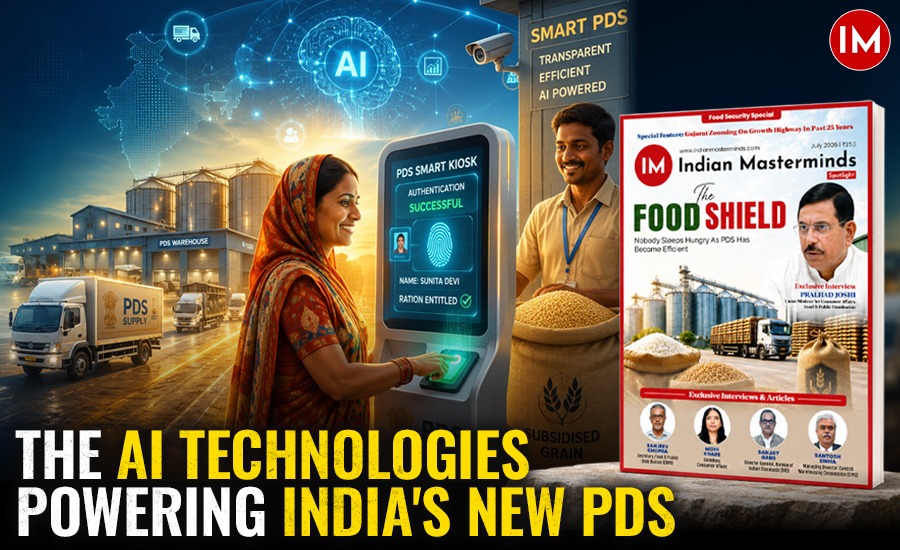
For seven decades, India’s Public Distribution System (PDS) was synonymous with leakage, ghost beneficiaries, and diversion — a vast welfare architecture haemorrhaging public money while the genuinely poor were left waiting at Fair Price Shop counters. That narrative is now changing. A convergence of Artificial Intelligence, Machine Learning, Blockchain, and advanced data analytics is rewriting the operational grammar of the world’s largest food security programme, which covers 81.35 crore beneficiaries under the National Food Security Act (NFSA). Union Food and Public Distribution (DFPD) department is probably the one government department using technology to the hilt.
The past few years have witnessed seamless free distribution of food grain to almost 60 per cent of country’s population. This has been made possible due to landmark technological deployments that are improving targeting accuracy, plugging supply-chain leakages, and dramatically cutting logistics costs. De-duplication of ration cards and improved efficiency of procurement, storage and distribution processes has resulted in food subsidy bill reducing from ₹2,86,469 in 2022-23 to Rs 1,97,420 in 2024-25 – an annual savings of over ₹89,000 crores.
Today, procurement and storage are monitored through live dashboards. Blockchain has reduced transportation cost by more than half through route optimisation. Adhaar seeding coupled with data matching from Income Tax and beneficiaries’ records of other services, has weeded out fake and unauthorised beneficiaries. E-POS machines and biometric identification of beneficiaries has checked the leakage to single digit.
The Baseline
The starting point matters. According to a comprehensive study by the International Food Policy Research Institute (IFPRI) and the Indian Council for Research on International Economic Relations (ICRIER), leakage in PDS stood at 46% in 2011-12. The Tata-Cornell Institute for Agriculture and Nutrition (TCI) estimated PDS leakage at 24.1% in 2022-23, declining further to just 8.8% in 2023-24, the lowest on record. State-level data underscores the transformative potential of digitisation: Bihar reduced leakage from 68.7% in 2011-12 to 19.2% in 2022-23, while West Bengal brought it down from 69.4% to just 9% over the same period.
Critically, the food subsidy budget — the fiscal sustainability barometer of PDS — crossed ₹2.03 lakh crore in 2025-26, making it the single largest expenditure item in the Union Budget after interest payments. Every percentage point reduction in leakage translates to thousands of crore rupees saved.
Also Read – How Pune Police Turned a Potential Flashpoint into a Lesson in Trust
Digitalisation’s Bedrock
The technology revolution in PDS rests on a near-complete digital foundation. As of mid-2025, 99.8% of all 5.43 lakh Fair Price Shops have been automated with electronic Point-of-Sale (e-POS) devices, and Aadhaar has been seeded with at least one member in 99.8% of all ration cards nationwide. Individual beneficiary Aadhaar coverage stands at 98.7%, covering ~80.6 crore persons as per SMART-PDS dashboard. All 20.4 crore household ration cards have been digitised.
The One Nation One Ration Card (ONORC) scheme, operational across all 36 States and Union Territories, allows migrant beneficiaries to lift their entitled foodgrain from any FPS in the country using biometric authentication. The Mera Ration 2.0 app enables Aadhaar-based login, real-time transaction tracking, and GPS-based FPS location services. Together, these form the interoperable data infrastructure upon which the more sophisticated AI/ML layer is now being constructed.
The Gamechanger
On May 27, 2026, the Cabinet Committee on Economic Affairs (CCEA) approved the Scheme for Assistance in Ration Transport and Handling-Income with Automation in Public Distribution System (SARTHAK-PDS) — a landmark ₹25,530 crore umbrella programme running through March 2031. This is the most ambitious technological overhaul of PDS since NFSA’s enactment in 2013, and it integrates AI, Machine Learning, Natural Language Processing (NLP), Blockchain, and IoT across three core AI-powered modules: NIRMAL, ASHA, and SAKSHAM.
NIRMAL
NIRMAL — meaning ‘clean’ or ‘pure’ — is the AI-powered real-time beneficiary registry at the core of SARTHAK-PDS. Its primary mandate is surgical: identify and eliminate ghost beneficiaries, duplicate records, deceased persons, and ineligible households from the PDS database. It aggregates existing ration card data with Aadhaar linkage and cross-references it across inter-ministry datasets — including socio-economic caste census data, death registries, income tax databases, and welfare scheme records.
At its technical core, NIRMAL deploys ML models for probabilistic matching and de-duplication, predictive analytics for fraud detection, and continuous eligibility scoring using dynamic socio-economic indicators. Blockchain elements within the broader SARTHAK stack ensure immutable, tamper-proof audit trails of beneficiary verifications and key transactions.
The significance is fiscal as much as administrative: every ghost beneficiary removed from the database translates to direct savings on the food subsidy bill. With the annual subsidy burden exceeding ₹2 lakh crore, even a 1-2% reduction in inclusion errors could yield annual savings in the thousands of crore.
SAKSHAM
SAKSHAM is SARTHAK-PDS’s supply chain brain — an AI, ML-enabled logistics platform for end-to-end tracking of foodgrain movement from FCI godowns to Fair Price Shops. Its key features include GPS-based vehicle tracking, QR code traceability of grain bags, AI-driven demand forecasting by state, district, FPS level, and intelligent route optimisation. Official projections peg annual logistics cost savings from SAKSHAM at approximately ₹280 crore, along with a potential 35% reduction in carbon emissions through route optimisation.
SAKSHAM builds directly on Anna Chakra, India’s first dedicated AI&ML-based PDS supply chain tool, launched on December 5, 2024, by the Department of Food and Public Distribution (DFPD). Developed jointly by IIT Delhi’s Public Systems Lab (through FITT) and the United Nations World Food Programme (WFP), Anna Chakra uses operations research algorithms with geospatial integration via the PM GatiShakti platform to optimise foodgrain routing. It has been rolled out in 30+ States/UTs, yielding estimated annual transport cost savings of ₹250 crore and a 15-50% reduction in transport distances on various routes, with significant reductions in carbon emissions.
ASHA
The third pillar of SARTHAK-PDS — ASHA — is an NLP-powered, multilingual citizen interface capable of handling up to 3 lakh grievance interactions daily through calls, WhatsApp, IVRS, and chatbots. By automating first-level complaint handling and resolution across languages, it reduces the administrative burden on state food departments while improving grievance turnaround time for the most vulnerable beneficiaries.
SCAN
Launched alongside Anna Chakra on December 5, 2024, the Subsidy Claim Application for NFSA (SCAN) Portal addresses a long-neglected backend inefficiency: the cumbersome, often delayed process by which State Governments claim food subsidies from the Centre. SCAN digitises and automates the entire claim lifecycle — from submission and rule-based verification to approval and settlement — through a single-window system.
By eliminating manual paperwork and deploying automated rule-based processing, it expedites subsidy releases to States and creates digital audit trails that curb irregularities in what is, in aggregate, a ₹2+ lakh crore annual flow.
Challenges That Remain
However, the NFSA’s beneficiary coverage — 81.35 crore persons— remains anchored to population figures from the 2011 Census. With India’s population now estimated at 1.44 billion and having last conducted a census in 2011, a significant portion of the actual population remains outside the NFSA net.
The government has indicated that NIRMAL’s dynamic targeting framework will help progressively align coverage to current demographic realities — but only when a fresh census provides the baseline data required for formal NFSA revisions.
Towards a Truly Intelligent PDS
SARTHAK-PDS represents India’s most coherent and comprehensive genuinely intelligent PDS — not merely digitised. The distinction is crucial. Digitisation (e-POS, Aadhaar seeding) reduced passive leakage by creating authentication barriers. Intelligence — AI-driven fraud detection, predictive demand forecasting, real-time beneficiary cleaning — actively anticipates and prevents leakage before it occurs.
While Quantum Computing applications in PDS remain prospective rather than operational today, the cryptographic and optimisation capabilities of quantum systems could, in a future phase, transform everything from route optimisation in SAKSHAM to unhackable beneficiary data security in NIRMAL. India’s National Quantum Mission, backed by ₹6,003 crore over 2023-31, is laying the groundwork for this next technological leap — and PDS, as the country’s most data-intensive welfare system, is among the most natural candidates for eventual quantum integration.
What is already certain is this: from Anna Chakra’s route-optimisation algorithms to NIRMAL’s AI-driven ghost-beneficiary detection, India’s PDS in 2026 is a fundamentally different system from what it was in 2022. The food security architecture that once symbolised the state’s most visible failure in welfare delivery is now — haltingly, imperfectly, but unmistakably — being reborn as a data-driven, AI-powered instrument of precision governance. For 81 crore Indians whose food security depends on it, the stakes of getting this transformation right could not be higher.
Also Read – From Ration to Revolution