Some conservation victories are measured not merely by the number of animals released into the wild, but by the life they create long after the cameras are gone. They are written in the songs of birds that return to forgotten forests, in the seeds they disperse across landscapes, and in ecosystems that slowly heal themselves.
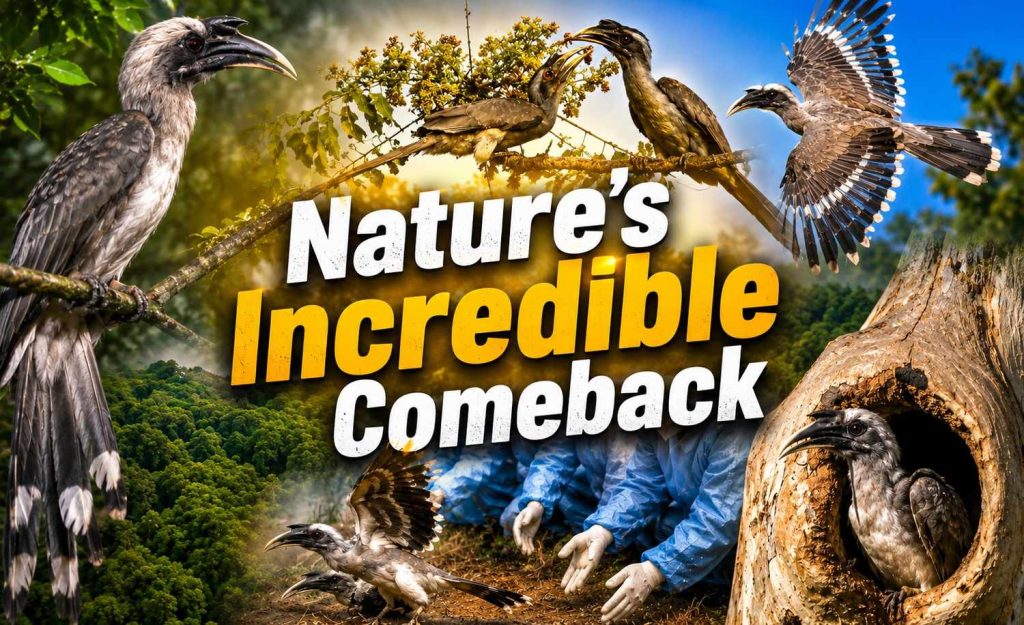
More than six decades after the Indian Grey Hornbill disappeared from Gujarat’s Gir landscape, the forests are once again echoing with the calls of one of India’s most important forest birds. Once believed to be permanently lost from Saurashtra, the species has now successfully bred for the fourth consecutive year, marking one of India’s most inspiring wildlife restoration stories.
Behind this remarkable ecological comeback lies years of scientific planning, patient fieldwork, meticulous monitoring and visionary leadership by the Gujarat Forest Department. What began as an ambitious reintroduction programme in 2021 under the leadership of senior IFS officer Mohan Ram (2012 batch), then Divisional Forest Officer (DFO) of Gir and now Conservator of Forests (CF), Junagadh Circle, has today evolved into a model of species restoration that is drawing attention across conservation circles.
The achievement has now received global scientific recognition as well. A peer-reviewed study published in the international journal Birds has documented the successful establishment of the reintroduced population, with breeding being recorded every year since the birds were released.
To understand the journey behind this remarkable success, Indian Masterminds spoke with Agneeshwar Vyas, a 2014-batch Indian Forest Service officer currently serving as Deputy Conservator of Forests (DCF), Wildlife Division, Sasan Gir, who has closely monitored the project and witnessed its transformation from an ambitious experiment into a thriving conservation success.
A Bird That Once Vanished from Saurashtra
While the Indian Grey Hornbill (Ocyceros birostris) is naturally found in North Gujarat and South Gujarat, its presence had disappeared from the Saurashtra region, particularly the Gir landscape, for more than six decades.
The prevailing belief was that Gir lacked suitable habitat, especially the tall mature trees and natural nesting cavities that hornbills require for breeding.
But the Forest Department decided to challenge that assumption.
“The Grey Hornbill is present in Gujarat, but it had not been seen in the Saurashtra landscape for a very long time. People believed the absence of taller trees was the reason it disappeared from here. However, the species continued to exist in North and South Gujarat. So around 2020-21, a programme was initiated to bring it back to Gir,” Mr Vyas told Indian Masterminds.
How the Reintroduction Programme Began
The restoration programme formally began during 2020-21 under the leadership of senior IFS officer Mohan Ram, who was then serving as the Divisional Forest Officer (DFO), Gir. With the approval and guidance of the Principal Chief Conservator of Forests (Wildlife), the Gujarat Forest Department designed a carefully planned scientific translocation programme.
Instead of introducing birds into unfamiliar surroundings, the department selected hornbills from habitats closely resembling those found in Gir.
“The birds were brought from a selected site in Aravalli district of North Gujarat with all necessary permissions. We ensured that the habitat from where they were captured was ecologically similar to the habitat where they were released. That increased the chances of successful adaptation,” Mr Vyas explained.
A Carefully Planned Scientific Exercise
The reintroduction programme was executed in two phases.
During the first phase, 28 Indian Grey Hornbills were released through three translocation events conducted in:
- October 2021
- February 2022
- March 2022
Recognising the encouraging signs from the initial releases, the department expanded the programme.
In the second phase, another 12 hornbills were released in December 2023.
In total, 40 Indian Grey Hornbills – comprising 21 males and 19 females – were successfully reintroduced into the Gir landscape.
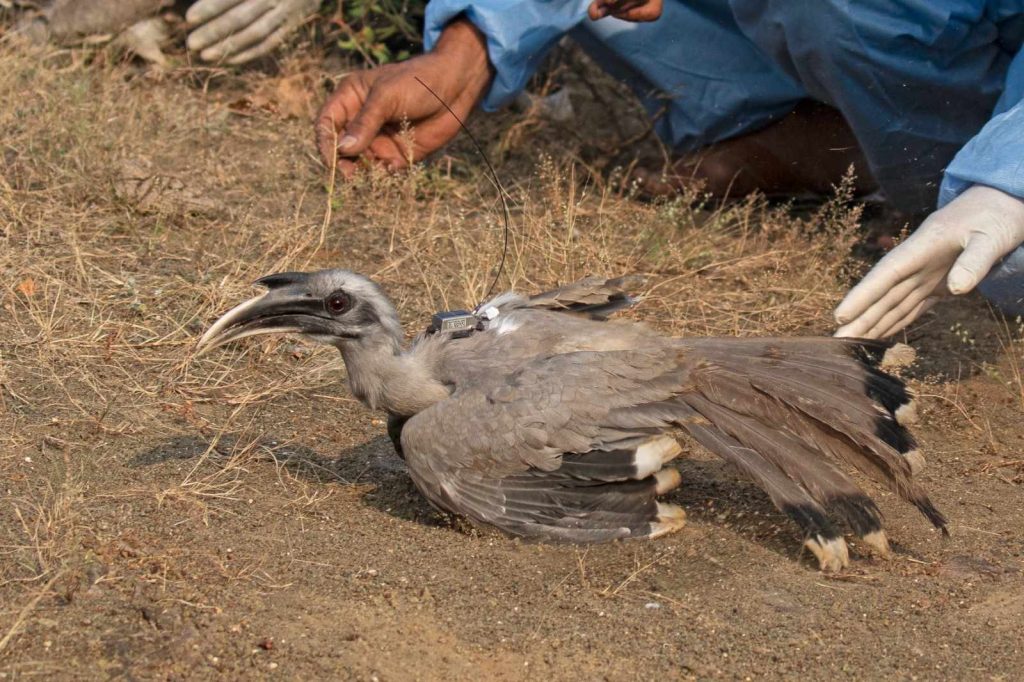
To scientifically monitor their movement and survival, 11 male hornbills were fitted with satellite transmitters, enabling researchers to study their movement patterns, habitat use, settlement behaviour and breeding activities after release.
Monitoring Every Flight: Tracking Birds Is Never Easy
Unlike large mammals, birds leave almost no physical evidence behind. There are no footprints to follow, no predictable movement corridors and no easy way of determining where they settle.
This made post-release monitoring one of the most demanding aspects of the programme.
“Tracking a bird after releasing it is never easy. Unlike large mammals, you cannot simply follow footprints or movement signs. Our field trackers and experienced staff spend enormous time searching forests to identify where individual birds have moved and settled,” Mr Vyas said.
To make identification easier, every released bird was tagged.
The monitoring teams regularly tracked sightings, movement patterns and breeding behaviour over the years.
“Post-release monitoring has been one of the most important components of this programme. By tagging the birds, we could identify whether the released individuals were surviving and where they were being seen,” he added.

The Biggest Sign of Success: Four Consecutive Years of Breeding
The true success of any wildlife reintroduction programme is not merely survival—it is reproduction.
The Gir hornbills have now achieved exactly that.
Since their release in 2021, the birds have bred successfully every single year.
“We have now observed nesting for four consecutive years. That itself is proof that the birds are adapting to the Gir landscape, surviving here and successfully propagating,” Mr Vyas said.
The latest breeding season in 2026 has added another milestone.
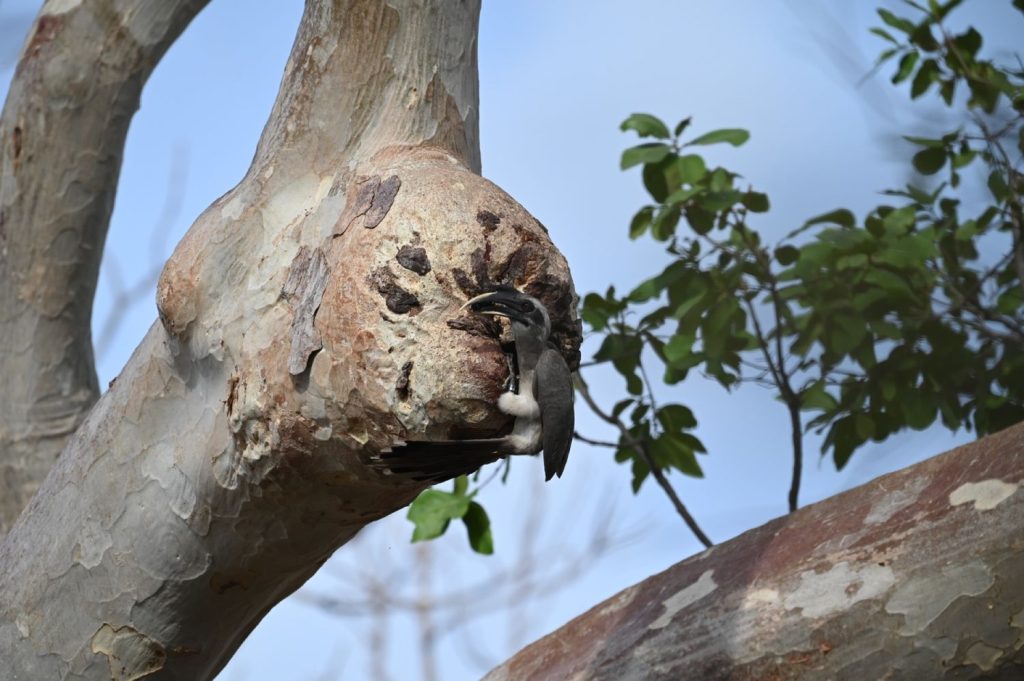
Field monitoring documented successful nesting at three separate locations:
| Nesting Area | Nest Tree Species | Local Name |
|---|---|---|
| Mindholi | Sterculia urens | Kadayo |
| Ravanchheli | Terminalia bellirica | Bedo |
| Bheradliya | Terminalia bellirica | Bedo |
Among these, one nest was recorded in Sterculia urens while two nests were found in Terminalia bellirica, demonstrating the birds’ successful use of naturally available nesting cavities.
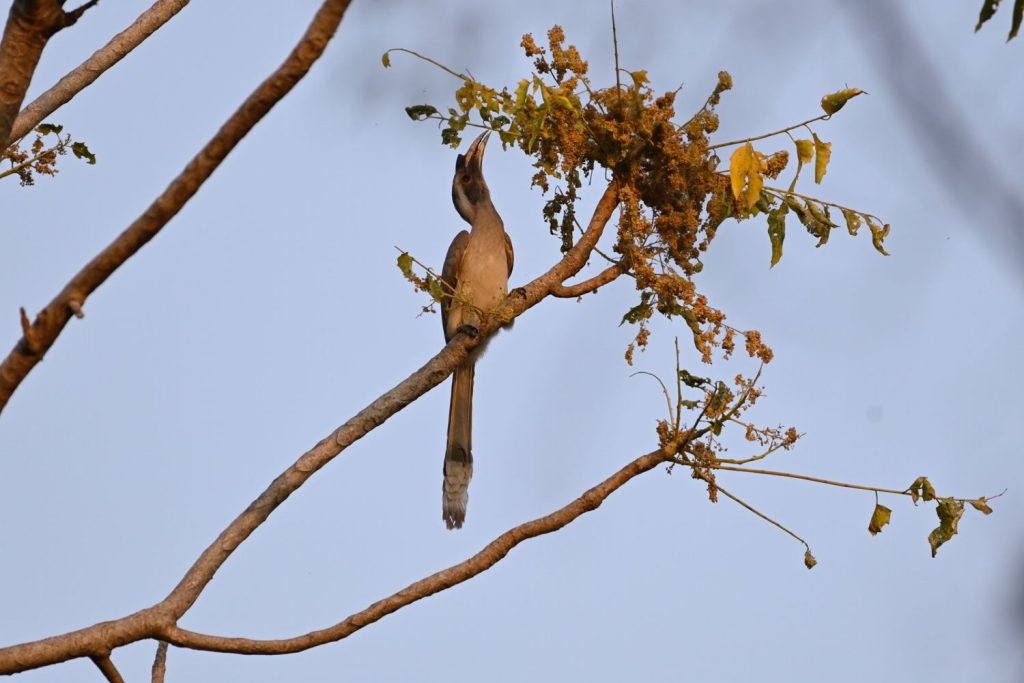
Discovering New Nesting Cavities Shows Natural Adaptation
Perhaps the most encouraging finding this year was not merely that hornbills nested again—but that they began exploring entirely new nesting sites.
Unlike previous years, several nests were located in fresh cavities.
“This year, apart from the nests that were observed earlier, we also found nests in entirely new cavities. Since hornbills breed inside natural tree cavities, finding new nesting sites shows that the birds are exploring the landscape, selecting new breeding locations and adapting naturally to Gir,” Mr Vyas explained.
For wildlife biologists, this is an important behavioural indicator that the population is no longer dependent solely on the original release area.
The Birds Are Expanding Their Range Across Gir
Another encouraging development is the gradual spread of the reintroduced population across the landscape.
The birds are no longer confined to their release site.
“Sightings have now been recorded nearly 70 to 80 kilometres away from the original release area, and in some cases even around 90 kilometres away. That shows the birds are naturally dispersing across the landscape and establishing themselves in different parts of Gir,” IFS Vyas said.
The expanding range provides strong evidence that the species has successfully established itself within its former habitat.
Why Scientists Don’t Count Individual Birds
One question naturally arises – how many hornbills are now present in Gir?
According to Mr Vyas, providing an exact number is nearly impossible. “In birds, individual counting across such a large landscape is extremely difficult. There is no practical formula for estimating every individual. Instead, we focus on observing nesting activity because successful nests provide much stronger evidence of establishment than simple population estimates,” he explained.
The department currently observes three to four active nesting sites around the release landscape.
However, many more may exist unnoticed.
“Once a bird flies deep into such a vast forest, finding exactly where it has nested becomes extremely difficult. But repeated nesting at multiple sites year after year clearly indicates that the species has become established,” he added.
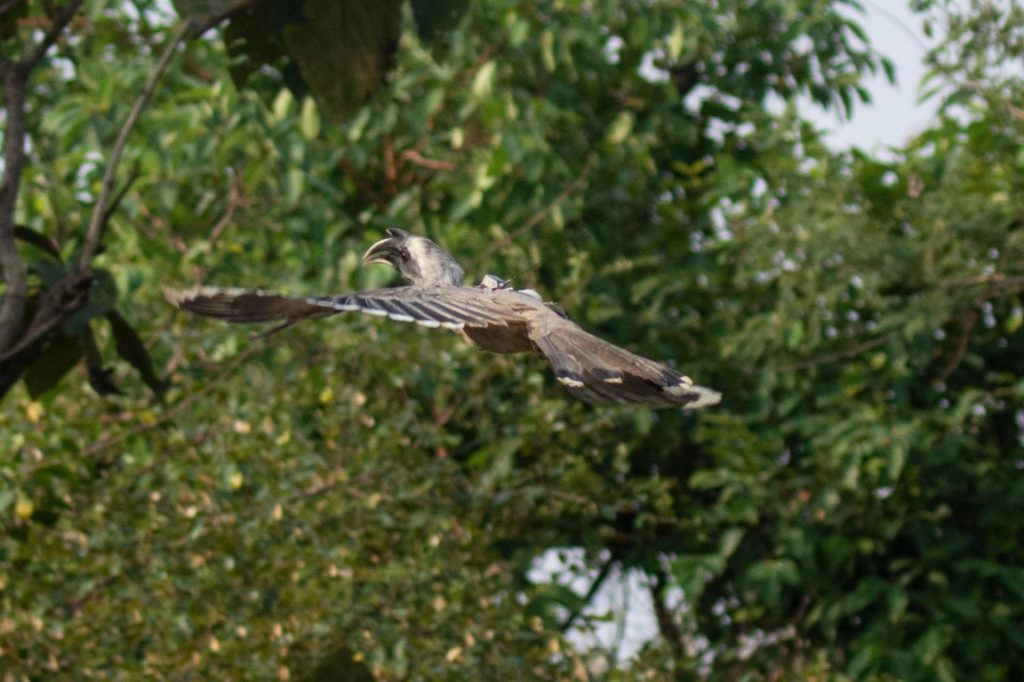
Why Repeated Nesting Matters More Than Numbers
For conservation scientists, successful breeding over multiple years is one of the strongest indicators of restoration success.
Mr Vyas explained that had the birds failed to adapt, they would likely have disappeared after the initial release.
“If the birds had not survived or had failed to find suitable nesting and breeding sites, they would not have been observed again after the first year. The fact that we continue to record nesting every year clearly indicates that the programme is succeeding,” he said.
The 2026 nesting records demonstrate that the hornbills have progressed well beyond their initial release phase and are now reproducing naturally in the wild.
More Than a Bird: Why the Indian Grey Hornbill Matters
The return of the Indian Grey Hornbill is significant not only because a lost species has returned to Gir, but because of the ecological role the bird performs.
Hornbills are often called the “farmers of the forest.”
As fruit-eating birds, they consume fruits from numerous tree species and disperse seeds across large distances.
This natural seed dispersal helps regenerate forests, improves vegetation connectivity and maintains plant diversity.
Their return therefore strengthens the ecological functioning of the Gir ecosystem itself.
Successful breeding means these ecological processes are gradually being restored after decades of absence.
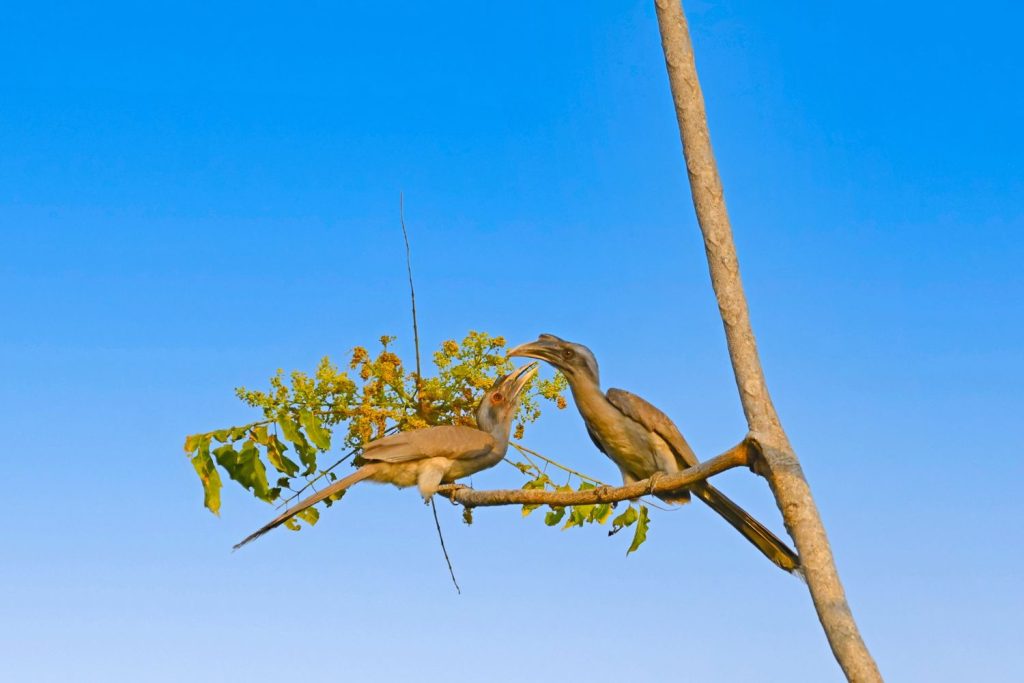
Scientific Recognition of a Conservation Success
The significance of the programme has now been documented in a peer-reviewed scientific paper published in the international journal Birds.
The study concludes that the reintroduced hornbill population has successfully established itself within the Gir landscape, recording breeding every year since its release in 2021.
The publication describes the project as an important example of successful local species restoration, demonstrating how carefully planned scientific translocations, combined with long-term monitoring, can restore wildlife populations that have disappeared from parts of their historical range.
A Conservation Milestone for Gujarat
The hornbill restoration comes at a time when Gujarat is witnessing multiple wildlife conservation achievements.
Recently, the state reported another significant milestone with the survival of the second Great Indian Bustard chick hatched through the innovative “jump-start” technique, surviving beyond the critical 40-day period.
Together, these achievements reflect Gujarat’s increasing focus on science-based wildlife conservation and long-term ecosystem restoration.
The Road Ahead
The successful reintroduction of 40 Indian Grey Hornbills between October 2021 and December 2023, followed by four consecutive years of breeding, represents far more than the return of a single bird species.
The nesting records at Mindholi, Ravanchheli and Bheradliya confirm that the birds have adapted, established territories and are continuing to reproduce under natural conditions.
For the Gujarat Forest Department, the project demonstrates that even species lost for generations can return when conservation is guided by science, persistence and long-term commitment.
As Mr Vyas summed up during the interaction, “Repeated nesting year after year tells us one thing very clearly – the birds are surviving, adapting and making Gir their home once again.”
More than sixty years after silence settled over Gir’s forests, the Indian Grey Hornbill has reclaimed its place in the landscape. And with every new nest carved into an ancient tree cavity, it carries not only the promise of its own future but also the renewal of the forest it helps sustain.