In the journey towards Viksit Bharat 2047, governance is no longer being measured merely by intentions but by outcomes. Across India’s villages, a quiet digital revolution is reshaping the way Gram Panchayats function, plan development and remain accountable to citizens. At the heart of this transformation is the Panchayat Advancement Index (PAI) – an ambitious initiative of the Ministry of Panchayati Raj that has emerged as the world’s first nationwide, objective framework to evaluate the performance of more than 2.6 lakh Gram Panchayats.
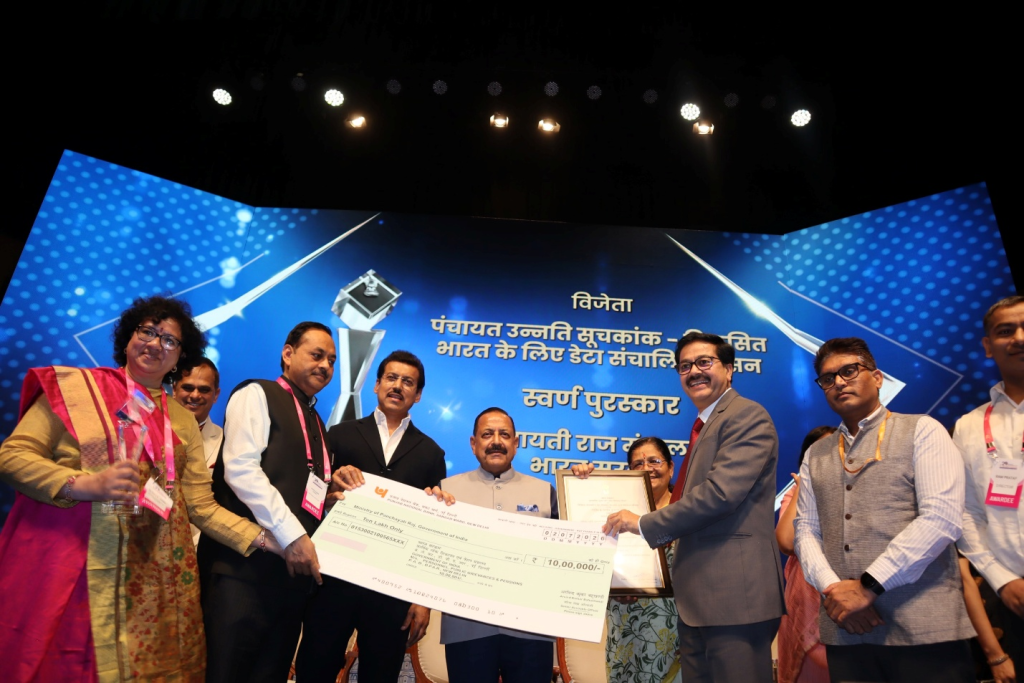
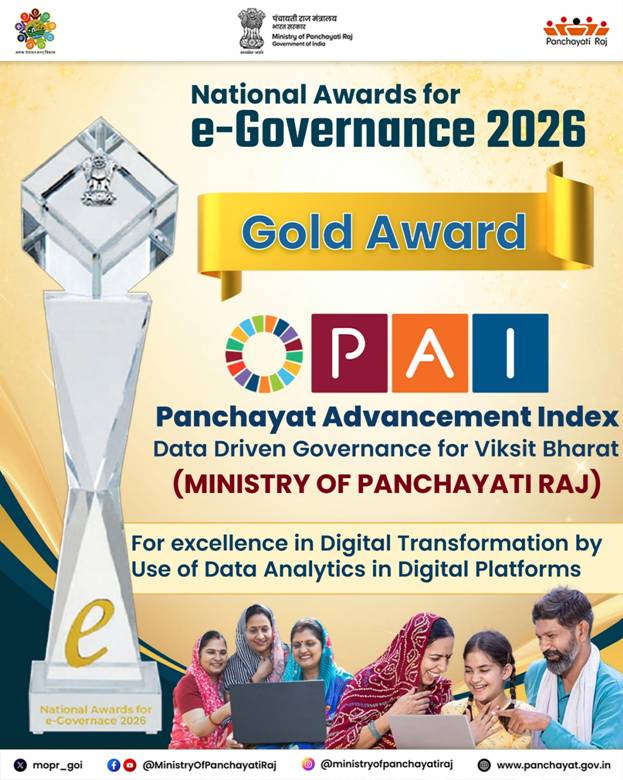
Built on the principles of transparency, accountability and evidence-based governance, the Panchayat Advancement Index has fundamentally changed how local governments are assessed. Instead of subjective evaluations, the platform relies on hundreds of verified indicators and data points to present an authentic picture of grassroots development. The initiative’s impact has now received national recognition after winning the Gold Award under the category ‘Digital Transformation through the Use of Data Analytics in Digital Platforms’ at the National Awards for e-Governance (NAeG) 2026.
The recognition is more than an award – it is a validation of how technology, when combined with sound governance, can strengthen democracy at its very foundation.
To understand the vision behind this pioneering initiative, its implementation and its impact on rural governance, Indian Masterminds spoke with Sushil Kumar Lohani, IAS (Odisha cadre, 1995 batch), Additional Secretary, Ministry of Panchayati Raj, GOI, who played a key role in driving this transformative project.
A New Era of Measuring Grassroots Governance
For decades, evaluating the performance of Gram Panchayats across India’s vast rural landscape remained a challenge. Different states followed different parameters, making comparisons difficult and often leaving room for subjective assessments.
The Panchayat Advancement Index was conceptualised to change that.
Developed by the Ministry of Panchayati Raj, PAI provides a comprehensive, objective and technology-driven framework to assess governance outcomes across all Gram Panchayats. Rather than relying on perception-based evaluations, it measures actual performance through quantifiable indicators linked to the nine themes of the Localisation of Sustainable Development Goals (LSDGs).
Read Also: From AI to Gram Panchayats: India Celebrates 17 Digital Governance Breakthroughs at NAeG 2026
The latest version, PAI 2.0, evaluates more than 2.6 lakh Gram Panchayats using 150 indicators and 230 data points, making it the world’s largest data-driven local governance assessment framework.
Speaking about the initiative, Mr Lohani said, “The objective was to create a transparent and evidence-based mechanism through which every Gram Panchayat could assess its own performance, identify gaps and plan future development based on credible data rather than assumptions.”
He explained that the Index serves not merely as a ranking exercise but as a planning tool that empowers Panchayats to improve governance outcomes.
How the Idea Took Shape
According to Lohani, the Ministry wanted to create a common national framework capable of objectively measuring development across India’s rural local bodies while respecting the diversity of states and regions.
The framework was therefore aligned with the nine Localised Sustainable Development Goals (LSDGs), ensuring that governance is assessed across every critical area of rural development.
These include sanitation, health, education, infrastructure, social justice, livelihoods, environmental sustainability and other essential aspects of local governance.
Instead of evaluating Panchayats through isolated schemes, PAI looks at the overall quality of governance and developmental outcomes.
“Data has the power to transform governance only when it becomes actionable. PAI enables Panchayats to understand where they stand and what needs to improve,” IAS Lohani explained.
Building the World’s Largest Panchayat Performance Framework
Creating an assessment framework for over 2.6 lakh Gram Panchayats was no small task.
The Ministry designed PAI as a comprehensive digital platform capable of collecting, analysing and presenting data in an objective manner.
PAI 2.0 assesses Gram Panchayats through:
- 230 data points
- 150 performance indicators
- Assessment across nine LSDG themes
- Participation from 2,59,867 Gram Panchayats
- Coverage across 33 States and Union Territories
The latest version witnessed an impressive 97.3 per cent participation, a remarkable improvement over PAI 1.0, which had recorded a participation rate of 80.79 per cent.
This high level of participation reflects increasing acceptance of digital governance among local bodies across the country.
Objective Rankings That Encourage Healthy Competition
One of the biggest innovations introduced by PAI is its transparent classification system.
Based on composite scores, Gram Panchayats are placed into five categories:
- Achiever – 90 and above
- Front Runner – 75 to below 90
- Performer – 60 to below 75
- Aspirant – 40 to below 60
- Beginner – Below 40
Rather than treating rankings as mere awards, the Ministry views them as developmental tools.
“The intention is not simply to rank Panchayats. The purpose is to encourage continuous improvement, healthy competition and informed planning,” Mr Lohani said.
The categorisation enables state governments to identify high-performing Panchayats, replicate successful models and focus developmental interventions where they are most needed.
From Data Collection to Development Planning
The Panchayat Advancement Index goes far beyond performance measurement.
Its findings directly support:
- Evidence-based planning
- Performance monitoring
- Incentivisation of Panchayati Raj Institutions
- Preparation of Gram Panchayat Development Plans
- Benchmarking of governance outcomes
- Identification of best-performing Panchayats as learning hubs
The Index has also become the objective basis for the prestigious National Panchayat Awards, ensuring that recognition is backed by measurable evidence instead of subjective evaluations.
Making Governance Transparent for Every Citizen
Perhaps one of the most citizen-centric aspects of the initiative is its accessibility.
Through the publicly available PAI portal (pai.gov.in), citizens can check the performance of their own Gram Panchayat without any login requirement.
This allows villagers to monitor local development, understand governance outcomes and participate more meaningfully in decision-making.
Mr Lohani believes this level of openness strengthens democracy itself. “Transparency builds trust. When citizens can see how their Panchayat is performing, they become active partners in the development journey,” he said.
The portal is equally valuable for policymakers, researchers, civil society organisations and development partners, providing reliable data for planning future interventions.
National Recognition at the e-Governance Awards 2026
The impact of the Panchayat Advancement Index received national recognition when it was selected for the Gold Award under Category VII – Digital Transformation through the Use of Data Analytics in Digital Platforms at the National Awards for e-Governance (NAeG) 2026.
The awards were presented during the 29th National Conference on e-Governance, held on 1–2 July 2026 at the Rajasthan International Centre, Jaipur.
The conference was jointly organised by:
- Department of Administrative Reforms and Public Grievances (DARPG)
- Ministry of Electronics and Information Technology (MeitY)
- Government of Rajasthan
The theme of this year’s conference was:
“Viksit Bharat 2047: AI-Enabled, Data-Driven and Secure Digital Governance.”
The Gold Award comprises:
- Trophy
- Citation
- Cash incentive of ₹10 lakh for strengthening the initiative
Out of 17 initiatives selected across seven award categories, the Panchayat Advancement Index stood out as one of the country’s finest examples of digital governance driven by data analytics.
Four Awards for the Ministry of Panchayati Raj
The Ministry of Panchayati Raj had another reason to celebrate.
Overall, four Panchayati Raj-related initiatives were honoured at the National Awards for e-Governance 2026.
These included:
- The Panchayat Advancement Index (Gold Award)
- Kadepur Gram Panchayat, Sangli district, Maharashtra (Gold Award under Grassroots Service Delivery)
- Bijoy Nagar Gram Panchayat, West Tripura (Silver Award)
- A district-level healthcare initiative
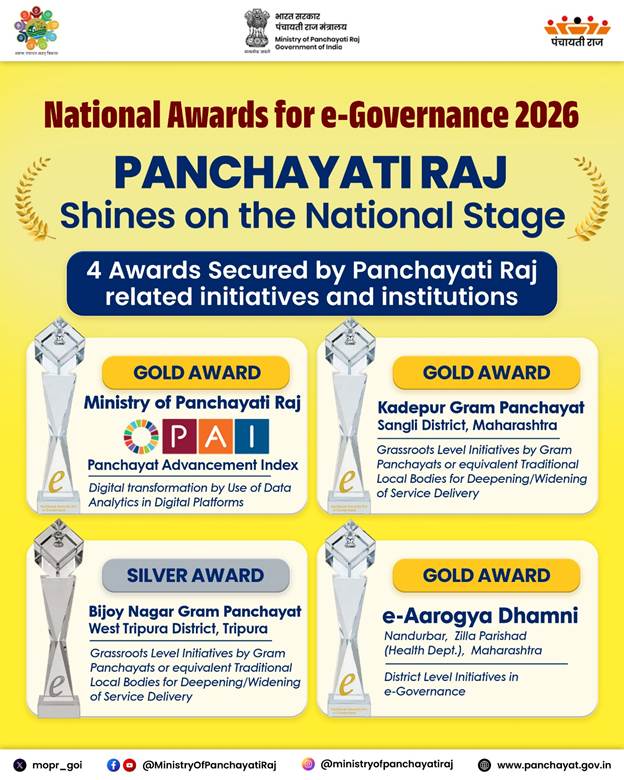
The awards reflected the growing role of Panchayats in delivering citizen-centric governance and digital public services.
Digital Public Infrastructure Strengthening Rural India
Alongside PAI, the Ministry has developed an integrated ecosystem of digital platforms for Panchayati Raj Institutions.
These include:
- eGramSwaraj
- Meri Panchayat
- AuditOnline
- Panchayat NIRNAY
- SabhaSaar
- Gram Manchitra
Together, these platforms are strengthening transparency, accountability, public participation and digital governance across rural India.
During Breakout Session III titled “Grassroots Governance: Digital, Decentralised, Data Driven,” Secretary, Ministry of Panchayati Raj, Vivek Bharadwaj, an IAS officer of 1990 batch from West Bengal cadre, described PAI as India’s first comprehensive data-driven performance assessment framework capable of enabling benchmarking, evidence-based planning and transparent governance.
“These digital initiatives reflect a sustained transformation, bringing government services to every citizen’s doorstep and making Panchayats more transparent, accountable and responsive,” IAS Bharadwaj said.
According to him, the framework enables evidence-based planning, transparent benchmarking and informed decision-making, helping Panchayats and governments identify developmental gaps and prioritize interventions more effectively.
Meanwhile, during Breakout Session IV featuring Gold Award winners, Additional Secretary Sushil Kumar Lohani highlighted the initiative as a scalable and replicable model for Panchayati Raj Institutions across the country.
Driving the Vision of Viksit Bharat 2047
The Panchayat Advancement Index represents far more than a digital platform.
It reflects a fundamental shift in governance—from subjective assessments to measurable outcomes, from isolated planning to evidence-based development, and from administrative reporting to citizen participation.
By analysing governance through data, encouraging transparency and empowering Panchayats with actionable insights, the initiative is strengthening India’s democratic institutions from the grassroots upwards.
As Mr Lohani concluded, “Our vision is to ensure that every Gram Panchayat has the information and tools required to improve governance. Better data leads to better decisions, better planning and ultimately better lives for citizens.”
With its Gold Award recognition and expanding nationwide adoption, the Panchayat Advancement Index has established itself as a global benchmark in digital local governance. More importantly, it demonstrates that when technology serves people, governance becomes not only smarter—but also more transparent, accountable and inclusive.