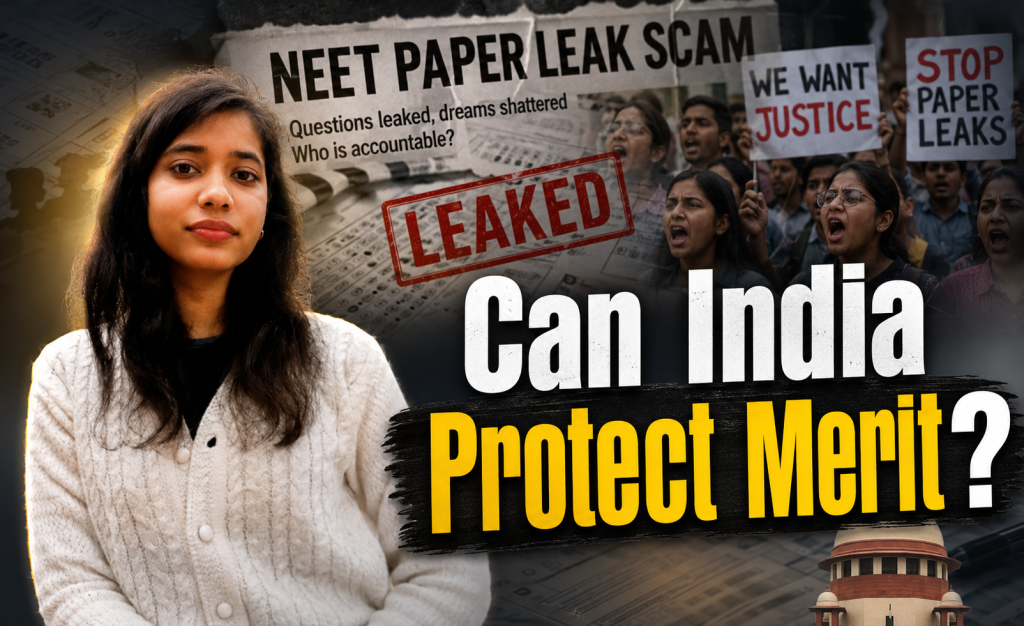
India’s examination system is one of the largest in the world. Every year, millions of students and job aspirants appear for public examinations that determine access to higher education and government employment. For many families, these examinations represent years of hard work, financial sacrifice, and the hope of upward social mobility. When an examination is compromised by a paper leak, the consequences extend far beyond the cancellation of a test. It weakens public confidence in institutions and raises a fundamental question: can merit still be trusted?
The recurrence of paper leaks across states and examination authorities suggests that these incidents are not isolated security lapses but symptoms of deeper institutional and governance failures. Recent controversies surrounding examinations such as REET, the Bihar Police Constable Examination, JSSC-CGL, and NEET have exposed vulnerabilities in examination administration that cannot be addressed through punitive measures alone. India conducts examinations on an enormous scale, with crores of candidates appearing every year for school boards, entrance examinations, and government recruitment tests. Given this scale, maintaining credibility is essential. Yet repeated cancellations, allegations of malpractice, and administrative irregularities have imposed significant economic, psychological, and social costs on candidates. Aspirants invest years preparing for these examinations, often spending considerable amounts on coaching, travel, accommodation, and application fees. When examinations are cancelled or delayed, those investments are lost, while uncertainty and anxiety continue to grow.
Also Read – Beyond Monuments: How Bihar is Using Tourism to Create Jobs, Empower Villages and Rewrite Its Story
The enactment of the Public Examinations (Prevention of Unfair Means) Act, 2024 was an important step towards strengthening legal deterrence. However, stronger laws alone cannot resolve the problem. Weak enforcement, delayed investigations, insider collusion, inadequate monitoring, and organised cheating networks continue to undermine examination integrity.
Evidence increasingly shows that examination fraud has evolved into an organised ecosystem involving multiple actors. In several cases, functions such as printing, transportation, logistics, and technology management are outsourced, creating additional vulnerabilities if oversight remains weak. Reports have highlighted the involvement of printing press employees, invigilators, transport personnel, IT staff, middlemen, coaching centres, and criminal networks. Cybersecurity risks have further complicated the challenge as question papers are increasingly stored and transmitted digitally.
While much attention is directed towards preventing malpractice by candidates, comparatively less attention is paid to institutional accountability. Regular independent audits of examination agencies remain limited. Tender allocation processes often lack sufficient transparency. Internal administrative failures—including incorrect answer-sheet uploads, evaluation errors, and operational deficiencies—have further eroded public confidence. International experience demonstrates that examination security requires a broader governance approach. China’s Gaokao follows strict administrative controls and layered security mechanisms, while the MCAT examination uses large question banks and multiple testing windows to reduce dependence on a single examination. Although these models cannot be replicated directly because of India’s demographic scale and federal structure, they offer valuable lessons that can be adapted to Indian conditions.
India therefore needs a comprehensive reform strategy rather than isolated interventions. The first priority should be strengthening examination security across the entire examination cycle. Security should not begin only on examination day but should extend from question
paper preparation to printing, storage, transportation, distribution, and evaluation. Encrypted digital transmission, GPS-enabled transport, biometric verification, CCTV monitoring linked to central control rooms, and periodic security audits should become standard practice for high-stakes examinations.
Second, accountability mechanisms require significant strengthening. Every organisation involved in examination logistics, printing, or technology services should undergo strict background verification. Tender processes should remain transparent and subject to independent audits. Officials responsible for negligence or malpractice must face timely disciplinary and legal action.
Third, India should gradually move towards larger question banks and multiple examination sessions wherever feasible. Reducing dependence on a single examination date would minimise the impact of any security breach while also reducing pressure on candidates. Reforms must also focus on the candidate experience. Examination centres should be accessible and equipped with basic facilities such as drinking water, electricity, sanitation, adequate seating, and medical assistance. During major national examinations, additional transport arrangements can reduce travel burdens. Authorities should also actively counter misinformation and establish dedicated mental health support mechanisms for candidates experiencing examination-related stress.
Finally, long-term reforms should reduce excessive dependence on single high-stakes examinations. Greater emphasis on skill-based learning, practical assessment, and faster recruitment cycles can reduce systemic pressure while improving fairness and employability. Restoring trust in India’s examination system will require coordinated action by the Central Government, State Governments, examination authorities, educational institutions, and local administrations. Regular audits, public disclosure of compliance reports, candidate feedback mechanisms, and continuous policy review should become integral components of examination governance.
For millions of young Indians, an examination is far more than a test. It represents years of perseverance and the promise that opportunity will be determined by merit. Every paper leak weakens that promise. Restoring credibility will therefore require more than stronger punishment. It demands stronger institutions, greater transparency, better technology, and governance reforms that place fairness and public trust at the centre of India’s examination system.
About the Author – (Ayushi Nigam is a policy researcher based in Lucknow, Uttar Pradesh, specializing in governance, foreign policy, and sustainable development. She has authored 9+ policy articles and briefs on topics ranging from Indo-Pacific strategy and AI governance to critical minerals and examination reform)
Disclaimer – (The views and opinions expressed in this article are solely those of the author and do not necessarily reflect the views of Indian Masterminds. For feedback or queries, please write to [email protected].)
Also Read – Powering India’s Resource Security Through Responsible Mining