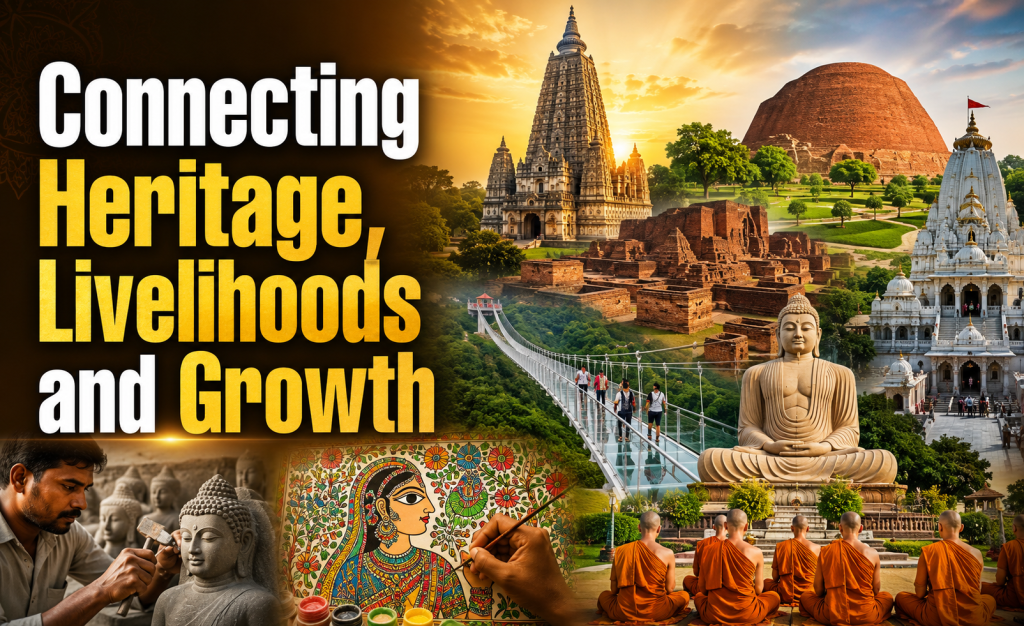
For decades, Bihar has lived with an image that never truly reflected its reality. Home to the world’s oldest university, the place where Lord Buddha attained enlightenment, and countless historical and spiritual landmarks, the state was often viewed through the lens of poor infrastructure and limited opportunities.
Today, Bihar wants to tell a different story.
The government is looking beyond monuments and pilgrimage sites. It is turning tourism into a driver of employment, rural development, cultural preservation and economic growth. Artisan villages are being connected with visitors. Eco-tourism destinations are being upgraded. Heritage sites are receiving renewed attention. At the same time, better roads, airports, hotels and digital promotion are helping reshape how the world sees Bihar.
Speaking to Indian Masterminds, Mr. Nand Kishore, Managing Director of the Bihar State Tourism Development Corporation (BSTDC) and a 2006-batch Bihar cadre IFS officer, says tourism today is about much more than sightseeing.
“Tourism is not only about attracting visitors. It is about creating livelihoods and giving local communities new opportunities. Our objective is to ensure that every destination contributes to the local economy while preserving Bihar’s rich heritage,” he says.
Also Read – CSE 2025 AIR 562 Nitesh Chose India Over an American Dream and Reached Civil Services After Six Attempts
TOURISM AS AN ECONOMIC ENGINE
Tourism is one of the few sectors that creates employment across multiple levels. Every tourist who visits a destination generates income not only for hotels and restaurants but also for taxi drivers, guides, photographers, shopkeepers, artisans and local entrepreneurs.
Recognising this, Bihar is designing its tourism policy around local participation rather than isolated infrastructure projects. The idea is simple. If tourists spend more time in Bihar, local businesses earn more, employment increases and regional economies become stronger.
This approach is gradually transforming tourism into a sustainable source of livelihood across the state.
VILLAGES ARE BECOMING TOURIST DESTINATIONS
One of Bihar’s most innovative initiatives is promoting villages known for their traditional crafts as tourism destinations.
Near Bodh Gaya lies Patharkatti, a village famous for its centuries-old black stone carving tradition. Skilled artisans here create beautiful Buddha statues and intricate sculptures that are admired across the country. Instead of treating the village merely as a production centre, Bihar now wants visitors to experience the craft firsthand.
Tourists can watch artisans at work, understand the history of the craft and purchase authentic handmade products directly from the creators. Such initiatives help preserve traditional skills while creating better income opportunities for local communities.
PROMOTING BIHAR’S TRADITIONAL CRAFTS
The tourism strategy extends well beyond Patharkatti. Near Rajgir and Nalanda, villages famous for the traditional 52 Buti textile craft are also being promoted. Similarly, Bihar’s globally renowned Madhubani paintings are being showcased as an integral part of the visitor experience. The objective is to connect tourism with local culture.
Instead of tourists simply visiting monuments, they are encouraged to interact with artisans, learn about traditional craftsmanship and support local products. This not only preserves cultural heritage but also strengthens rural economies.
ECO-TOURISM GETS A MAJOR BOOST
Bihar is also expanding its footprint in eco-tourism. To give this sector a dedicated focus, the government has established the Bihar Eco Tourism Development Society under the Forest Department. The aim is to develop nature-based tourism while ensuring environmental conservation.
Several popular destinations are now being managed under a more integrated framework. These include:
- Rajgir Glass Bridge
- Jungle Safari
- Zoo Safari
- Ghoda Katora Lake
- Venu Van
The government is also developing new eco-tourism destinations such as Bhimbandh, known for its natural hot springs and lakes, and the Kaimur Wildlife Sanctuary, which offers enormous untapped tourism potential.
These destinations are expected to attract both adventure enthusiasts and families looking for weekend travel experiences.
HERITAGE TOURISM REMAINS A PRIORITY
While promoting new attractions, Bihar continues to invest heavily in preserving its extraordinary heritage.
A comprehensive master plan has already been prepared for Nalanda, one of the world’s oldest centres of learning.
Development work is progressing, although projects involving Archaeological Survey of India (ASI)-protected monuments require additional regulatory approvals.
Vikramshila, another ancient seat of learning, is also on the government’s long-term development agenda.
The broader vision is to conserve Bihar’s priceless heritage while making these historic sites more visitor-friendly through improved infrastructure and interpretation.
WHY PERCEPTION MATTERS
For Bihar, tourism is also about changing perceptions. Mr. Nand Kishore believes many people still judge Bihar based on outdated assumptions.Visitors, however, often leave with a completely different impression.
“When tourists experience good roads, quality hotels and efficient services, they naturally begin to see Bihar differently. Tourism plays a very important role in changing perceptions about the state,” he tells Indian Masterminds.
According to him, Bihar has made significant progress in infrastructure over the years.
Road connectivity has improved considerably. Electricity supply has become more reliable. New airports are under development. The state is also emerging as a major player in renewable energy, with one of Asia’s largest solar power projects taking shape.
Tourism provides an opportunity for visitors to experience these changes firsthand.
SOCIAL MEDIA IS HELPING TELL BIHAR’S STORY
Infrastructure alone cannot transform perception. People also need to hear positive stories. That is why Bihar Tourism has increasingly embraced digital campaigns, social media and influencer collaborations to showcase destinations across the state.
Travel creators, photographers and digital storytellers are helping introduce Bihar to audiences that may never have considered visiting the state before. The focus is not only on famous destinations like Bodh Gaya, Rajgir and Nalanda but also on lesser-known attractions that deserve greater visibility.
Destination branding has become an important pillar of Bihar’s tourism strategy.
BUILDING A NEW IMAGE FOR BIHAR
The state’s vision goes beyond increasing tourist arrivals. It seeks to build confidence. Officials believe tourists should not only admire Bihar’s history but also enjoy a seamless travel experience supported by clean surroundings, comfortable accommodation, reliable transport and warm hospitality.
When these elements come together, visitors become ambassadors for the state. Their experiences help replace old stereotypes with new realities. This, in turn, encourages more tourists, greater investments and stronger local economies.
A DEVELOPMENT MODEL ROOTED IN HERITAGE
Bihar’s tourism strategy today is no longer confined to restoring monuments or attracting pilgrims. It is evolving into a broader development model that links heritage with livelihoods, infrastructure with economic growth and local traditions with global tourism.
From artisan villages and eco-tourism circuits to improved connectivity and destination branding, the state is attempting to ensure that tourism benefits both visitors and local communities.
If these efforts continue at the current pace, Bihar may soon be recognised not only as one of India’s greatest historical and spiritual destinations but also as a model for how tourism can drive inclusive development, preserve cultural heritage and transform public perception—one visitor at a time.
Also Read – From Enlightenment to Experience: Bihar’s Master Plan to Make Bodh Gaya a Global Buddhist Destination