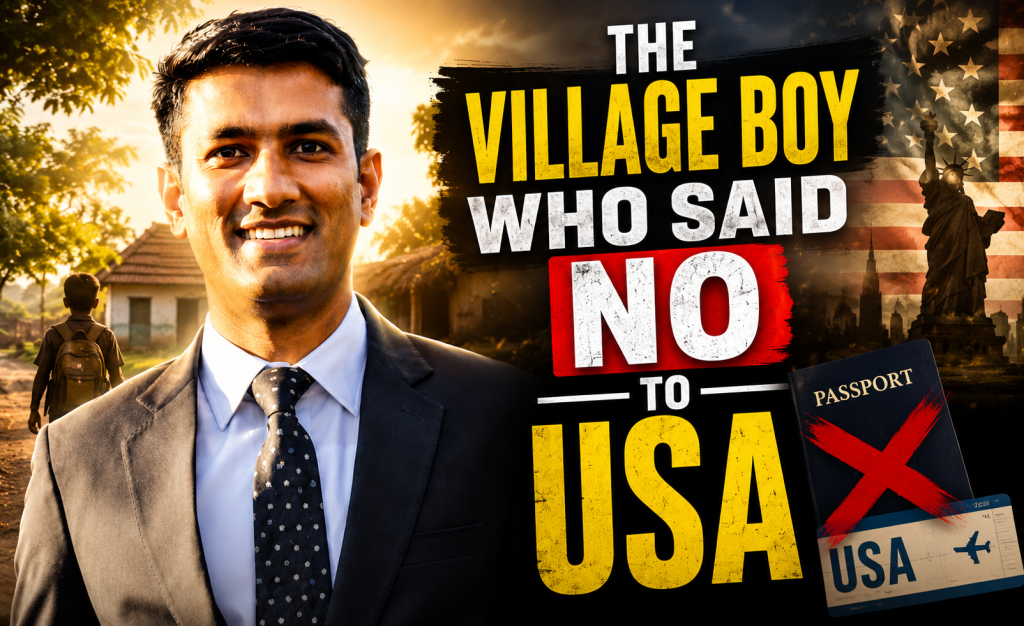
For many engineering graduates from IIT Bombay, the next destination is predictable: a multinational company, an overseas opportunity, and a life that most people aspire to. Nitesh’s path seemed to be moving in exactly that direction. He had a promising career at LG in Bengaluru, travelled to California for work, and even secured the coveted H1B visa through the lottery system.
Everything was ready.
But one conversation with his family changed everything.
“My entire family lives in one village. For them, the US felt very far. They believed that once someone goes there, they never come back,” he told Indian Masterminds in an exclusive conversation.
Instead of boarding a flight to America, Nitesh chose a road that offered no certainty. Years later, that decision has culminated in All India Rank 562 in the UPSC Civil Services Examination 2025, making him not only the first civil servant in his family but also the first member of his family to attend an engineering college.
His journey is not simply about clearing UPSC. It is about choosing purpose over comfort, learning from repeated setbacks, and constantly finding better ways to improve.
Also read: How IFS Anurag Tiwari Is Reviving Ujjain’s Lost Mahakal Van and Building a 500-Acre World-Class Zoo
A VILLAGE CHILDHOOD THAT DREAMED BEYOND ITS BOUNDARIES
Nitesh belongs to a village in Madhya Pradesh’s Ujjain district. His father serves as a government school teacher, while his mother is a homemaker. Until Class 8, every bit of his education happened in his village.
Later, he moved to Ratlam for further schooling before earning admission to IIT Bombay, where he pursued Metallurgical Engineering and Material Science. For his family, even this decision seemed unusually ambitious.
“They wondered why I wanted to study in Bombay when I could study somewhere closer like Indore,” he says with a smile.
No one in his family had ever imagined engineering at IIT, let alone preparing for India’s toughest examination.
THE DECISION THAT CHANGED EVERYTHING
After graduating, Nitesh joined LG Electronics in Bengaluru. His work even took him to California, opening doors to an international career.
When he secured the H1B visa, moving to the United States appeared to be the obvious next step. But watching his family’s anxiety made him pause.
“I thought if I go abroad, they’ll always feel they’ve lost someone.”
Around the same time, he reflected on the changes he had witnessed in his own village over the previous decade. He realised how administrative decisions had quietly transformed rural life.
That observation planted a new idea.
“If good administration can bring so much change in villages, then civil services seemed like the best way to contribute.”
In 2020, he resigned from his corporate job and began preparing for UPSC.
SIX ATTEMPTS THAT REFUSED TO FOLLOW A STRAIGHT LINE
The journey that followed was anything but smooth. His first attempt in 2020 ended at the Preliminary stage after COVID disrupted preparations.
In 2021, he reached the Interview stage but missed the final list by just ten marks. Then came perhaps the most frustrating phase.
He could not clear the Preliminary examination in both 2022 and 2023. The 2022 cycle became even more complicated because the result of his previous attempt arrived only five days before the next Preliminary examination, leaving almost no time to prepare mentally.
In 2024, he once again reached the interview stage. Again, he missed the final selection by only ten marks.
Many aspirants would have stopped there. Nitesh prepared for one final attempt. This time, the result carried his name with AIR 562.
HE DIDN’T JUST STUDY HARDER. HE STUDIED SMARTER
Instead of repeating old methods, Nitesh carefully analysed every weakness. History had always troubled him during Preliminary examinations.
Rather than memorising endless facts, he started visiting historical monuments across Delhi.
“I wanted to experience history instead of only reading it.”
That simple shift transformed his understanding of the subject. He also increased his mock tests from around twenty to nearly forty while solving a much larger number of previous years’ question papers.
For Mains, he realised his weakest areas were Essay and Anthropology. He stopped relying only on coaching notes, went back to original books, prepared fresh notes himself, and dramatically increased answer-writing practice.
The improvement in his optional subject also strengthened his General Studies and Essay papers.
HOW CHATGPT HELPED HIM PREPARE FOR THE INTERVIEW
One of the biggest changes came during interview preparation. Instead of only reading newspapers quickly, he began reading them slowly and aloud.
Speaking regularly improved both confidence and communication. He also practised summarising complicated topics into short, simple explanations that anyone could understand.
Then came an unusual addition. Using ChatGPT and other AI tools, he generated random interview questions and answered them in front of a mirror.
“I used ChatGPT to prepare random questions and answered them through mirror practice. It improved both my answer delivery and answer structuring,” he shared with Indian Masterminds.
His preparation paid off. He scored more than 195 marks in the Personality Test, one of his strongest performances.
AN INTERVIEW HE STILL SMILES ABOUT
The interview itself became one of the happiest memories of his UPSC journey. One board member unexpectedly complimented his suit and shoes before asking where he had bought them.
His hobby, historical tourism, sparked an engaging discussion with the Chairman on how artificial intelligence could help decode ancient inscriptions, sculptures and historical symbols.
When asked whether he had fully explored the National Museum, Nitesh smiled and replied that it was so vast he could only finish one section in an entire day.
The interview felt more like an intellectual conversation than an interrogation.
THE CHALLENGES NO SCORECARD REVEALS
Behind every attempt lay struggles that never appeared in the marksheet. During one examination cycle, he contracted COVID while writing the exams.
Just days before another examination, he lost his grandmother and could not even attend her funeral.
Leaving a secure corporate job also brought financial uncertainty. With every unsuccessful attempt, anxiety grew stronger.
“What if this doesn’t work? What comes next?” became a recurring question.
Family support helped him continue when self-belief became difficult.
Another emotional challenge came from someone closest to him. His wife, whom he first met as an IIT batchmate and fellow UPSC aspirant, appeared for three interviews herself but could not make the final list. The couple got married only a month after the results.
While one dream came true, the other remained unfinished, making the victory deeply personal for both of them.
ONE LESSON FOR EVERY ASPIRANT
Nitesh knows the competition today is tougher than ever. Resources are available to everyone. What separates one candidate from another is not access to material but the willingness to keep evolving.
“Every attempt should make you better than the previous one. Continuous improvement is what helps you rise above the competition.”
From a small village classroom to IIT Bombay, from an H1B visa to UPSC, from repeated disappointments to AIR 562, Nitesh’s story reminds aspirants that success rarely follows a straight road.
Sometimes, it arrives only after every shortcut has disappeared.
Also read: How IFS Piyusha Jagtap Is Changing Conservation Through Stories, Communities and Compassion | Video Interview