Millions arrive in Ujjain every year with folded hands, seeking blessings from Mahakaleshwar. They walk through ancient temple corridors, complete the revered Panchkoshi Yatra, and immerse themselves in a city whose identity is deeply rooted in faith.
But few pause to imagine what Ujjain once looked like.
Long before it became one of India’s holiest pilgrimage centres, ancient texts described it as Mahakal Van, a landscape where forests, biodiversity and spirituality existed together. Over centuries, urban expansion steadily replaced much of that natural cover, leaving behind a city where green spaces are increasingly difficult to create.
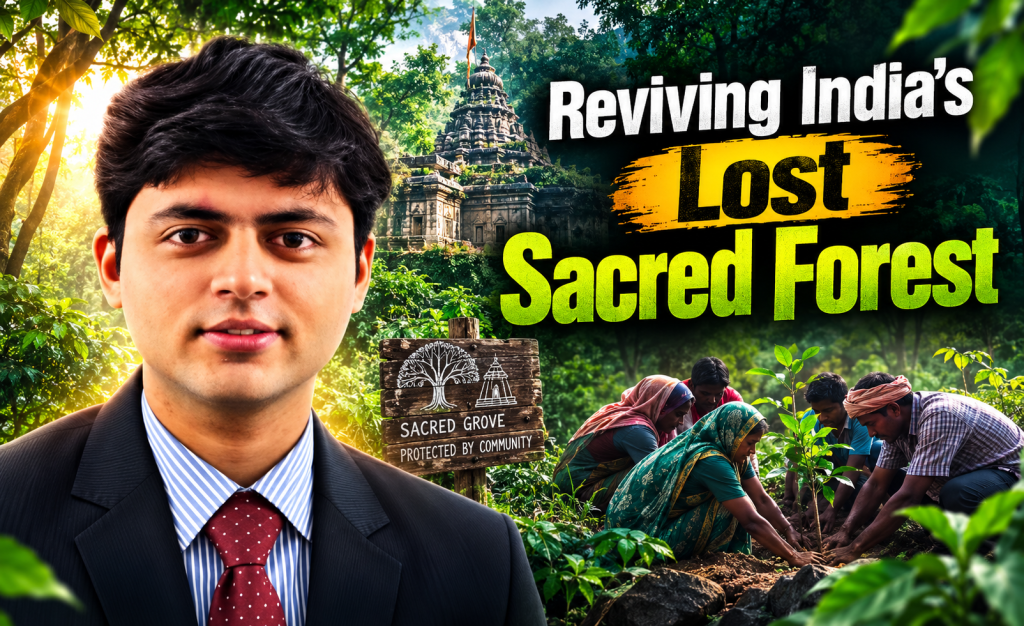
For Anurag Tiwari, Indian Forest Service officer of the 2018 batch Madhya Pradesh cadre and Divisional Forest Officer, Ujjain, that forgotten history has become the blueprint for the future.
Instead of viewing conservation and culture as separate ideas, he is bringing them together, one sacred grove, one native species and one community at a time.
Also read: The JRDA Story: How Dhanbad Is Moving 15,080 Families Away from India’s Century-Old Underground Coal Fires
FROM BIODIVERSITY FORESTS TO A WORLD RECORD
Before arriving in Ujjain, Tiwari served in Barwani Forest Division in Khargone district, where he developed three urban forests with a strong focus on ecological restoration.
Rather than treating plantation drives as mere numbers, the forests were designed around biodiversity. Rare and endangered species were introduced, medicinal plants received special attention and thematic plantations helped create ecologically rich landscapes.
The work earned international recognition through a World Book of Records honour.
“We focused on creating biodiversity-rich areas where rare and endangered species and medicinal plants became the priority. That work eventually led to the recognition,” he shared in an exclusive conversation with Indian Masterminds.
Today, his attention has shifted from building forests to rebuilding the ecological identity of an entire city.
THE BIGGEST CHALLENGE WAS FINDING SPACE
Unlike heavily forested districts, Ujjain presents an entirely different problem.
The city continues to expand rapidly while forest cover remains limited. Development projects compete for land, and much of the available area falls under revenue ownership rather than forest land.
“The first challenge was identifying land where greening could actually happen. Ujjain is an ancient city, and land availability is never easy,” Tiwari explains.
Instead of seeing that limitation as a roadblock, his team began searching for spaces around the city that could reconnect people with nature in a way that felt meaningful.
That search led them back to history.
BRINGING BACK THE FORGOTTEN MAHAKAL VAN
Ancient references in the Skanda Purana describe Ujjaini as the City of Mahakal Van. Even the city’s 84 Mahadev temples are believed to represent shrines that once stood within this vast sacred forest.
Inspired by this cultural memory, the Forest Department is developing Aastha Vans: sacred groves along the Panchkoshi Yatra route.
These green spaces will feature tree species associated with Lord Shiva alongside native biodiversity that historically belonged to the region.
The effort goes beyond plantation.
The department is identifying species that have slowly disappeared from the local landscape. Trees like tamarind continue to survive in scattered patches, while species such as Miswak, once native to the Kshipra river basin but now largely found in southern India, are being identified for restoration.
“We are trying to develop Aastha Vans that can function as sacred groves while showcasing local biodiversity,” Tiwari says. “The idea is to reconnect people with nature through the spiritual identity of Ujjain.”
It is conservation built around memory rather than merely geography.
WHEN COMMUNITIES BECOME CUSTODIANS
Planting trees is only the first step. Keeping them alive requires ownership. Instead of retaining complete departmental control, the Forest Department plans to hand over each Aastha Van to local temple trusts and Gram Panchayats.
Every year, thousands of devotees participate in the Panchkoshi Yatra. The same institutions that preserve religious traditions will now also help protect these sacred forests.
“The idea is that temple organisations and Gram Panchayats become the custodians of these sacred groves,” he told Indian Masterminds.
The response has already been encouraging. Plantation work has begun, and local communities have shown strong interest in participating.
To strengthen public involvement further, the department organised a six-day Van Mela in Ujjain earlier this year.
The statewide herbal fair brought together over 60 cooperative societies involved in Non-Timber Forest Produce (NTFP) collection, more than 100 traditional practitioners, herbal product companies, Van Dhan Kendras and brands such as Vindhya Herbals.
The response surprised even the organisers.
More than 1.5 lakh visitors attended the event, while sales of herbal and forest-based products crossed ₹1 crore, demonstrating that conservation can also generate economic opportunities for forest communities.
With Simhastha 2028 approaching, officials believe such initiatives will create even greater public engagement around greenery and biodiversity.
STOPPING ILLEGAL WILDLIFE TRADE IN A TEMPLE CITY
Conservation in Ujjain extends beyond plantations. As one of India’s busiest pilgrimage destinations, the city occasionally becomes a transit and sale point for prohibited wildlife products.
The Forest Department has intensified surveillance around temple areas, targeting the illegal sale of items such as Hatha Jodi and Sehi Singhi, which are often linked to wildlife crime and superstition.
Within a single month, officials carried out four to five major crackdowns against illegal wildlife articles. The effort reflects another side of conservation: protecting wildlife not just inside forests, but also within urban markets.
BUILDING A DIFFERENT KIND OF ZOO
Perhaps Tiwari’s most ambitious project is still on the drawing board.
Spread across 210 hectares (over 500 acres) of reserved forest land, Ujjain is preparing for what could become one of Madhya Pradesh’s largest and most immersive zoological parks.
The concept departs from conventional zoo design.
Instead of small enclosures organised species by species, the proposed facility will recreate 11 tropical biogeographic zones, including landscapes representing India, Africa, Southeast Asia and Central America.
More than 300 species, nearly 80 percent of them native to India, are planned. Carnivore habitats will exceed five hectares each, with nearly 30 hectares dedicated to multiple predator species viewed through a two-hour safari-style drive.
Visitors will move through the park using electric shuttle vehicles or a pedestrian walkway stretching across the campus. A green overbridge will connect portions of the zoo separated by a road, turning an engineering challenge into an ecological feature.
“We want visitors to experience wildlife in a much more natural setting while remaining fully compliant with Central Zoo Authority norms,” says Tiwari.
The project has already received in-principle approval from the Central Zoo Authority, and officials are aiming to complete the first phase before Simhastha 2028.
If realised as planned, the zoo could transform Ujjain from a destination where visitors spend a few hours into one where they stay longer, exploring not only its temples but also its forests, wildlife and ecological heritage.
For Anurag Tiwari, that is perhaps the larger vision.
Not simply planting trees.
But helping a sacred city rediscover the forest that once defined it.
Also read: IFS Gitanjali Janarthanan: The Woman Behind Vindhya Herbals’ 42 Crore Growth Story