For more than 100 years, the ground beneath Jharia has been on fire.
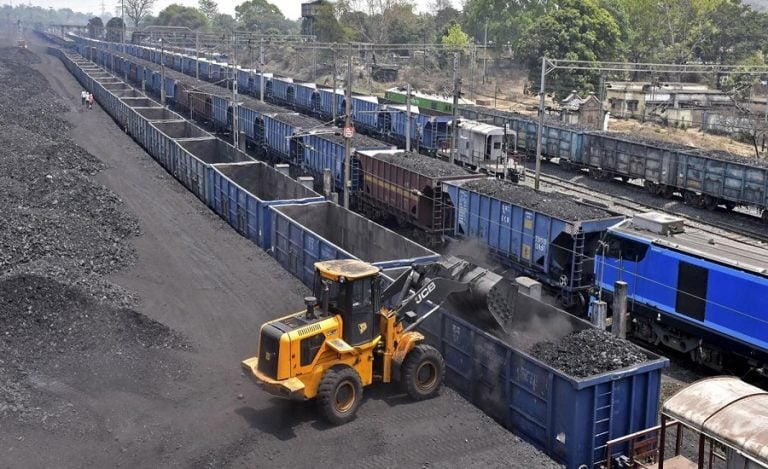
Since 1916, underground coal seams in Jharkhand’s famous coalfield have continued to burn, silently eating away at the earth below. Entire neighbourhoods have lived above hollow, unstable land. Roads have cracked. Houses have sunk. Toxic smoke has escaped through fissures in the ground. Every passing day has carried an invisible question for thousands of families: How long before the land beneath us gives way?
Yet despite the danger, convincing people to leave was never easy.
Many believed rehabilitation was simply another way to clear land for mining. Years of uncertainty had created deep mistrust between communities and the administration.
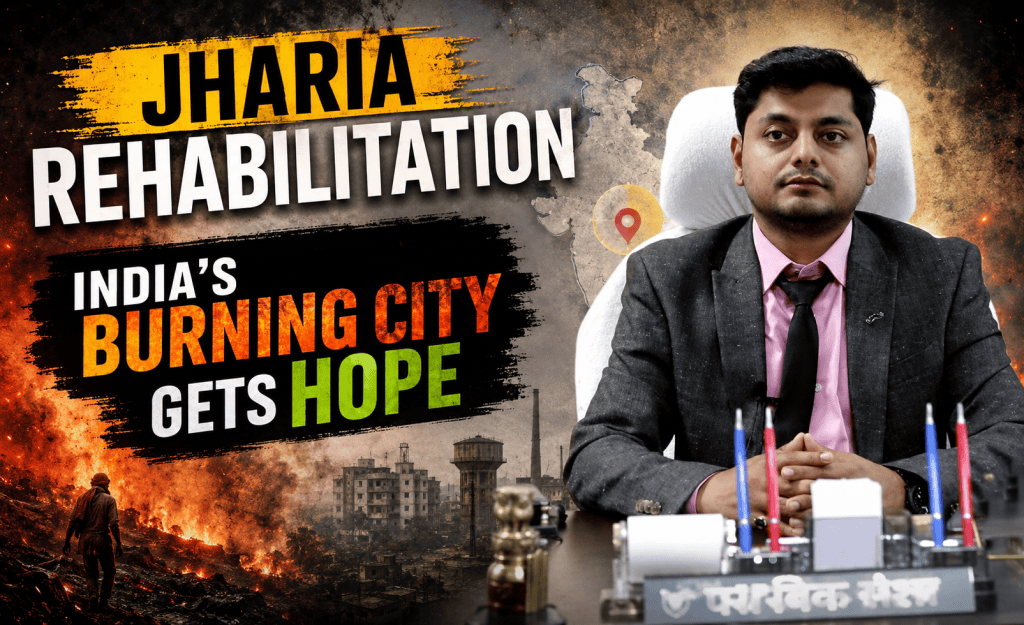
Today, that narrative is beginning to change under the leadership of IAS Aditya Ranjan, the 2015-batch officer serving as the Deputy Commissioner of Dhanbad and overseeing the Jharia Rehabilitation & Development Authority (JRDA).
Rather than treating rehabilitation as a construction project, his administration is trying to make it a people-first movement.
Also read: Transforming Education in Jharkhand, One School at a Time
A PROBLEM BIGGER THAN RELOCATION
Established on 31 December 2004, JRDA was created to rehabilitate non-BCCL families living in fire-affected and subsidence-prone areas of the Jharia Coalfield. Working alongside Bharat Coking Coal Limited (BCCL), the authority implements one of India’s most challenging rehabilitation programmes.
The original Jharia Master Plan, approved by the Government of India in 2009 with an investment of ₹7,112.11 crore, focused on extinguishing underground fires, relocating vulnerable populations, and diverting affected roads and railway lines.
After the completion of the original implementation phase in 2021, the government constituted a high-level committee. Its recommendations eventually led to the approval of the Revised Jharia Master Plan (JMP 2.0) by the Union Cabinet in June 2025.
The revised plan dramatically expands both the scale and quality of rehabilitation.
It now covers 81 highly vulnerable sites along with 27 active fire locations, targeting the relocation of 15,080 families, including 649 BCCL families, 1,130 Legal Title Holder (LTH) families, and 13,301 Non-LTH families.
WINNING TRUST BEFORE MOVING FAMILIES
For years, the biggest obstacle wasn’t engineering. It was belief.
Residents feared losing ancestral homes without receiving meaningful rehabilitation in return. Recognising this, Aditya Ranjan’s team shifted the focus from compulsory relocation to informed choice.
“People don’t rebuild their lives because they’re instructed to. They do it when they believe the alternative offers dignity, safety and opportunity,” Aditya Ranjan shared in an exclusive conversation with Indian Masterminds.
Instead of forced displacement, eligible families are offered a choice-based rehabilitation package. Beneficiaries can opt for newly constructed houses, while cash compensation becomes available once housing stock is exhausted. Every financial benefit is transferred directly through Direct Benefit Transfer (DBT), eliminating middlemen and increasing transparency.
The administration also conducts door-to-door surveys, understanding each household’s specific needs before relocation begins.
The objective is simple: replace suspicion with confidence.
A CAREFULLY PLANNED JOURNEY FROM HAZARD TO HOME
The rehabilitation process follows a structured sequence rather than hurried evacuation.
It begins with detailed verification of eligible families by the Survey and Civil departments. The Rehabilitation and Resettlement wing prepares tentative allotments, which are then confirmed through BCCL Area Offices.
Once beneficiaries agree, allotment letters are issued, unsafe structures are demolished, and No Objection Certificates are generated. Families then move to Belgaria Township, where documents are verified before house keys are officially handed over.
Only after relocation are financial benefits such as shifting assistance and livelihood grants released. This systematic approach ensures that every relocation is documented, verified and transparent.
MORE THAN JUST HOUSES
Perhaps the biggest transformation lies in what awaits families after relocation.
Belgaria Township is no longer envisioned as merely a housing colony. Spread across eight development phases, it is gradually evolving into a complete urban settlement with 18,272 houses across 1,191 residential blocks.
Every relocated household receives access to piped drinking water, electricity, sewerage systems, waste management, improved roads and transport connectivity. More than 500 LED solar streetlights have been installed to improve safety while promoting sustainable infrastructure.
Schools have been upgraded to ensure children’s education continues uninterrupted. Healthcare facilities, community centres and Public Distribution System outlets are part of the township’s design. Resident Welfare Associations are also being encouraged to strengthen community participation.
Eventually, Belgaria is planned to be upgraded into an independent municipal body.
REHABILITATION MEANS LIVELIHOOD TOO
The revised package recognises that moving people without securing incomes simply shifts hardship from one place to another.
For Legal Title Holders, compensation includes land compensation under applicable laws, a 50-square metre house or ₹5 lakh cash, a ₹1 lakh livelihood grant, ₹1 lakh rental assistance, ₹50,000 shifting assistance, and access to loans of up to ₹3 lakh.
For Non-Land Title Holders, the package includes a 38.92-square metre house or ₹5 lakh cash, along with identical livelihood, rental and shifting benefits.
Skill development has become another major pillar.
Through the Multi Skill Development Institute, established in partnership with the National Skill Development Council, youth receive training in customer care, assistant fitter trades, beautician services, healthcare, CCTV installation, electronics and two-wheeler servicing. Residential training programmes, hostel facilities, Self-Help Groups, bamboo craft clusters and e-rickshaw cooperatives are creating new income opportunities.
Families are also being linked to Ayushman Bharat, pension schemes and insurance programmes including PMJJBY, PMSBY and APY.
“Rehabilitation is complete only when families have the confidence that their future will be more secure than their past,” Aditya Ranjan explains.
PREPARING JHARIA FOR ITS NEXT CHAPTER
While families move to safer homes, work beneath the surface continues.
BCCL has been tasked with controlling fires at 27 identified sites, supported by scientific monitoring through satellite imagery, drones and AI-based technologies. Vacated land will undergo ecological restoration through plantation, land stabilisation and sustainable reuse.
Once people are safely relocated, valuable prime coking coal currently trapped beneath inhabited settlements can be accessed without putting lives at risk.
“The long-term vision is straightforward: protect every life, restore the damaged landscape and preserve a national resource for future generations,” says Aditya Ranjan.
For a town that has lived above fire for more than a century, that vision could redefine its future.
Jharia’s story is no longer only about burning coal.
It is increasingly becoming a story about rebuilding lives.
Also read: Koderma Achieves Full Literacy in 50 Villages, Thanks to DC Aditya Ranjan