Every time we have a choice to make, the universe splits into two, or more, to allow for the possibilities of our different paths. All these different worlds exist in parallel, densely packed, each oblivious to the existence of the other. In this universe, a butterfly could flap its wings in Brazil and stir a tornado in Texas; in another, the atmospheric diamonds of Saturn might freeze into glaciers on Earth. In one obnoxious universe, there are no humans. Perhaps in a fourth, more obliging possibility, we live simultaneously in the times of the insects and the times of the stars.
Tara Kumar had been obsessed with parallel universes in the quicksilver curiosity of her youth. A little earlier, the focus of her attention had been hybrid animals like mules. A little later, she shifted to musing over the inexplicable mysteries of evolution. Ultimately, these ripples would swirl into the inevitable choice of becoming a wildlife biologist, a “relentless paparazzo” to endangered Himalayan dogs called dholes, gathering scatological samples towards decoding migration patterns. Tara had known early on, since her first splitting headache as a child, that she would have a strange life: “Many people, she thinks, would see it as an illness of the spirit. It is hard to say where it comes from, the conviction that leads some women to believe that they can do something wildly different from what society has ordained for them.”
Her real-life friend Mansi Deshmukh is more ordinary than the radical sorority of unwell-young-famous women whose biographies Tara pored over — poets and scientists who had taken the chance to apply themselves fully to the pursuit of truth and beauty. Mansi’s teenage fantasy was to study abroad because she wanted to flip burgers for pocket money at fast-food restaurants like the heroines of American sitcoms and comics: “How perfect,” Tara had cruelly replied to this confession of a derivative dream, “The working-class life without the taint of caste.” It had stung to hear an insult from a best friend, but Mansi is honest about her dishonesty as a narrator. “There is inside me a kind of blindness that lets me look past the things I do not know, that I do not care to know. It makes me see but not understand, hear but not listen. In other words, I was raised to never be a difficult woman.”
Thus Mansi marries a handsome young man with affectionate parents (whose affection is reserved for their handsome young son) and spends her days working to improve the efficacy of India’s third-most-popular fairness cream, while Tara earns a PhD in her quest to understand the behavioural tendencies of elusive-yet-friendly dholes and wanders across mountains under a relentlessly bright sun. Between them is “Romeo” Bhaskar, a machine learning engineer who believes in the potential of artificial intelligence to alleviate human suffering despite his awareness of the fundamental truth that human existence is far from uni-dimensional.
“Am I one person with everyone I talk to? There is a camaraderie I share with my college friends,” thinks Bhaskar to himself, “for my mother I reserve an adoring but playful tone, and when I speak to my father, a vulnerable formality creeps into my voice. You could think of this as the many masks a single person wears in his interactions with the world, but whichever way you put it, real people are many people in one, and yet, there is always a single light animating all these moving shadows.” What if these shadows could be integrated through AI? Could generating optimized textual analysis reproduce anima? Perhaps in one universe, code performs the syntax of sentience so convincingly that speech and silence and soul become unnecessary.
His real-life work at a lab in the Bay Area had enabled extraordinary experiments towards compressing character patterns into chatbots — large language models which extract from the environment for the convenience of humans. Bhaskar knows that personal biases can be encoded into software but has no friend to hold a mirror to the delusions which corrupt his sincere desire to serve a greater purpose: “Techno-solutionism can easily become the mindless pursuit of efficiency,” Tara had suggested to him once. Bhaskar dislikes the antiseptic curation of modern life, but is less transparent to himself than Mansi about his own hypocrisies. “It did not matter what he wanted; he had come to understand that the world did not operate that way… And yet, he liked people to think that he alone steered the ship of his life.”
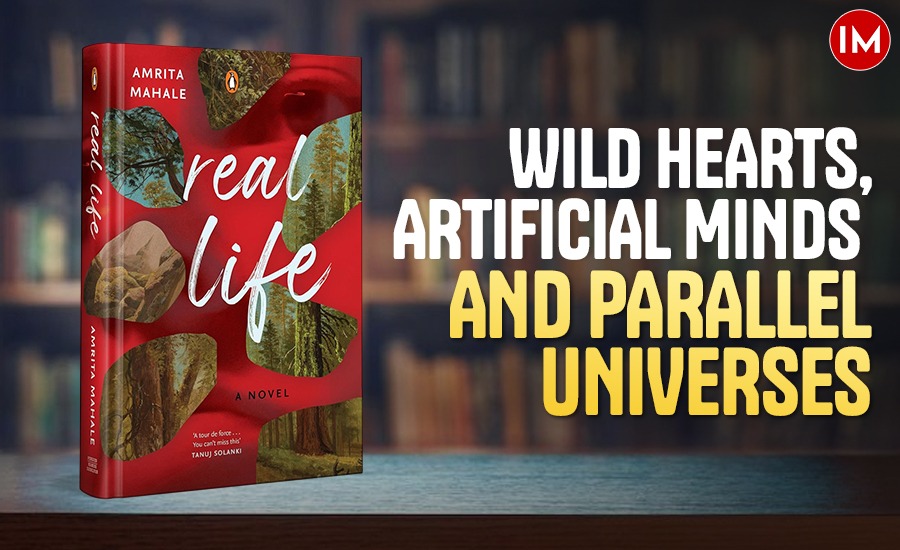
There is surveillance, and perception, and the real self blinking through them whenever possible in Amrita Mahale’s ambitious and remarkably insightful second novel. Intricacies of ethology and ethical AI dance in her lyrical prose as the book uncovers layers of complexity behind cursory stereotypes of a shrinking girl, a lonely boy, and a wild woman.
The stories of Mansi, Bhaskar, and Tara are a meditation on the importance of questioning stories—especially those which we know best, because the most dangerous lies are the ones we tell ourselves. We begin by believing in our magnificence, then realise the cracks in that belief, and fix the fissures as best as we can. But it is precisely in these breaks that evolution accelerates because that is when life is presented with new opportunities and new necessities.
“Mountains, Tara knows, remain a work in progress forever, and nature keeps a ledger of all changes. As wind and rain chisel away at the cliffs, as erosion cuts open entire chunks, the story of the mountains’ birth is made visible: layers of geological history thrust through one another like two halves of a pack of cards shuffled together. One tends to think of the earth as a gentle and pitiful mother, but here in the mountains, she is witness to the earth’s enormous and terrifying power.” In the fictional Mahamaya Valley (whose scenic beauty and plastic pollution evoke the awful paradox of Uttarakhand), it is easy to imagine a multiverse in which one possibility could be a root that survives the most ruthless seasons by going deep beneath the frost, a root which “drinks first from snow and then from spring. It bursts forth. Like a fairytale beanstalk, it grows, and it reaches beyond the realm of giants, beyond the clouds, beyond the grasp of the earth itself. All the way to the stars.”
From Amrita Mahale to Adrienne Rich’s poem “Planetarium” (dedicated to astronomer Caroline Herschel with a line from her memoirs), there could be “a woman ‘in the snow / among the Clocks and instruments / or measuring the ground with poles’”. There are other galaxies of women doing penance for their impetuousness, and what we see is how we change, and “I am an instrument in the shape / of a woman trying to translate pulsations / into images for the relief of the body / and the reconstruction of the mind.”
Also Read – How Regular Phone Calls and Home Visits Reduced Maternal Deaths in Shahdol by 50%