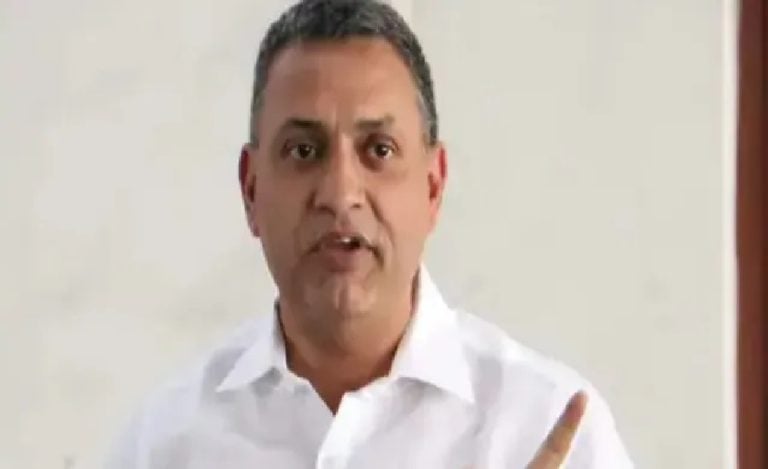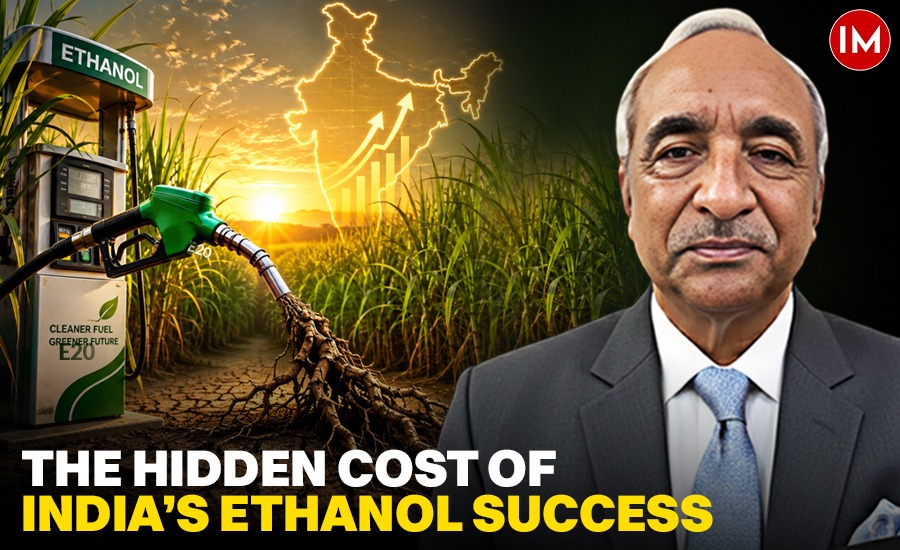
Every time the government talks about the ethanol blending programme, the numbers sound uniformly good: 20 per cent blending achieved five years ahead of schedule, thousands of crores saved in crude imports, and farmers earning more. What rarely makes it into the same sentence is who is quietly paying for this success — and how much, writes former IAS officer V.S.Pandey
Also read: India’s Gold Obsession Is Costing 20 Times More Than Ethanol Saves: Time to Rethink Forex Priorities
A written reply in the Rajya Sabha this week supplied the missing half of the story. The Food Corporation of India sold 6.35 million tonnes of rice to ethanol distilleries between June 2025 and June 2026 at ₹2,250 to ₹2,320 a quintal, even though its own average cost of acquiring and holding that rice was ₹3,720 a quintal in 2024-25 and ₹3,889 a quintal in 2025-26. That is a discount of roughly 40 per cent, translating into an implicit transfer of somewhere between ₹9,000 crore and ₹9,500 crore to distilleries in a single year. For 2026-27, the government has approved an even larger allocation — 7.2 million tonnes at about ₹23,900 a tonne against an economic cost of about ₹43,100 a tonne — pushing the annual gap to roughly ₹13,800 crore.
The minister’s response to Parliament insisted that no subsidy is being given to ethanol producers, because the rice is sold at a fixed price under the Open Market Sale Scheme. This is technically true and substantively misleading. FCI does not conjure rice out of thin air; every quintal it hands over below cost is a quintal whose true price is absorbed somewhere else in the government’s books — typically the food subsidy bill, funded by the taxpayer. Calling it “not a subsidy” because it is booked under a different head is an accounting sleight of hand, not an economic fact.
This would be easier to accept if the savings on the other side of the ledger were unambiguous. They are not. Official claims about how much the ethanol programme has saved in crude oil imports have varied wildly depending on who is speaking and when — anywhere from about ₹28,400 crore for a single year to ₹1.06 lakh crore “over the past decade” to ₹1.44 lakh crore “till 2025” in different government statements. None of these figures come with a published, auditable methodology. Averaged over ten years, they land in roughly the same range as the ₹14,000 crore or so that reduced oil imports are believed to save annually — which means the rice subsidy alone, in some years, could be cancelling out much of the benefit the programme is meant to deliver.
There is a second cost that the government’s arithmetic leaves out entirely: the one borne by ordinary vehicle owners. Maruti Suzuki, India’s largest carmaker, has said its data show no serious E20-related damage even in older, non-certified engines, with mileage loss of under a kilometre per litre. But that is not what motorists themselves are reporting. A survey of more than 44,000 urban petrol vehicle owners by the community platform LocalCircles found that a majority had noticed mileage drops of 15 to 20 per cent since early 2025. An independent analysis by the investigative outlet The Reporters’ Collective, using the government’s own fuel consumption data, estimated that Indian motorists have collectively paid nearly ₹88,000 crore extra in fuel costs over three years because of this efficiency loss. Even the government’s own clarification, issued in July this year, conceded a 3 to 5 per cent fuel economy hit in some vehicles — a tacit admission that the “no real difference” line was not the whole truth.
None of this means the ethanol blending programme is baseless. India imports close to 90 per cent of the crude oil it consumes, and any credible way to dent that dependence deserves serious consideration. Diverting rice that is rotting in overflowing FCI godowns — India’s stocks have run well above the mandated buffer for years — into productive use is not inherently indefensible either; storage and wastage have their own costs. The problem is not that the government chose to pursue ethanol blending. The problem is the pattern of how it has been pursued: blending targets advanced repeatedly, from 2030 to 2025 to 2023, procurement prices for ethanol fixed well above what oil marketing companies would ever have chosen on commercial logic, and now food-security grain routed to private distilleries at a fraction of its cost — all while officials insist, against the arithmetic, that none of this constitutes a subsidy.
The beneficiaries of this pricing are concentrated and organised: sugar mills first, and now increasingly grain-based ethanol producers, clustered heavily in politically significant states such as Uttar Pradesh, Maharashtra and Haryana. The people bearing the cost are diffuse and unorganised: taxpayers funding the food subsidy bill, and the tens of millions of ordinary car and two-wheeler owners quietly absorbing a mileage penalty that shows up nowhere in the government’s press releases. That asymmetry — concentrated, well-lobbied gains against dispersed, invisible losses — is precisely the pattern one would expect if a policy justified in the language of energy security had, over a decade, become equally a vehicle for producer support.
What is needed now is not the abandonment of ethanol blending but honesty about its true costs. Parliament and the Comptroller and Auditor General should insist on a transparent, audited accounting of the actual subsidy embedded in FCI’s rice sales to distilleries, set against an independently verified estimate of crude import savings and the fuel-efficiency losses documented by consumers. Only then can citizens judge whether this is genuinely a programme that serves the national interest, or one whose real balance sheet has simply never been shown to them.
Also read: From Nation Building to Brain Drain? Reassessing the IIT Legacy After Six Decades