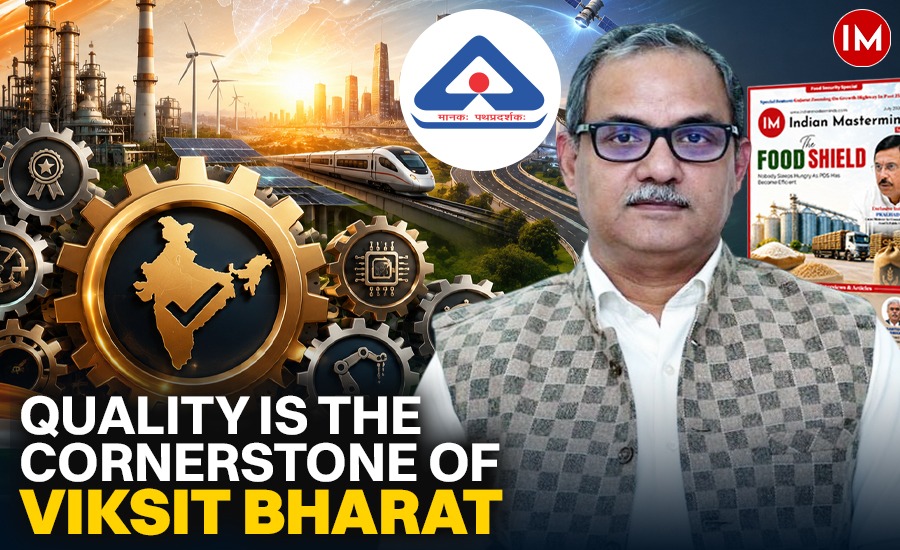
As India moves towards becoming a developed nation by 2047, quality, safety and standardisation have become central to economic growth and consumer protection. In this exclusive interview, Bureau of Indian Standards (BIS) Director General Sanjay Garg explains how BIS is strengthening consumer confidence, driving innovation in emerging technologies, modernising hallmarking, enhancing food safety and positioning Indian Standards on the global stage.
Q1. How is BIS strengthening consumer confidence and protecting public interest, especially in food and consumer products?
A: BIS ensures quality and safety remain the foundation of India’s growth. Indian Standards prescribe benchmarks for safety, hygiene, packaging and performance, protecting consumers while guiding manufacturers. Standards for products like pressure cookers and food packaging have significantly improved safety. Millions of households use pressure cookers every day, often without realizing that standardized safety requirements have significantly reduced accidents over the years. Similarly, standards ensure that packaging materials do not release harmful chemicals into food, remain suitable under different storage conditions, and preserve food quality throughout transportation. BIS is creating a nationwide culture of quality and informed consumer choice through Consumer Awareness Programmes, Standards Clubs, Gram Panchayat sensitization and Quality Connect campaigns,
Q2. What is your vision for BIS over the next decade?
A: Taking forward the Hon’ble Prime Minister’s vision of making Indian Standards the new international standards, BIS aims to become one of the world’s leading national standards bodies. BIS aims to become a leading global standards body by aligning Indian Standards with international benchmarks while helping shape future global standards. With focus on AI, EVs, semiconductors, green hydrogen, cybersecurity and sustainability, BIS will support Make in India, Atmanirbhar Bharat and Viksit Bharat 2047. Digitalisation and greater stakeholder participation will make standardisation faster, transparent and globally relevant.
Q3. What role does BIS play in strengthening India’s food security framework?
A: Food security today depends on quality and safety as much as availability. BIS develops standards covering agricultural inputs, processing, packaging, storage, transportation, testing and distribution. Our standards provide scientifically established requirements that help maintain product quality, reduce contamination, improve hygiene, enhance traceability and minimise post-harvest losses. These standards reduce contamination, improve hygiene, enhance traceability and minimise post-harvest losses. Working with FSSAI and industry, BIS is also developing standards for smart packaging, sustainable agriculture and digital traceability to ensure quality from farm to fork.
Q4. How is BIS helping consumers navigate the expanding market of packaged and processed foods?
A: BIS regularly updates standards to reflect new technologies, sustainable packaging and changing consumer needs. The BIS CARE App enables consumers to verify certification marks, hallmarking and lodge complaints. Combined with nationwide awareness programmes, Standards Clubs and Quality Connect initiatives, BIS empowers consumers to make safe and informed purchasing decisions.
Q5. What have been BIS’s major achievements in the last 2–3 years?
A: BIS has accelerated standards development in AI, EVs, green hydrogen, drones, cybersecurity and smart manufacturing while digitising standardisation through its new Standards Portal. Major hallmarking initiatives include voluntary Silver HUID, expansion of mandatory gold hallmarking to 385 districts, introduction of Transfer HUID for complete supply-chain traceability, and digital capture of jewellery photographs and weight to curb fake hallmarking and duplicate HUIDs.
Q6. How is BIS leveraging technology to strengthen quality assurance and consumer protection?
A: BIS has adopted integrated digital platforms like e-BIS, Manak Online and Laboratory Information Management Systems (LIMS) to automate certification, testing and laboratory processes. Predictive analytics support market surveillance while the BIS CARE App enables consumers to verify licences, hallmarking and certification. BIS is also developing standards for AI, IoT, cybersecurity and digital trust, making quality assurance faster, transparent and technology-driven.
Q7. How is BIS encouraging industry, MSMEs and startups to adopt Indian Standards?
A: BIS actively partners with industry, MSMEs, startups, academia and research institutions through consultations, outreach programmes and stakeholder participation. During the current financial year, 79 MSME awareness programmes have already been conducted. BIS Student Chapters, pre-standardisation studies and collaboration with GeM and public procurement systems are strengthening India’s quality ecosystem while enhancing global competitiveness.
Q8. What initiatives has BIS taken to improve consumer awareness?
A: BIS considers informed consumers the strongest drivers of quality. Through Consumer Awareness Programmes, Standards Clubs, Student Chapters, Gram Panchayat sensitization, SHINE, Gram Chaupals and Quality Connect campaigns, BIS educates citizens on certification marks, hallmarking and product quality. Digital platforms and social media further expand awareness, encouraging informed purchasing decisions.
Q9. What lessons has BIS learnt from the rollout of mandatory gold hallmarking?
A: The phased rollout across 385 districts has highlighted the importance of strong hallmarking infrastructure, digital traceability and continuous stakeholder engagement. Today, over 2.23 lakh registered jewellers, more than 1,500 Assaying and Hallmarking Centres, and HUID-based traceability have significantly strengthened consumer confidence. Going forward, BIS will expand awareness, strengthen surveillance, improve infrastructure for gold and silver hallmarking, and work towards nationwide implementation.
Q10. Has BIS developed standards for diamonds and precious gems?
A: Yes. BIS has published IS 19469:2025, which establishes standard terminology for natural, laboratory-grown, treated, composite and imitation diamonds. The standard promotes transparency, consumer confidence and fair trade across the diamond industry.
Q11. What are BIS’s strategic priorities as India moves towards Viksit Bharat 2047?
A: BIS will focus on future-ready standards for emerging technologies, sustainability and digital transformation while expanding India’s leadership in international standardisation. By strengthening partnerships with industry, MSMEs, academia and consumers, BIS aims to
build a strong quality culture that supports innovation, trade, consumer protection and global competitiveness. Its vision is that by 2047, products designed, manufactured and certified in India