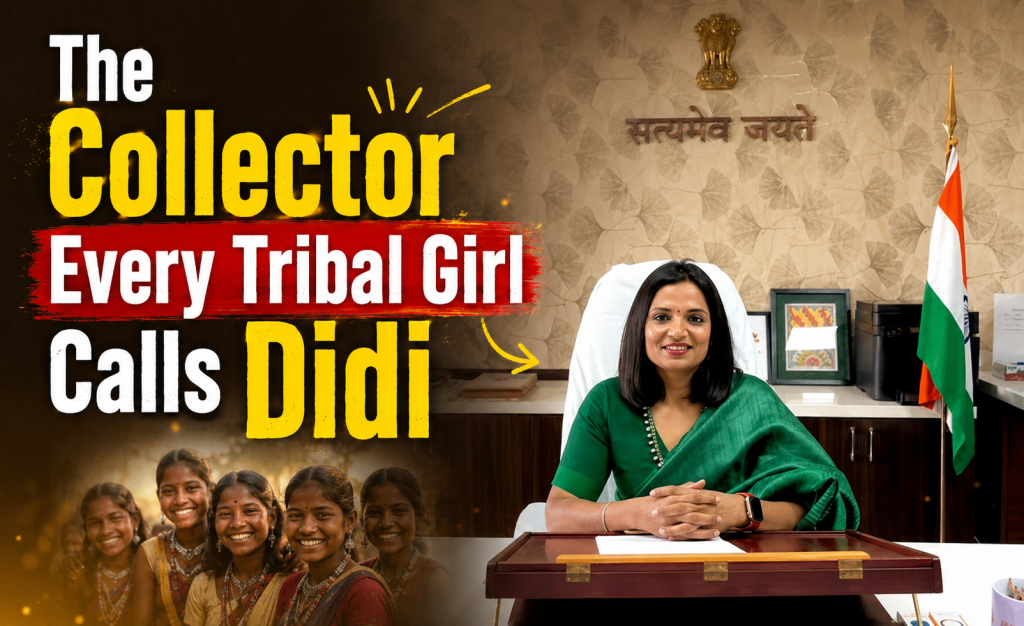
Every government office has a visitor’s chair. But in Gujarat’s Chhota Udepur district, District Collector Gargi Jain chose a different seat, one inside a classroom.
Every week, instead of spending another afternoon behind files and meetings, she walks into schools tucked away in tribal villages. There is no formal inspection, no prepared speeches, and no intimidating official atmosphere. She simply sits among the girls, listens to them, laughs with them, answers their questions, and slowly becomes someone they trust.
Today, they no longer call her “Madam Collector.” They call her Collector Didi. That simple shift in identity has become the heart of an initiative that is quietly changing hundreds of young lives.
Also read: No Playground? No Problem. IAS Gargi Jain is Rewriting the Rules of Rural Sports in Chhotaudepur
BEYOND GOVERNMENT SCHEMES, BUILDING CONFIDENCE
Chhota Udepur is one of Gujarat’s most tribal-dominated districts, where many girls are the first in their families to attend school. Financial hardship, early marriage, lack of awareness, and social pressures have long contributed to school dropouts.
Government schemes could provide scholarships and infrastructure. But Gargi Jain believed there was another gap that numbers alone could not solve: the absence of aspiration and someone who genuinely listened. So, she decided that instead of waiting for students to approach the administration, the administration would walk into their classrooms.
That idea became ‘Collector in Classroom.’
For the past year, she has been regularly visiting girls’ schools across tribal areas, turning ordinary classrooms into spaces where students can speak freely about dreams, fears, family struggles, and ambitions.
“When I became the Collector of Chhota Udepur, I regularly started visiting schools attended by girls in tribal areas. I wanted these girls to know that their dreams are just as valid as anyone else’s,” she shared in an exclusive conversation with Indian Masterminds.
MORE THAN A COLLECTOR, A MENTOR
The initiative now directly mentors more than 750 girls across five Kanya Vidyalayas. During these sessions, Gargi Jain does far more than discuss academics.
She speaks about life skills, communication, confidence, leadership, career opportunities, legal rights, and how to challenge harmful social practices. Students ask questions about UPSC, engineering, medicine, police services, higher education, and government jobs. Others seek advice on family problems, financial challenges, and personal dilemmas.
Conversations that many girls hesitate to have even at home now happen openly with their District Collector.
A STORY THAT CHANGED THE CONVERSATION
Perhaps the most defining moment of every session comes when Gargi Jain shares a deeply personal chapter from her own childhood.
She tells the girls about an incident that she carried silently for years.
“When I was a young girl travelling on a bus with my mother, a fellow passenger subjected me to bad touch. I remained deeply traumatized for a long time but could not tell anyone about it.”
The classroom usually falls silent.
By opening up about an experience many survivors struggle to discuss, she creates a safe space where students begin to ask questions they had never voiced before.
She explains the difference between good touch and bad touch, encourages children to speak up without fear, and reminds them that silence should never become a burden.
The conversation is not just about safety. It is about giving girls the confidence to trust their own voice.
FROM REDUCING DROPOUTS TO CREATING IAS OFFICERS
The initiative has already produced measurable results.
In 2025, nearly 9,000 children had dropped out of schools across Chhota Udepur district. By 2026, that number had come down to around 5,500, with nearly 4,500 students returning to classrooms, reflecting an overall reduction of about 39 percent. Among girls, the dropout rate declined by nearly 60 percent within a year, supported by a combination of government interventions and sustained outreach through the Collector in Classroom initiative.
Yet, for Gargi Jain, the numbers are only part of the story. Her ambition reaches much further.
“I will not stop until five tribal girls become IAS officers.”
It is an ambitious goal, but every classroom visit, every conversation, and every student who chooses to stay in school brings that dream a little closer.
THE POWER OF BEING PRESENT
Leadership is often associated with large projects, policy announcements, and headline-making decisions. But sometimes, its greatest impact begins with something much simpler: a chair pulled beside a student instead of across a desk.
Gargi Jain’s initiative proves that administration is not only about implementing schemes; it is also about building trust. By becoming “Collector Didi,” she has shown that when young girls feel heard, they begin to believe in possibilities they had never imagined.
Years from now, if even one of those girls walks into the Lal Bahadur Shastri National Academy of Administration as an IAS probationer, the journey will have started not with a coaching institute or a competitive exam.
It will have started in a tribal classroom, where a Collector chose to listen before she chose to lead.
Also read: IAS Vaishali Jain Is Transforming Ratlam’s Government Schools with Benches, Digital Classrooms and Rural Libraries