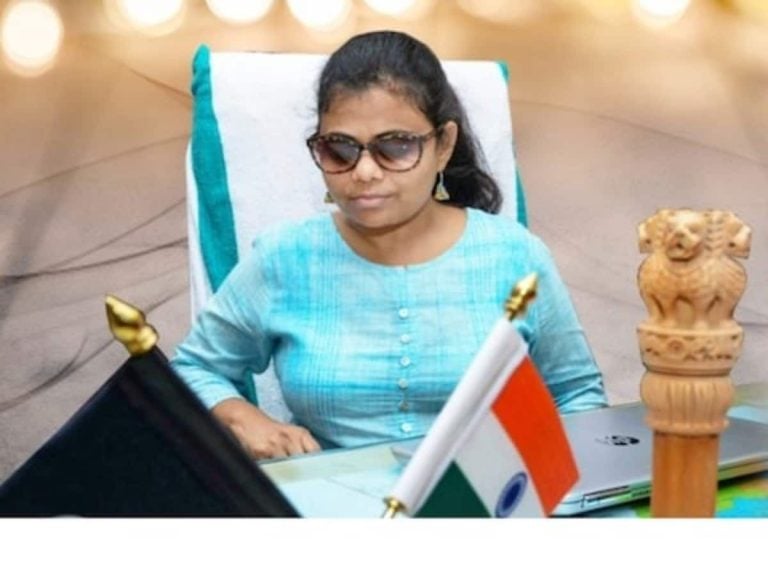
New Delhi: The Central Administrative Tribunal (CAT) has cancelled the transfer of 2017 Batch, AGMUT Cadre IAS Pranjal Patil, India’s first visually impaired woman IAS officer, from Delhi to Arunachal Pradesh.
The tribunal ruled that the government must consider the medical needs and special requirements of employees with disabilities before ordering transfers.
The decision highlights the importance of equal treatment, reasonable accommodation and the rights of persons with disabilities in government services.
IAS Pranjal Patil Transfer Row: Why Did CAT Cancel Transfer
The Central Administrative Tribunal delivered its decision on November 4, 2026, in the case of Pranjal Patil vs Union of India.
Read more: CAT Overrules Centre: Tribunal Reverses Centre’s Order, Sends IAS Amrapali Kata Back to Telangana
Judicial Member Rajveer Singh Verma observed that the government cannot apply routine transfer policies without considering the special needs of employees with disabilities.
The tribunal also stated that reasonable accommodation under the Rights of Persons with Disabilities Act, 2016, must take priority over normal administrative transfer guidelines.
Who Is Pranjal Patil
Pranjal Patil is a 2017-batch, AGMUT Cadre IAS officer and is widely recognised as India’s first visually impaired woman IAS officer.
She has had no perception of light since childhood. Despite her visual disability, she cleared the UPSC Civil Services Examination and joined the Indian Administrative Service.
She was initially allocated the Kerala cadre. In 2018, her request for an inter-cadre transfer to the AGMUT cadre was accepted under a policy applicable to officers with disabilities.
IAS Pranjal Patil Transfer Row: Why Was Pranjal Patil Transferred To Arunachal Pradesh
Patil joined the Delhi segment of the AGMUT cadre in January 2020. She moved to Delhi to access specialised medical treatment and social support. However, the Ministry of Home Affairs transferred her to Arunachal Pradesh in September 2024.
She challenged the transfer, arguing that it violated Section 20 of the Rights of Persons with Disabilities Act, 2016, and government instructions that provide exemptions from routine rotational transfers for employees with disabilities.
She also explained that she needed continuous specialised ophthalmic care in Delhi and Noida. Her grandmother, who was her only caregiver, had also passed away two days before the transfer order was issued.
What Did The Central Government Argue
The Central Government defended the transfer and argued that IAS officers belonging to the AGMUT cadre must serve in different regions, including difficult and remote locations.
The government also stated that Patil had spent nearly four years in Delhi without completing her required tenure in a Category B posting.
It further pointed to a shortage of senior-level officers in Arunachal Pradesh. However, the tribunal found these arguments insufficient to justify the transfer without properly considering her disability-related requirements.
What Did The CAT Say About Disability Rights
The tribunal observed that requiring an employee with a disability to complete a difficult posting cannot automatically become a reason to deny legal protections.
It explained that applying the same transfer rules to a totally blind officer without an individual assessment could amount to treating unequal persons equally.
The tribunal also referred to the principle of reasonable accommodation under the Rights of Persons with Disabilities Act, 2016.
Section 20 of the Act requires government establishments to provide reasonable accommodation and prohibits discrimination against employees with disabilities. It also allows governments to frame policies for the posting and transfer of employees with disabilities.
Why Did The Tribunal Reject The Government’s Arguments
The CAT found that the government had not provided sufficient evidence about vacancies, sanctioned staff strength or the availability of other officers who could have been posted to Arunachal Pradesh.
It also found no convincing proof that comparable specialised medical facilities and support systems were available at Patil’s proposed posting location.
The tribunal referred to the Delhi High Court’s ruling in Ircon International Ltd. v. Bhavneet Singh while discussing the employer’s responsibility to establish genuine administrative constraints.
It also rejected the argument that Patil had accepted the possibility of postings across the AGMUT cadre when she requested an inter-cadre transfer in 2018.
According to the tribunal, a statutory right cannot be waived simply by accepting a general transfer liability.
IAS Pranjal Patil Transfer Row: What Directions Did CAT Issue
After examining the matter, the Central Administrative Tribunal set aside the transfer order, the relieving order and the rejection of Patil’s representation.
It directed the authorities to continue her posting in Delhi or repost her there within four weeks of receiving a certified copy of the order.
The tribunal also protected her future career prospects. It ruled that her inability to complete a difficult posting because of her disability must not negatively affect her promotion, empanelment, central deputation or other service benefits.
Importantly, the tribunal clarified that any future proposal to transfer her outside Delhi must be supported by a reasoned order.
The authorities must first hear her views and consider her medical condition, support requirements and possible alternative postings.
Read also: Supreme Court Seeks Urgent Assurance On Tribunal Appointments Amid Growing Vacancies