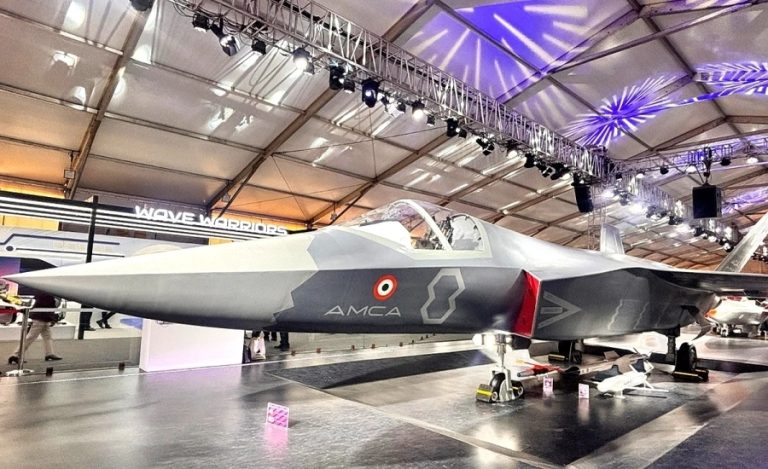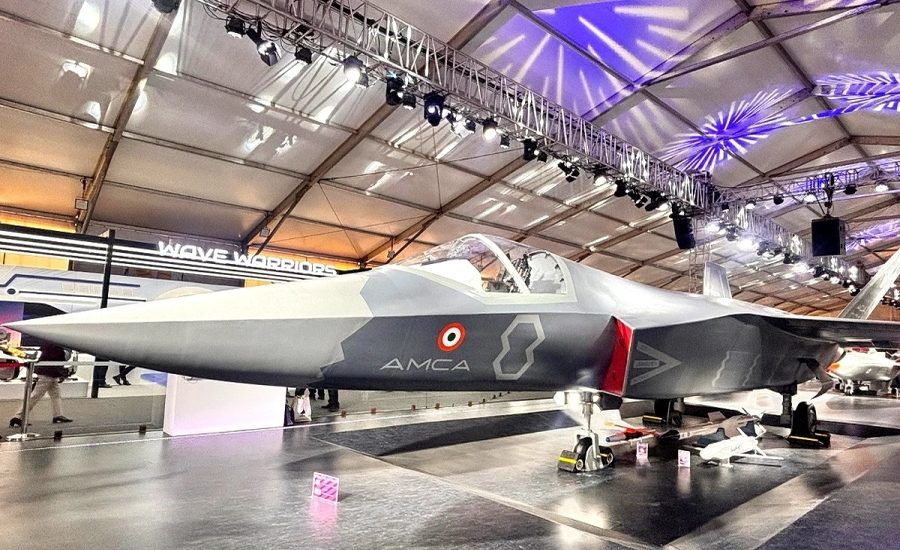
New Delhi: India’s Advanced Medium Combat Aircraft (AMCA) programme has entered an important phase after Hindustan Aeronautics Limited (HAL) failed to qualify for the development and production of India’s indigenous fifth-generation stealth fighter.
Former Indian Air Force (IAF) Chief Air Chief Marshal (Retd.) RKS Bhadauria has offered insights into the reasons behind the decision, pointing towards technical shortcomings among HAL’s consortium partners. The development marks a major shift in India’s fighter aircraft manufacturing industry and creates new opportunities for private defence companies.
Why Did The HAL Consortium Fail To Qualify For The AMCA Stealth Fighter Project
The main reason behind HAL’s disqualification was its failure to meet certain technical requirements during the evaluation process, according to the explanation reported from former IAF Chief RKS Bhadauria.
Read also: India Set To Manufacture Advanced GE F414 Fighter Engines After Key Breakthrough
HAL had participated in the competition as the lead company of a consortium with smaller private-sector partners. However, the technical capabilities of the entire consortium were evaluated rather than HAL’s manufacturing experience alone.
According to Bhadauria’s explanation, HAL’s private partners could not fulfil some of the technical requirements set by the Aeronautical Development Agency (ADA).
This meant that HAL’s long experience in aircraft manufacturing was not enough to secure qualification for the project.
The AMCA programme requires advanced manufacturing capabilities, precision engineering, aircraft systems integration and the ability to support the development and testing of a fifth-generation fighter aircraft.
AMCA Stealth Fighter Project: Defence Secretary Confirms Technical Reasons Behind HAL’s Rejection
The technical reasons behind HAL’s exit also received attention after Defence Secretary R.K. Singh addressed the issue at the NDTV Defence Summit 2026.
He stated that HAL had failed to qualify on certain routine technical grounds that the company was expected to meet.
He also explained that the government wanted to develop another fighter aircraft production line in India instead of depending on a single major manufacturer.
According to him, three bidders successfully met the required qualification standards and moved forward in the selection process. However, the Defence Secretary did not publicly identify the exact technical conditions that HAL failed to satisfy.
This clarification is important because earlier reports had also highlighted HAL’s large order book and financial qualification conditions as possible reasons behind its disqualification.
AMCA Stealth Fighter Project: HAL’s Manufacturing Experience Was Not Enough
Hindustan Aeronautics Limited is one of India’s most experienced aerospace manufacturers.
The company has played a major role in producing and maintaining several military aircraft, helicopters and other aviation platforms.
HAL is also an important manufacturing partner in India’s indigenous Light Combat Aircraft (LCA) Tejas programme.
Its experience includes licensed production of foreign-designed fighter aircraft, indigenous aircraft manufacturing, maintenance and aircraft system integration. However, the AMCA is a much more advanced project that requires specialised technologies and a strong industrial supply chain.
The selection process was designed to identify companies capable of handling the complete development, prototype manufacturing, testing and future production requirements. Therefore, experience in manufacturing existing aircraft alone could not guarantee qualification for the AMCA contract.
HAL’s Large Order Book Also Attracted Attention
Another important issue during the selection process was HAL’s large order book compared with its annual turnover.
According to earlier media reports, HAL had an order book of approximately ₹2.52 lakh crore, while its annual turnover was around ₹30,000 crore.
Reports also highlighted financial evaluation conditions under which companies with an order book exceeding three times their annual turnover could receive lower marks.
This raised questions about whether HAL’s existing workload affected its chances of qualifying. However, Defence Secretary R.K. Singh later described the disqualification as a technical failure.
The distinction is important: the publicly available explanation does not establish HAL’s order book as the final reason for its rejection.
Three Bidders Move Ahead In The AMCA Competition
Following the evaluation of seven applicants, three bidders qualified for the next stage of the AMCA development-cum-production partner selection process. The shortlisted bidders are:
1. Tata Advanced Systems Limited (TASL)
Tata Advanced Systems entered the competition independently. The company has been expanding its aerospace and defence manufacturing capabilities and is seeking a bigger role in India’s advanced fighter aircraft industry.
2. Larsen & Toubro (L&T) Consortium
L&T is leading a consortium involving Bharat Electronics Limited (BEL) and Dynamatic Technologies. The partnership brings together capabilities in engineering, defence electronics and aerospace manufacturing.
3. Bharat Forge Consortium
Bharat Forge is leading another consortium involving Bharat Earth Movers Limited (BEML) and Data Patterns. The group aims to combine heavy engineering, defence manufacturing and advanced electronics capabilities.
These three bidders moved ahead after the qualification process, creating a competitive environment for India’s next-generation fighter aircraft programme.
What Is India’s AMCA Programme
India’s Advanced Medium Combat Aircraft (AMCA) is an indigenous fifth-generation stealth fighter being developed under the Aeronautical Development Agency (ADA), which operates under the Defence Research and Development Organisation (DRDO).
The aircraft is being designed to provide advanced combat capabilities to the Indian Air Force. Its expected capabilities include:
- Stealth technology to reduce radar detection.
- Advanced avionics and electronic warfare systems.
- Internal weapons bays to support stealth operations.
- Advanced sensors and integrated mission systems.
- High-performance engines and modern flight-control technologies.
The government has approved approximately ₹15,000 crore for the AMCA design and prototype development phase.
The programme includes the development of five flying prototypes and one structural test specimen. The aircraft is expected to strengthen India’s ability to design, develop and manufacture advanced combat aircraft within the country.
Government Wants To Build A Second Fighter Aircraft Production Line
HAL’s exclusion from the AMCA competition reflects an important change in India’s defence manufacturing policy. For several decades, HAL has played a central role in manufacturing fighter aircraft for the Indian Air Force. However, the government now wants to increase private-sector participation in major defence programmes.
In May 2025, Defence Minister Rajnath Singh approved the AMCA programme execution model through industry partnerships.
Under this model, both public-sector and private-sector Indian companies received equal opportunities to participate. Companies were allowed to submit bids independently or through joint ventures and consortia.
The main objective is to develop a stronger domestic aerospace industry, increase manufacturing capacity and create an additional fighter aircraft production line. This approach could also help India reduce its dependence on a limited number of defence manufacturers.
Read also: India Set To Manufacture Advanced GE F414 Fighter Engines After Key Breakthrough
FAQs
Three bidders qualified for the next stage: Tata Advanced Systems Limited, the L&T-led consortium involving BEL and Dynamatic Technologies, and the Bharat Forge-led consortium involving BEML and Data Patterns.
HAL failed to meet certain technical qualification requirements as part of its consortium. Former IAF Chief RKS Bhadauria indicated that the company’s private-sector partners could not fulfil specific technical conditions required by the Aeronautical Development Agency.
The Indian government has approved approximately ₹15,000 crore for the AMCA design and prototype development phase. The programme includes five flying prototypes and one structural test specimen.