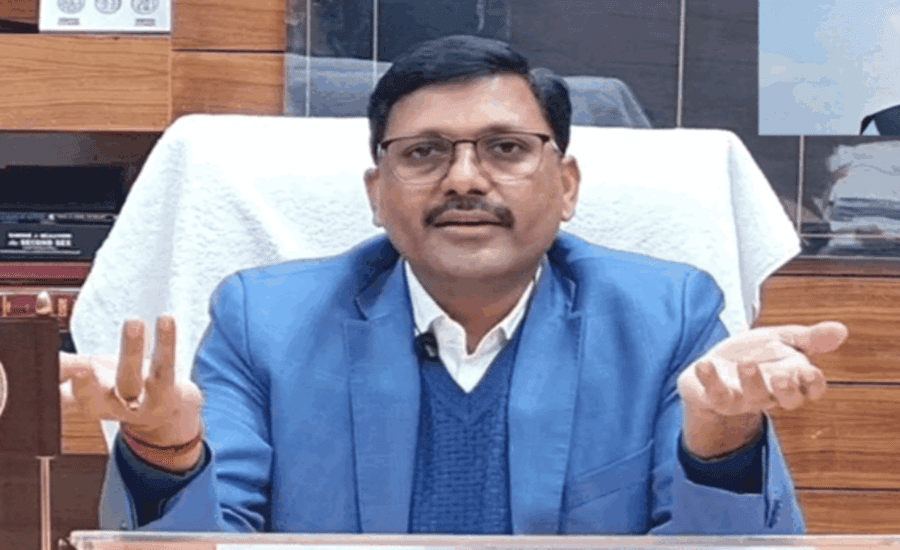
Rampur: A 2024 order of the Moradabad Divisional Commissioner’s Court, issued when IAS officer Anjaneya Kumar Singh was serving as Commissioner, has come under scrutiny over the ownership of government land valued at approximately ₹40 crore in Uttar Pradesh’s Rampur district.
The controversy concerns a 4,355.72-square-metre plot near Sarai Darwaza in Rampur’s Sadar tehsil. The land, recorded in government revenue documents under Khata No. 11 and Gata No. 34/1, was declared to be under the ownership rights of a private businessman, Dr. Mahmood Ali Khan, through an order of the Commissioner’s Court.
The matter resurfaced when the businessman approached the Rampur Collectorate with the court order and sought to have his name entered in the revenue records and on the Bhulekh portal.
However, officials reportedly found that the disputed property was recorded as government land. The administration subsequently halted the mutation process and approached the Commissioner and Secretary of the Uttar Pradesh Board of Revenue for guidance on the legal and administrative steps to be taken.
How Did the Dispute Over Government Land Begin?
According to reports, Dr. Mahmood Ali Khan claimed that he had purchased the disputed property from Wajahat Ali Rizvi on April 6, 2019.
He subsequently attempted to undertake construction on the land, but the district administration reportedly stopped the activity. Following this, he approached the court of the Sub-Divisional Magistrate (SDM), Rampur, seeking recognition as a ‘Sankramaniya Bhumidhar’.
A person recognised as a Sankramaniya Bhumidhar enjoys transferable landholding rights, including the right to sell or transfer the property, subject to applicable legal provisions.
However, the SDM court rejected his petition on January 16, 2024. It maintained that the property belonged to the state government and that the court did not have the jurisdiction to grant the requested ownership status over the disputed land.
Moradabad Commissioner’s Court Reversed the SDM’s Decision
Dissatisfied with the SDM court’s decision, Dr. Mahmood Ali Khan approached the Moradabad Commissioner’s Court.
His appeal reportedly relied on Section 207 of the Uttar Pradesh Revenue Code, 2006, which provides for appeals against specified orders passed by revenue authorities.
The Commissioner’s Court subsequently overturned the SDM’s decision and ruled in favour of the businessman in 2024. It recognised him as a Sankramaniya Bhumidhar, thereby granting him transferable rights over the property.
At the time, IAS officer Anjaneya Kumar Singh was serving as the Moradabad Divisional Commissioner.
The Commissioner’s Court reportedly held that provisions of the Uttar Pradesh Zamindari Abolition and Land Reforms Act, 1950, were applicable to Non-ZA land situated within the municipal limits of Rampur.
Why Is the Land Classification Important?
The disputed property is reportedly recorded under Category 15 of the Non-ZA land classification in the revenue records.
Non-ZA refers to land outside the application of the Uttar Pradesh Zamindari Abolition and Land Reforms framework. The classification and the specific nature of the land are important in determining whether private ownership rights can be recognised.
According to reports, the disputed property was recorded as government land under the description of ‘Shikmi Kashtkar’.
The distinction between different categories of Non-ZA land is particularly significant because the legal provisions applicable to agricultural land cannot automatically be extended to government or public-use land.
The administration’s concern is that a property recorded as government land may have been granted transferable private ownership rights through the Commissioner’s Court order.
Earlier Board of Revenue Decisions Raise Questions
Another aspect of the controversy concerns the legal precedents reportedly relied upon by the Moradabad Commissioner’s Court while deciding the appeal.
The court referred to an earlier matter titled Uttar Pradesh Government vs Akhilesh Kumar, decided by a member of the Board of Revenue in Lucknow.
However, the earlier case reportedly involved Category 5 Non-ZA land, whereas the present dispute concerns Category 15 land.
The distinction is important because the two categories do not necessarily carry the same legal implications.
Reports also refer to a separate order dated June 5, 2023, passed by a member of the Board of Revenue in Prayagraj in the matter of Uttar Pradesh Government vs Jameel Khan.
In that case, the Board reportedly rejected a private individual’s claim concerning Non-ZA land in Rampur.
The earlier proceedings had also examined whether the provisions of the Zamindari Abolition Act could automatically be extended to all categories of land in Uttar Pradesh.
The Board of Revenue reportedly rejected such a broad interpretation, referring to the legal position established by the Supreme Court.
What Does the 2012 Government Order Say?
A government order dated June 15, 2012, has also emerged as an important reference in the dispute.
As reported, the order clarifies that zamindari abolition provisions cannot be extended indiscriminately to urban areas and that urban Non-ZA government or public land cannot simply be converted into private ZA land.
This provision is now relevant to the questions being raised over the legal basis of the Commissioner’s Court’s 2024 decision.
The Rampur administration has sought guidance from the Board of Revenue on how to proceed, given the conflicting interpretations and the government’s recorded ownership of the property.
The final position will depend on the examination of the original revenue records, the court orders and the applicable legal provisions.
Who Is IAS Anjaneya Kumar Singh?
Anjaneya Kumar Singh is a 2005-batch IAS officer of the Sikkim cadre who served in Uttar Pradesh on inter-cadre deputation.
He came to prominence in Uttar Pradesh during his tenure as District Magistrate of Rampur, particularly for the administration’s actions in cases involving Samajwadi Party leader Azam Khan.
Before becoming Moradabad Divisional Commissioner, Singh held several administrative assignments in Uttar Pradesh.
His tenure as Moradabad Commissioner lasted over five years, making it one of the longest tenures in the division.
The present controversy concerns an order issued during his tenure as Commissioner.