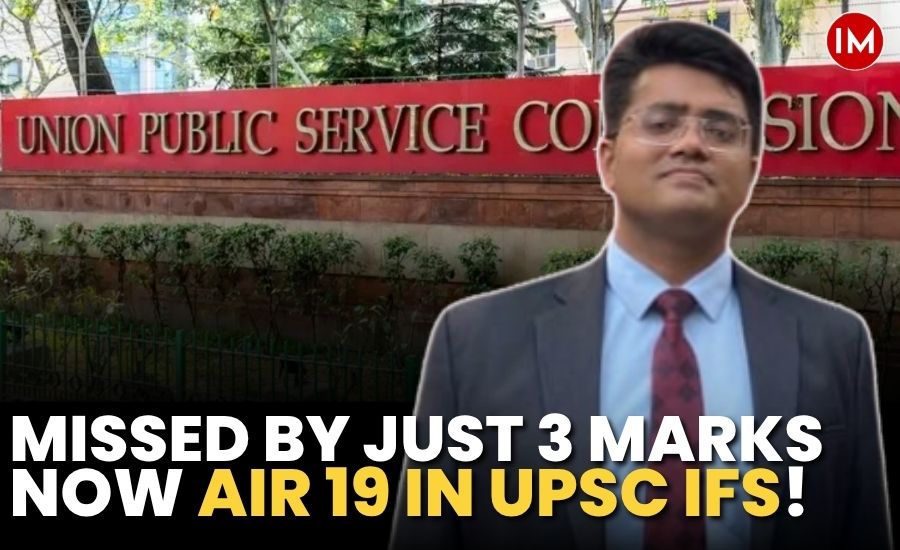
Missing the final selection list by just three marks would have been enough to discourage many aspirants. For Abhay Raghav, however, it became the turning point of his UPSC journey.
The IIT (BHU) Varanasi graduate had already built a promising career as a GPU architect at NVIDIA, one of the world’s leading technology companies. Yet, despite professional success, he found himself searching for a career that offered a stronger connection with people and a greater opportunity to contribute to society. That search eventually led him to the Union Public Service Commission (UPSC).
In his second attempt, Abhay secured All India Rank (AIR) 19 in the UPSC Indian Forest Service (IFS) Examination 2025, proving that one setback can become the foundation for a much bigger achievement when lessons are applied with discipline.
From Bihar to IIT-BHU and NVIDIA
Originally from Supaul, Bihar, Abhay completed his schooling in Gwalior, Madhya Pradesh, before earning a B.Tech. in Electronics Engineering from IIT (BHU), Varanasi.
After graduation, he joined NVIDIA as a GPU architect, where he worked for three years. The role offered exciting technical challenges and career growth, but over time he realised that his long-term aspirations lay elsewhere.
Reflecting on the decision that changed his career, Abhay shared with Indian Masterminds,
“After working for a few years in the tech industry, I wanted something that was more people-facing and had a wider and more direct impact on society and national progress. I explored various options and felt civil services was my calling.”
His family has also been rooted in public service. His father served in the Indian Air Force before retiring and now works with the Central Bank of India, while his mother is a teacher in a state government school. Their commitment to serving the country naturally shaped his outlook.
A Painful Miss That Became His Biggest Lesson
Abhay’s first serious brush with success came a year earlier when he narrowly missed making the final UPSC IFS selection list.
The difference? Just three marks.
Many candidates spend months recovering from such a result. Abhay instead began identifying exactly where he had fallen short.
His optional subject, Geology, had fetched only 196 marks, despite a strong interview score of 210. Rather than blaming the examination or circumstances, he focused on improving the weakest part of his preparation.
That decision would completely change his final outcome.
Treating UPSC Like a Data-Driven Project
One of the most striking aspects of Abhay’s preparation was his scientific approach, especially for the Preliminary Examination.
Having seen seniors struggle despite good preparation, he decided not to leave prelims to chance.
He attempted more than 100 mock tests, but simply solving papers was not enough. After every test, he analysed his mistakes using Excel sheets, tracked recurring errors, and systematically worked on weak areas until his accuracy improved.
The result was remarkable consistency. Throughout his attempts, his preliminary examination scores remained above 120 marks, giving him confidence before moving to the next stage.
For the Mains examination, his strategy revolved around continuous answer writing.
He regularly practised previous years’ questions, prepared concise handwritten notes, studied topper copies for value addition, and wrote numerous mock tests to improve speed, presentation and content.
Instead of collecting excessive study material, he concentrated on revising limited resources repeatedly.
Turning His Weakest Subject into His Strongest
If there was one area that truly changed Abhay’s final rank, it was his optional subject. After scoring 196 in Geology during his earlier attempt, he completely redesigned his preparation.
He enrolled in Planet Geology’s course, strengthened his understanding through standard reference books and Forestudy notes, and prepared concise revision notes for the final phase.
The improvement was dramatic. His optional marks increased from 196 to 276—an 80-mark jump that played a decisive role in securing AIR 19.
An Interview That Didn’t Go as Expected
Ironically, the stage where Abhay felt least confident eventually helped him secure a top rank.
His previous UPSC interview had been cordial and comfortable, earning him 210 marks. This year, however, the experience was completely different.
The interview board asked several unconventional questions and subjected him to intense cross-questioning. Looking back, he admits he walked out believing he had performed poorly.
“This year I was grilled in the interview, and the questions were a bit unorthodox as well. Although I defended my views, I felt I had done poorly and thought it might cost me this attempt.”
When the marks were declared, he was pleasantly surprised. Despite his doubts, he scored 200 marks, enough to comfortably secure a place in the final merit list.
His experience serves as an important reminder that candidates often judge their interviews far more harshly than the board does.
Simple Habits That Helped Him Stay Consistent
UPSC preparation often stretches across several years, making consistency one of the biggest challenges.
For Abhay, two simple habits made a significant difference.
The first was journalling, which helped him monitor his daily progress, identify areas requiring improvement and remain accountable to himself.
The second was jogging, which helped him maintain his physical fitness and keep his mind fresh during long periods of preparation.
These routines provided structure to an otherwise demanding preparation schedule.
A Family’s Happiness Became His Greatest Reward
When the UPSC IFS 2025 results were announced, the achievement belonged not only to Abhay but also to his parents.
Recalling that moment, he says, “My parents were very happy, and seeing them happy, I was very happy as well.”
Sometimes, years of preparation are best measured not by marks or ranks but by the smiles they bring to those who stood beside the candidate.
His Message for UPSC Aspirants
Abhay believes that UPSC preparation demands honesty, consistency and constant self-evaluation.
Instead of expecting overnight improvement, candidates should focus on identifying weaknesses and improving them step by step.
Sharing his advice, he says,
“UPSC is brutal and ruthless, but if one can remain consistent, keep making small improvements, and address deficiencies, there is light at the end of the tunnel.”
His own journey reflects this philosophy.
A candidate who once missed the final list by just three marks returned with better planning, improved execution and a stronger optional strategy. The result was AIR 19 in one of India’s toughest examinations.
For thousands of UPSC aspirants, Abhay Raghav’s story carries a simple but powerful lesson: success is rarely about avoiding failure. More often, it comes from understanding exactly why you fell short and ensuring you do not repeat the same mistakes.