New Delhi: The Coal Controller Organisation (CCO), under the Ministry of Coal, Government of India, has developed SUVIKALP – Mine Repurposing Tool, a digital decision-support platform aimed at transforming closed and abandoned coal and lignite mines into productive assets.
Aligned with the Mining Plan Guidelines for Coal and Lignite Mine, 2025, the platform seeks to establish a scientific, transparent and standardised framework for identifying suitable land-use opportunities after mining operations come to an end.
The initiative recognises that the responsibility towards mining regions does not end with the completion of extraction activities. Effective mine closure requires environmental restoration, productive utilisation of post-mining land and sustainable socio-economic development of local communities.
SUVIKALP addresses these requirements by bringing together technical assessments, environmental considerations, financial factors and community priorities within a single digital platform.
SUVIKALP: A Scientific and Data-Driven Approach to Mine Repurposing
The SUVIKALP platform has been designed to overcome challenges associated with fragmented assessments, independent evaluation of multiple parameters and limited consideration of community priorities in conventional mine repurposing decisions.
It integrates several factors, including:
- Geo-mining characteristics of individual mine sites.
- Environmental conditions and ecological considerations.
- Availability of infrastructure and resources.
- Financial and economic feasibility.
- Socio-economic factors and community requirements.
Users can create a comprehensive profile of a particular mine by entering relevant site-specific information. Based on these details, the platform evaluates potential repurposing opportunities against the characteristics, suitability and limitations of the selected site.
This approach enables mine owners, project proponents and government agencies to identify suitable redevelopment options through systematic and evidence-based assessments.
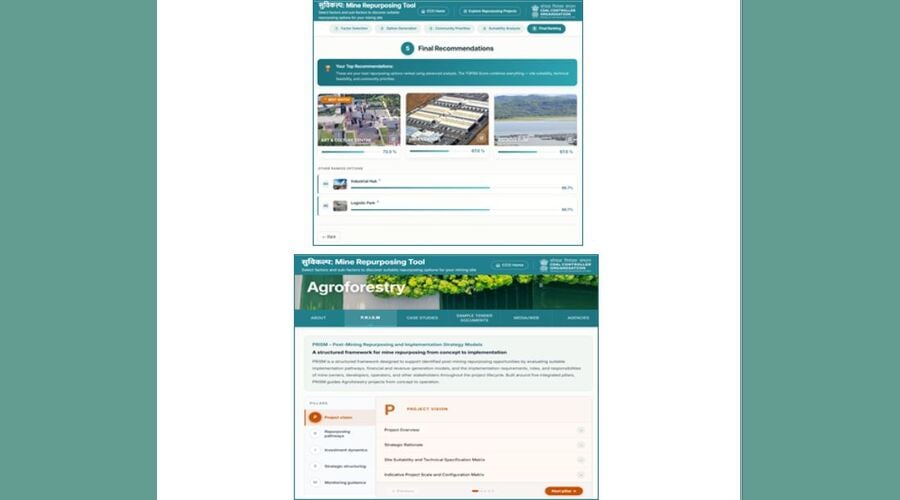
TOPSIS Methodology to Evaluate and Rank Mine Repurposing Options
A key feature of SUVIKALP is its use of the Multi-Criteria Decision-Making (MCDM) methodology, based on TOPSIS (Technique for Order Preference by Similarity to Ideal Solution).
The methodology evaluates and ranks different mine repurposing alternatives by comparing them against multiple parameters. It helps identify options that offer the most suitable combination of technical, environmental, financial and socio-economic factors.
The assessment follows a structured process involving:
- Selection of relevant assessment factors.
- Generation of potential mine repurposing options.
- Integration of community priorities.
- Assessment of the suitability of different alternatives.
- Final evaluation and ranking of potential projects.
Through this process, SUVIKALP provides transparent, consistent and evidence-based recommendations, reducing dependence on subjective assessments.
RECLAIM Framework to Integrate Community Priorities
Recognising the importance of local participation in post-mining development, SUVIKALP incorporates RECLAIM – Community Engagement and Development Framework.
The framework ensures that the preferences and development priorities of communities living in mining regions are considered alongside technical feasibility, environmental suitability and economic viability.
It facilitates the identification of projects that can support:
- Employment generation and livelihood opportunities.
- Local infrastructure development.
- Community welfare and regional growth.
- Sustainable economic activities.
- Long-term benefits for people living in mining areas.
By integrating community perspectives into the decision-making process, RECLAIM promotes participatory mine repurposing and strengthens the connection between mine closure and inclusive regional development.
PRISM Model to Support Project Planning and Implementation
Another important component of SUVIKALP is PRISM (Post-Mining Repurposing Implementation Strategic Model), which extends the platform beyond identifying and ranking potential projects.
PRISM provides a structured framework to explore practical implementation pathways for selected mine repurposing opportunities.
It covers key aspects such as project vision, repurposing strategies, investment dynamics, strategic structuring and monitoring.
The model is supported by an integrated knowledge repository containing:
- Project concept notes.
- National and international case studies.
- Sample tender documents.
- Information on implementation agencies.
- Best-practice resources for project development.
This knowledge repository will help stakeholders understand the practical requirements of project planning and execution. It will also facilitate knowledge sharing and support informed decision-making during the implementation of mine repurposing initiatives.
SUVIKALP: Key Priorities for Wider Adoption and Implementation
The next phase of SUVIKALP will focus on expanding its adoption and strengthening the transition from project recommendations to actual implementation.
The major priorities include:
1. Wider Adoption: Expanding the use of SUVIKALP across closed and abandoned coal and lignite mines.
2. Project Development: Converting platform recommendations into site-specific feasibility studies, project concept notes and Detailed Project Reports (DPRs).
3. Institutional Convergence: Strengthening coordination among government departments, industry stakeholders, experts and implementation agencies.
4. Investment Mobilisation: Exploring funding opportunities, partnerships and investment avenues for viable mine repurposing projects.
5. Knowledge and Capacity Building: Sharing best practices and strengthening the capabilities of stakeholders involved in post-mining development.
6. Monitoring and Evaluation: Tracking project implementation and assessing environmental, economic and community-level benefits.
SUVIKALP Aims to Build a Sustainable Post-Mining Future
SUVIKALP represents a step towards institutionalising scientific, transparent and participatory decision-making in mine repurposing.
By integrating technical assessments, community priorities, objective project ranking and implementation guidance within a single digital ecosystem, the platform provides a structured foundation for sustainable post-mining land-use planning.
Its long-term vision is to evolve into a scalable national knowledge and decision-support ecosystem that can be adapted to different mining conditions and regional development priorities.
The success of the initiative will ultimately depend not only on identifying suitable projects but also on their effective implementation and the long-term benefits they deliver to mining communities.
Through SUVIKALP, the Ministry of Coal aims to turn the legacy of mining into an opportunity for environmental restoration, economic diversification, productive land utilisation and sustainable regional development.
Read also: Coal India Turns 51 with a Triple Record: October Production Hits 67.2 MT, Supply Crosses 70 MT