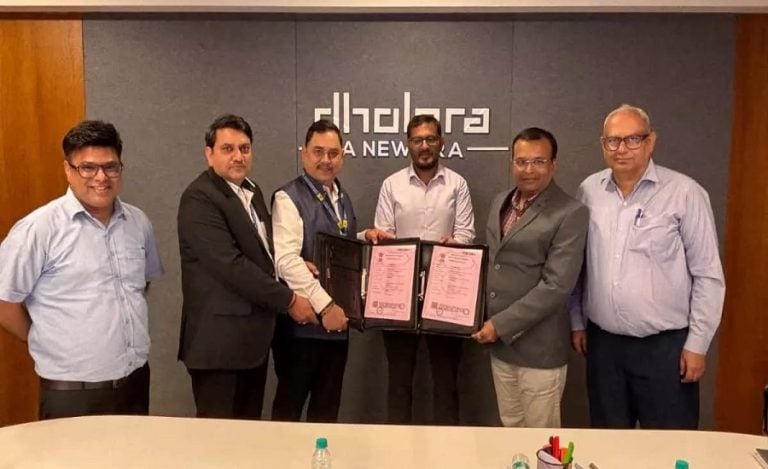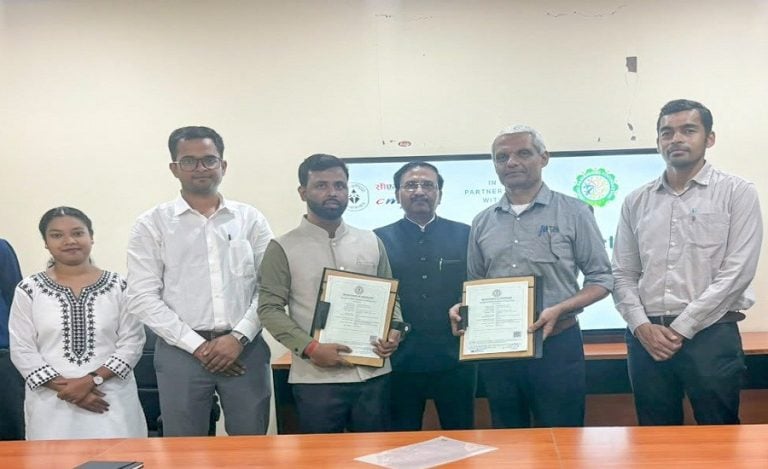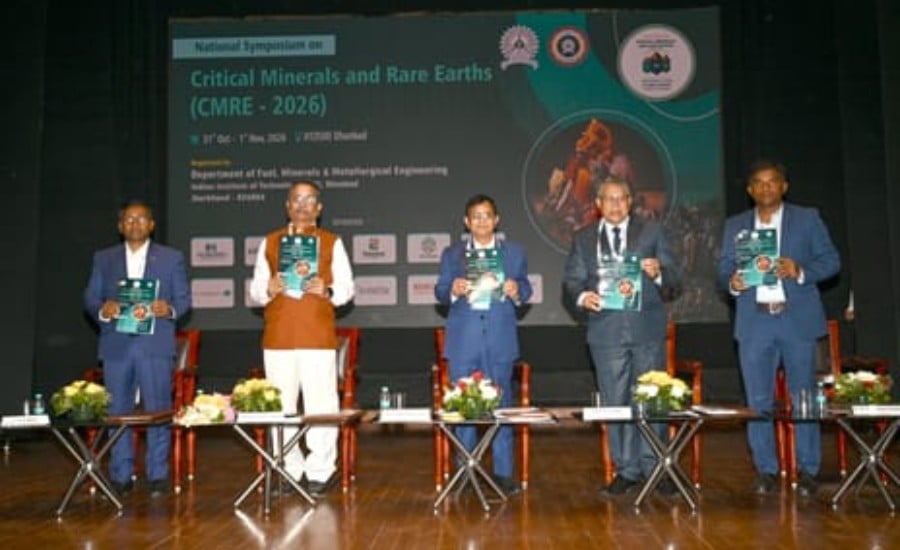
New Delhi: NITI Aayog and TEXMiN, the Technology Translation Research Park at IIT (ISM) Dhanbad, have signed a Joint Statement of Intent (SoI) to strengthen India’s critical and strategic minerals ecosystem through research collaboration, indigenous technology development and policy support.
The collaboration seeks to build resilient and sustainable critical mineral value chains, reduce technological dependence and strengthen India’s capabilities in a sector considered important for national security and the country’s long-term development goals.
The agreement aligns with the objectives of the National Critical Mineral Mission (NCMM) and the vision of an Aatmanirbhar and Viksit Bharat.
NITI Aayog Member Highlights Strategic Importance of Critical Minerals
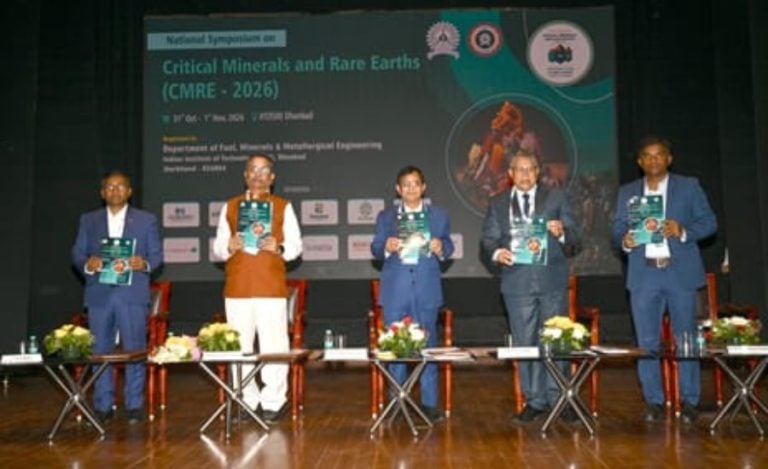
The Joint Statement of Intent was signed during the visit of NITI Aayog Member Professor Gobardhan Das to IIT (ISM) Dhanbad.
On October 31, Das inaugurated the National Symposium on Critical Minerals and Rare Earths (CMRE 2026), organised as part of the 45th Annual National Conference of the Indian Council of Chemists.
Read Also: NITI Aayog’s Rajiv Gauba Calls for Risk-Based, Light-Touch Regulation to Support Innovation
Addressing the symposium, he highlighted the growing importance of critical minerals for:
- National security: Ensuring access to minerals essential for strategic industries and infrastructure.
- Technological self-reliance: Developing domestic capabilities in advanced technologies and materials.
- Industrial development: Supporting sectors that depend on critical mineral inputs.
- Viksit Bharat 2047: Strengthening India’s capacity to develop and manufacture advanced technologies.
Drawing on India’s metallurgical heritage, Das emphasised the need to combine scientific research, innovation and industry participation to develop indigenous technological capabilities.
Four Key Areas of NITI Aayog–TEXMiN Collaboration
The Joint Statement of Intent identifies four broad areas in which the two institutions will work together:
- Collaborative research and technology development: Promoting joint research initiatives and developing indigenous technologies for the critical minerals sector.
- Technical and strategic studies: Undertaking studies to identify technological requirements, sectoral challenges and opportunities.
- Policy and institutional support: Strengthening policy frameworks and institutional coordination to support the development of the critical minerals ecosystem.
- Capacity building and knowledge exchange: Facilitating the exchange of expertise and strengthening technical capabilities among stakeholders.
The partnership is also expected to improve coordination between government bodies, universities, research institutions and industry.
Focus Shifts from Mining to the Entire Critical Mineral Value Chain
A key point highlighted by Professor Das was the need to move beyond a mine-centric approach to critical minerals.
He called for an integrated value chain covering the entire process, including:
- Mineral exploration and identification.
- Extraction and processing.
- Refining and material development.
- Production of advanced materials.
- Recycling and recovery from secondary resources.
This approach is intended to strengthen domestic capabilities at different stages of the mineral supply chain rather than focusing only on the extraction of raw materials.
Coal Fly Ash, Red Mud and E-Waste Identified as Secondary Mineral Sources
Professor Das also highlighted the potential of recovering critical minerals from materials generated through industrial and mining activities.
The secondary resources identified during the discussion included:
- Coal fly ash: A by-product of coal-based power generation that may contain recoverable mineral resources.
- Red mud: A residue generated during alumina production.
- Mine tailings: Materials left behind after the extraction and processing of ores.
- Electronic waste: Discarded electronic equipment that can contain recoverable metals and other valuable materials.
Recovering minerals from these sources could support resource efficiency, reduce waste and contribute to more sustainable mineral utilisation.
Das stressed that research outcomes must be translated into commercially viable technologies to ensure that scientific advances can be applied at the industrial level.
TEXMiN to Support Technology Translation and Industry Collaboration
TEXMiN operates as a Technology Translation Research Park at the Indian Institute of Technology (Indian School of Mines), Dhanbad, under an initiative of the Department of Science and Technology (DST).
The collaboration with NITI Aayog is intended to strengthen the link between research and practical applications in the critical minerals sector.
By combining policy-level engagement with research and technological expertise, the partnership aims to facilitate the development of domestic solutions and improve cooperation among academic institutions, government agencies and industry stakeholders.
Critical Minerals and India’s Self-Reliance Goals
Critical minerals and rare earth elements are important inputs for several advanced industrial and technological applications. Their availability, processing and supply-chain security have therefore become important considerations for countries seeking to strengthen domestic manufacturing and technological capabilities.
Through the NITI Aayog–TEXMiN partnership, India is seeking to strengthen research, innovation and technology translation across the critical minerals value chain.
The initiative is expected to support the broader objectives of the National Critical Mineral Mission and contribute to building more resilient supply chains as India works towards its Viksit Bharat 2047 vision.
Read Also: OMC Signs MoU With AMD to Explore Critical Minerals in Odisha, Boost Domestic Mineral Security