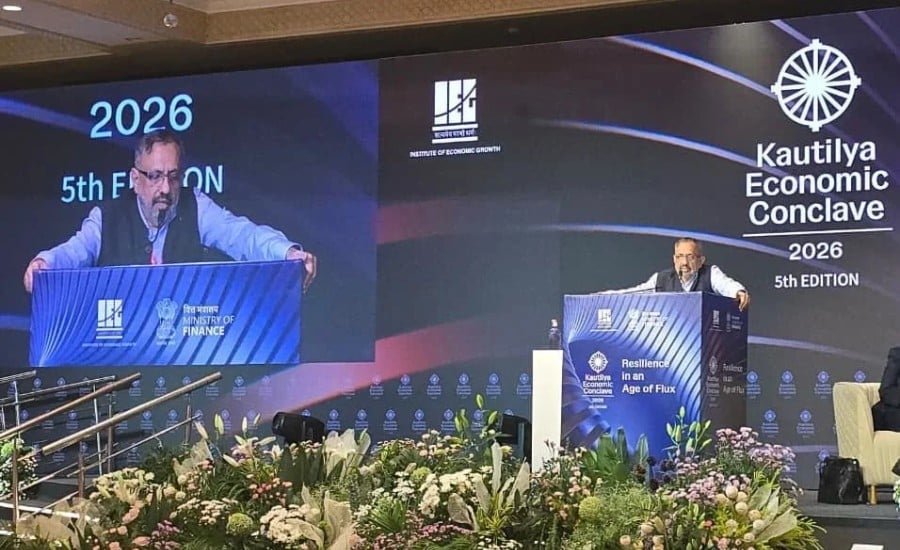
New Delhi: NITI Aayog Member Rajiv Gauba, a 1982-batch IAS officer of the Jharkhand cadre, called for a shift towards light-touch and risk-proportionate regulation to balance regulatory oversight with innovation, competition and investment.
Gauba made the remarks while addressing a plenary session on “Regulatory Oversight in an Age of Disruption” at the 5th Kautilya Economic Conclave.
Gauba Calls for Regulation Calibrated to Risk
Gauba said policymakers should focus on developing regulations that manage risks without unnecessarily restricting innovation, competition and investment.
He pointed to geopolitical uncertainty, disruptions to trade routes and global supply chains, as well as the growing use of tariffs, export controls and investment restrictions as strategic tools.
He also highlighted the pace of technological change, particularly in artificial intelligence, cybersecurity and digital technologies, which he said was advancing faster than some institutional and regulatory frameworks could adapt.
Calls for Clearer and More Predictable Regulatory Environment
Gauba said regulation remains important for safety, consumer protection, market integrity and systemic stability. At the same time, he cautioned against excessive or poorly designed regulation that could affect innovation, competition and investment.
He said national competitiveness also depends on the clarity, consistency and predictability of the regulatory environment, particularly for businesses making investment and expansion decisions.
He stressed that regulatory requirements should be calibrated according to the nature and consequences of the risks involved.
Regulatory Independence Must Come With Accountability
Gauba said regulatory independence should be accompanied by accountability. While regulators require autonomy to take decisions without undue influence, he said public confidence requires transparent decision-making, clear procedures, effective review mechanisms and accountability for regulatory performance.
He also highlighted the need to strengthen the capacity of the State as markets and technologies become more complex.
Greater Coordination, Specialised Expertise Needed
Gauba called for greater investment in regulatory capabilities, including specialised expertise, analytical capacity and skilled personnel.
He also stressed the importance of structured engagement between regulators, industry, academia and technology institutions.
Greater coordination among regulators, he said, would help address overlapping mandates, reduce duplication and close regulatory gaps as businesses increasingly operate across traditional regulatory boundaries.
‘Firm Where Risks Are High, Light-Touch Where Risks Are Low’
Gauba said the regulatory approach should be “firm where risks are high, and light-touch where risks are low”, while remaining predictable in both situations.
Linking the approach to India’s growth objectives, he said sustaining the high growth required for Viksit Bharat by 2047 would require a shift towards light-touch regulation.
He also linked the approach to Prime Minister Narendra Modi’s stated governance philosophy of Trust Based Governance or Jan Vishwas.
Read Also: From Budgets to Outcomes: NITI Aayog Pushes SDG Budgeting Across States