Climate change is no longer a distant environmental concern. It is already reshaping India’s oceans in ways that scientists can measure, and coastal communities are beginning to experience it.
Rising sea surface temperatures, ocean acidification, declining oxygen levels and changing ocean currents are transforming marine ecosystems across the Arabian Sea and the Bay of Bengal.
As waters warm, fish and plankton are moving towards cooler regions, disrupting food chains that have existed for centuries. Marine heatwaves are becoming more frequent, cyclones are growing more intense, and habitats that support countless species are under increasing pressure.
Among the animals most affected by these changes are whales. These ocean giants depend on predictable migration routes, healthy feeding grounds and stable ocean conditions. But climate change is altering all three.
As prey species shift their distribution, whales are forced to travel farther in search of food. Changing ocean currents, stronger storms, underwater noise from ships and habitat degradation further increase stress and disorientation.
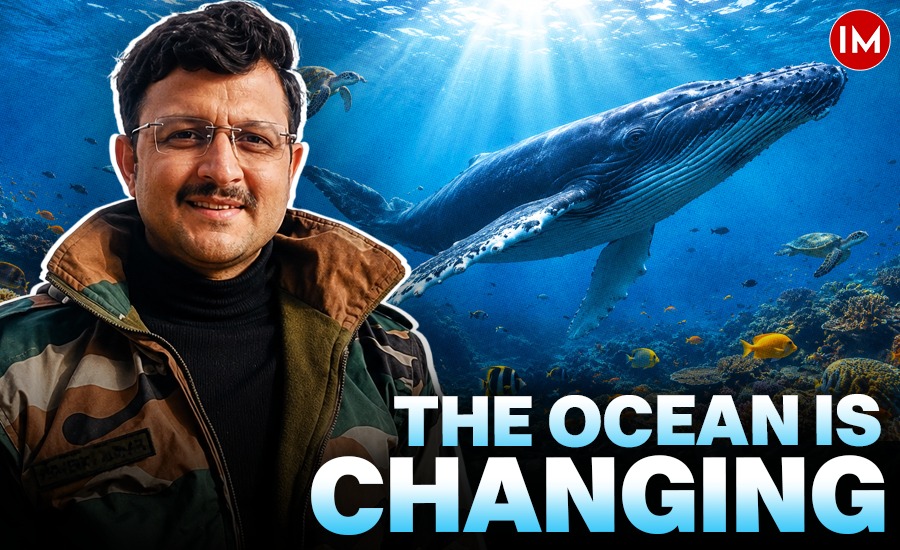
In a conversation with Indian Masterminds, IDAS officer Himanshu Tembhekar (2024 batch) Assistant Controller of Defence Accounts PAO Nashik said that these changes are making incidents such as whale strandings more common and more concerning.
“Climate change is significantly influencing whale migration by altering ocean temperatures, prey availability and oceanic current systems. These stresses, combined with increased shipping traffic, fishing gear entanglement and coastal development, raise the likelihood of strandings.”
The recent death of a 26-foot baby humpback whale on Mumbai’s Bandra coastline has become one such reminder that the health of marine life is closely linked to the health of our oceans.
The Mumbai Humpback Whale Incident
On the morning of 27 June 2026, workers engaged in the Bandra-Versova Sea Link project noticed a young humpback whale stranded near Carter Road Promenade in Mumbai.
Soon, forest officials, wildlife veterinarians, local fishermen, the Brihanmumbai Municipal Corporation and the Mumbai Fire Brigade reached the site. Rescue teams worked for hours, trying to guide the exhausted calf back into deeper waters. Despite their efforts, the whale remained weak and immobile before eventually dying.
While every stranding has its own causes, experts say such incidents often reflect multiple environmental pressures rather than a single reason.
Why This Incident Matters
Whales are often described as indicators of ocean health. Their survival depends on balanced marine ecosystems. When whales begin facing unusual stress, scientists view it as an indication that the ocean itself is under stress.
As Himanshu Tembhekar explains:
“Large-scale strandings serve as ecological indicators, much like the ‘canary in the coal mine’. They indicate that marine ecosystems are under mounting stress from climate change, pollution, overfishing, underwater noise and habitat degradation.”
He adds that protecting whales is not only about saving one species.
“Ocean health is closely linked to climate stability, biodiversity, food security and the livelihoods of millions of coastal communities.”
Understanding Whales
Whales have lived in Earth’s oceans for nearly 50 million years. Although they spend their entire lives in water, they are mammals just like humans.
They breathe through lungs using blowholes instead of gills, give birth to live young, feed their calves with milk and maintain a constant body temperature.
Scientists have identified nearly 90 species of whales, dolphins and porpoises worldwide.
Broadly, whales fall into two major categories:
Baleen whales include species such as the blue whale and humpback whale. Instead of teeth, they possess baleen plates that filter tiny organisms like krill and plankton from seawater.
Toothed whales include species such as the sperm whale, which rely on echolocation to navigate and hunt prey in deep waters.
India’s coastline supports several whale species, including humpback whales, blue whales and sperm whales, particularly across the Arabian Sea and the Bay of Bengal.
Among them, humpback whales are especially famous for their haunting songs. Male humpbacks produce long, complex vocalisations lasting between 10 and 30 minutes, sometimes repeating the same sequence for hours. Scientists believe these songs play an important role during breeding seasons and social communication.
Why Do Whales Wash Ashore?
Whale strandings have fascinated and puzzled scientists for decades. There is rarely one single reason.
One common cause is separation from the mother, particularly in the case of calves that may become exhausted before learning essential survival skills.
Illness, infections or physical weakness can leave whales unable to swim effectively, causing currents to push them towards shallow waters.
Disorientation also plays a major role. Whales depend on underwater sound, Earth’s magnetic field and ocean currents to navigate across thousands of kilometres. Disturbances in any of these systems may lead them off course.
Human activities further complicate the situation. Loud underwater noise from ships, offshore construction and seismic surveys can interfere with whale communication and navigation.
Climate change adds another layer of pressure by changing food availability and migration routes.
Finally, expanding coastal infrastructure increases interactions between whales and human activities, especially near busy shipping corridors.
Climate Change Is Changing Whale Migration
Migration is central to whale survival. Every year, whales travel thousands of kilometres between feeding and breeding grounds.
But warming oceans are changing where food is available.
Krill, plankton and small fish are shifting towards cooler waters, forcing whales to alter traditional migration routes. These longer journeys require more energy and expose whales to unfamiliar environments, busy shipping lanes and fishing activities.
As Himanshu Tembhekar explains:
“Climate change is fundamentally altering India’s marine ecosystems by increasing sea surface temperatures, causing ocean acidification, reducing dissolved oxygen levels and changing ocean currents. Fish and plankton are shifting towards cooler waters, disrupting food chains and affecting fisheries.”
Such changes affect not only whales but the entire marine ecosystem.
What Can India Do?
Protecting marine ecosystems requires action at multiple levels.
Experts recommend expanding Marine Protected Areas to safeguard biodiversity hotspots while restoring mangroves, coral reefs, seagrass meadows and coastal wetlands that naturally protect coastlines.
India also needs a dedicated national marine mammal stranding response network supported by satellite monitoring, drones and rapid-response rescue teams across coastal states.
Reducing plastic pollution, untreated sewage and industrial discharge remains equally important. Sustainable fishing practices, safer fishing gear and better regulation of underwater noise can reduce accidental harm to marine mammals.
Research into whale migration patterns, stronger enforcement of Coastal Regulation Zone (CRZ) rules and greater collaboration between scientists, government agencies, NGOs and coastal communities can further strengthen conservation efforts.
What Could India’s Oceans Look Like by 2056?
If present climate trends continue, scientists warn that India’s oceans could become warmer, more acidic and less productive over the next three decades.
This would affect fisheries, tourism, marine biodiversity, food security and the livelihoods of millions who depend on the sea.
For Himanshu Tembhekar, preparing for that future means acting today.
“India should expand Marine Protected Areas, restore mangroves, coral reefs and seagrass meadows, establish a national marine mammal stranding response network, strengthen ocean monitoring, reduce pollution and integrate marine conservation into India’s Blue Economy and climate policies.”
A Message From the Ocean
The death of the young humpback whale in Mumbai was more than an isolated wildlife incident. It reflected larger changes taking place beneath the ocean’s surface.
Every stranded whale tells a story about changing seas, disturbed habitats and increasing pressure on marine life. Whether caused by climate change, pollution, coastal development or human activity, these incidents remind us that ocean ecosystems are becoming increasingly fragile.
An ancient Sanskrit saying captures this relationship simply:
“सागरः सर्वजीवनस्य आधारः।”
“The ocean is the foundation of all life.”
Protecting whales therefore goes beyond conserving a single species. It means protecting the oceans that regulate Earth’s climate, support biodiversity and sustain millions of people. The message washing ashore on Mumbai’s coastline is one India—and the world—cannot afford to ignore.
Read Also: How Trust, Teamwork and Persistence Helped Two Friends Crack UPSC IFS 2025