There is a famous saying: Shoot for the moon. Even if you miss, you will land among the stars.
But what happens when someone spends nearly a decade chasing one dream, gives it everything, clears multiple stages, reaches the interview room three times, yet still does not find her name in the final selection list? Does the story end there? Perhaps not.
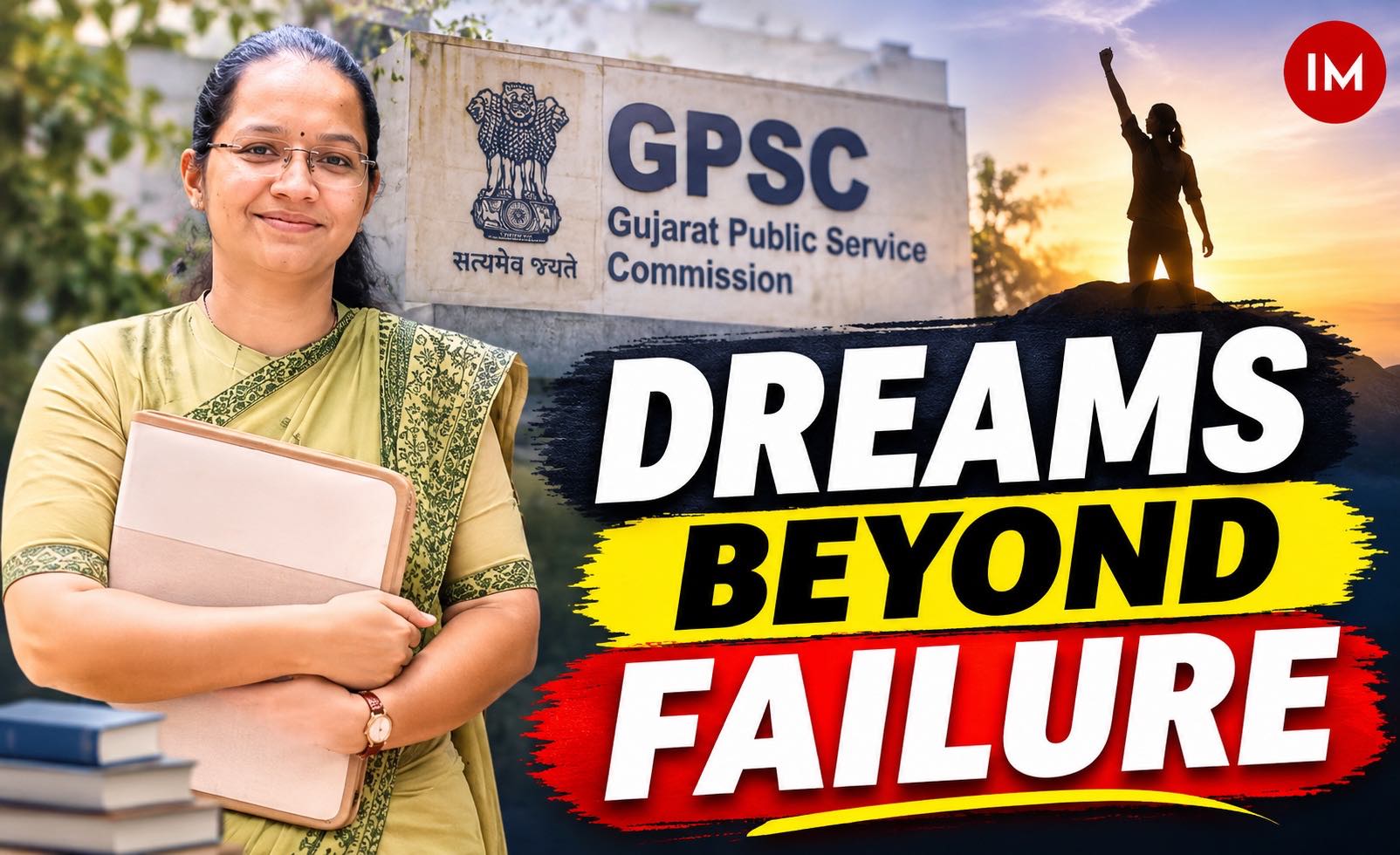
The story of Kailash Rajgor from Gujarat is a reminder that life is much bigger than a single examination, a rank or a result. Growing up in a society where girls often have to negotiate with restrictions, expectations and invisible boundaries, she dared to imagine a future beyond the limits set for her. From 2018 to 2026, she devoted eight-and-a-half years to her dream of becoming a Gujarat Public Service Commission (GPSC) officer. Six attempts, five Mains examinations and three interviews later, she secured the 47th position, but her name still did not appear among the selected candidates.
For many, this might sound like the end of a long and exhausting journey. But for Kailash, it is much more than an examination result. Before dreaming of becoming an officer, she had to fight for the opportunity to study. She had to convince her family, continue her education after marriage, manage motherhood alongside examinations, overcome financial difficulties and step outside the social boundaries that had shaped her upbringing.
She was not someone who had the privilege of uninterrupted preparation, expensive coaching or an environment where pursuing higher education was considered natural for girls. Every step came with a challenge, and every examination demanded sacrifices.
Yet, she kept going.
And even after giving eight-and-a-half years to one dream, she refuses to define her life by an unsuccessful result. She already serves in the Gujarat government as an Assistant BDO and has not completely closed the door on another attempt.
Speaking with Indian Masterminds, Kailash shared a journey that is not simply about an examination she could not clear. It is about a woman who refused to let circumstances decide how far she could dream, who kept going despite repeated disappointments, and who discovered that an unsuccessful result does not make an unsuccessful life.
Because sometimes, the greatest achievement is not reaching the destination, but having the courage to walk a path that society never imagined you could take.
As she expressed through an emotional message after the result: “Life does not come to an end just because some dreams have died.”
Her Background: A Girl Who Had to Fight for Education
Kailash belongs to Gujarat’s Banaskantha region, and her childhood was largely spent in Janur village of Bharuch district. She is the eldest among seven siblings – six brothers and one sister. Her father was engaged in catering work, and the family did not have a strong financial background.
Coming from a conservative social environment, education for girls was not always encouraged. In her village, opportunities for girls to continue studying were limited, and going outside the village for education was itself a major challenge.
Kailash was academically inclined from an early age. She was particularly interested in general knowledge, debates and speech competitions. She recalled participating in several competitions and winning debates. Her team also won the Quality Circle of India competition twice at the national level.
However, her enthusiasm for education did not mean that the path was easy.
She passed Class 10 in 2012 and Class 12 in 2014. Since there were no suitable higher secondary options in her village initially, her parents were reluctant to send her elsewhere. Girls going outside for education was not considered easy in the social environment she came from.
Fortunately, an Arts and Commerce school eventually opened in the village. Kailash insisted that she wanted to continue studying. Her teachers encouraged her to complete her education, and she chose the Arts stream.
But just after completing Class 12, another major change came into her life.
She got married in 2014.
Marriage, Motherhood and the Fight to Continue Studying
For many girls in conservative families, marriage often marks the end of their educational ambitions. Kailash, too, entered a new phase of life with responsibilities that made continuing her studies difficult.
In 2015, she gave birth to a daughter and had to take a break from education.
She belonged to a conservative family where the tradition of wearing a veil or ghoonghat was still prevalent. Even stepping outside the house as a woman could become difficult.
But her desire to study remained alive.
Kailash credits her husband for supporting her educational aspirations. After the birth of their daughter, he encouraged her to continue her studies, and she eventually resumed her education in 2016, pursuing a BA in English.
Her college years were far from ordinary. She could not attend classes regularly because of family responsibilities and practical difficulties. She often studied from home and travelled to college mainly for examinations.
She even had to wear a saree to college because of the expectations and restrictions within her family environment.
But perhaps the most difficult moments came when motherhood and examinations collided.
Recalling one such incident, Kailash told Indian Masterminds that her daughter was just 11 months old when she developed severe diarrhoea during her second-semester final examinations.
Her daughter had to be admitted to a hospital near the college. Kailash was torn between her responsibility as a mother and her determination to complete her education.
She had three examination papers remaining.
Her husband stayed at the hospital with their daughter and encouraged her to go and write the examinations. Kailash went to the examination hall, often in tears, knowing that her little child was unwell and admitted to the hospital.
She completed all three papers and then returned to the hospital, where she stayed with her daughter.
Despite the circumstances, she managed to secure a distinction.
There were other difficult occasions too. She recalled travelling long distances by bus to appear for examinations, sometimes while unwell herself. On one occasion, her health deteriorated so badly that she could barely write properly and had to request the college authorities to allow her to write a shorter paper during an internal examination.
“College was not easy for me. For three years, I struggled a lot. There were so many times when I felt that I should leave my studies, but I did not want to give up,” she recalled.
For someone who later spent years preparing for competitive examinations, those college years were perhaps her first major lesson in perseverance.
Journey So Far: How a Newspaper Story Changed Her Dreams
After completing her graduation in 2018, Kailash began thinking seriously about competitive examinations.
Her interest in general knowledge, public speaking and social issues had already developed during her school and college years. She wanted to do something beyond the conventional expectations placed on women in her surroundings.
A newspaper interview of 2018 batch IAS officer of Kerala cadre, Ms Anu Kumari, who had cleared the UPSC Civil Services Examination while raising a young child, became an important turning point.
Kailash found similarities between Anu Kumari’s circumstances and her own. She, too, had a young daughter and was trying to balance family responsibilities with her ambitions.
She shared the story with her husband and asked him a simple question: If another woman could overcome such challenges, why couldn’t she?
Her husband supported her decision.
However, preparing for GPSC required her to move to Gandhinagar for coaching. This was not a small decision. She had a young daughter, family responsibilities and very limited financial resources.
Her family did not have the money to comfortably afford coaching, accommodation and living expenses in another city. Her husband was engaged in a small catering business, and they had no substantial financial backing.
Eventually, they took a loan of around Rs 1.5–2 lakh to support her preparation.
Her parents also stepped in. They agreed to take care of her daughter so that Kailash could concentrate on her studies.
For nearly ten months, the family was physically separated across Gujarat. Her daughter stayed with her maternal grandparents in Bharuch, her husband remained in another part of the state, and Kailash moved to Gandhinagar for coaching.
It was a difficult emotional and practical adjustment.
She came from a rural background and had rarely travelled outside her village. Suddenly, she found herself in Gandhinagar, surrounded by hundreds of competitive examination aspirants, unfamiliar academic competition and an entirely different environment.
For the first month, she even questioned whether she had made the right decision.
But she gradually adapted.
“I was good at studying. Even today, if someone asks me to study for 12 hours, I can do it. I have worked hard since my school days. So, gradually, I settled down and started preparing seriously,” she said.
She began her GPSC preparation in May 2018, immediately after completing her college examinations, and appeared for her first attempt in October that year.
She cleared the preliminary examination.
That first result gave her confidence that her dream was achievable.
Six Attempts, Five Mains and Three Interviews
Kailash’s GPSC journey between 2018 and 2026 was marked by repeated near-misses, but also by an extraordinary ability to return to preparation after every disappointment.
Her first attempt in 2018 brought encouraging results. Alongside GPSC, she also appeared for other Gujarat government recruitment examinations and cleared multiple examinations.
She secured opportunities in different government services, including the recruitment process for the Assistant BDO position and an Anganwadi-related post.
Eventually, she joined government service as an Assistant BDO.
However, her larger ambition of becoming a GPSC Class-I officer remained alive.
Her first GPSC Mains examination was particularly challenging because she did not have proper guidance for the written examination. She had already cleared another recruitment examination and was also dealing with her job joining and posting.
She prepared largely on her own.
The result was heartbreaking. She missed the interview stage by just eight marks.
In 2019, she attempted the examination again while managing her government job.
Her posting was in Junagadh, nearly 500 kilometres away from her home region. The geographical distance, work responsibilities and preparation schedule made the process difficult.
For one preliminary examination, she had to travel around 300 kilometres by bus to reach the examination centre.
But even on that day, an unexpected tragedy affected her. Just before the examination, she received a phone call informing her that a young woman from her extended family circle had died by suicide after setting herself on fire. The news left her deeply disturbed. Nevertheless, she appeared for the examination.
Her subsequent attempts continued to demand enormous effort.
In 2022, she cleared the preliminary examination and began preparing for the Mains alongside her government responsibilities.
This was one of the most demanding phases of her preparation.
She recalled studying until 2 or 3 am after completing her official work. Her daughter was still at home, and she had to manage her responsibilities as a mother while maintaining the discipline required for competitive examinations.
She eventually cleared the Mains examination and qualified for the interview.
On September 24, 2024, she appeared for her GPSC interview.
However, the interview marks did not work in her favour. She secured 42 marks and missed the final selection by around ten marks.
It was another painful near-miss after years of preparation.
But she did not stop.
By then, she had already qualified for another examination cycle. Instead of allowing one disappointing result to end her preparation, she shifted her attention to the next opportunity.
She cleared the subsequent preliminary and Mains examinations and appeared for another interview in February 2025.
Once again, she missed the final selection by around ten marks.
For anyone preparing for competitive examinations, repeatedly coming so close to the final list and still missing out can be emotionally exhausting.
For Kailash, however, there was still one more attempt ahead.
She continued her preparation, appeared for another Mains examination and reached the interview stage for Advertisement No. 47.
This time, she was particularly hopeful.
She had worked hard and believed that the result could finally bring the long wait to an end.
But when the result came, her name was not among the selected candidates.
Six attempts, five Mains examinations and three interviews – but no final GPSC selection.
An eight-and-a-half-year journey had reached an unexpected point.
The Struggles Behind the Result: More Than Just an Examination
What makes Kailash’s journey important is not simply the number of attempts she made. It is everything she had to overcome to reach each examination hall.
For many aspirants, preparation means managing books, coaching, mock tests and revision schedules. For Kailash, it also meant negotiating with social expectations, motherhood, family responsibilities, financial limitations and a demanding government job.
There were years when she had to study after completing her official duties. There were examinations when her daughter was unwell. There were journeys that involved travelling hundreds of kilometres by bus, and there were moments when personal tragedies affected her concentration.
She also had to make difficult decisions about living away from her daughter for preparation.
Even her first move to Gandhinagar was made possible through a loan because the family could not afford the expenses otherwise.
And perhaps one of the biggest challenges was the social environment she came from.
In a society where girls’ education was limited and early marriage was common, she wanted to pursue higher education and build an independent identity.
She had to insist on studying even before she could begin dreaming of becoming an officer.
Her journey therefore raises a larger question: How many dreams never even get an opportunity to reach an examination hall because the circumstances surrounding them do not allow them to grow?
Kailash’s story is an answer to that question.
She did not have a smooth road, but she kept creating opportunities for herself.
Not an Unsuccessful Life: She Is Already Serving in Government
One important aspect of Kailash’s story is that her GPSC journey was not the only achievement of her life.
She is already working in the Gujarat government as an Assistant BDO.
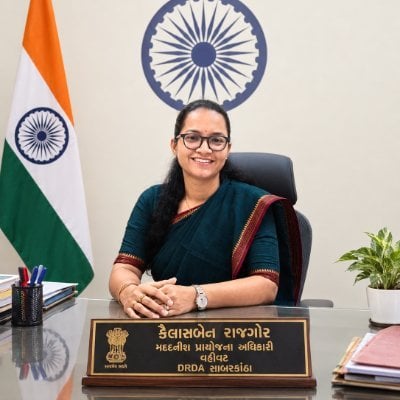
At present, she is posted in the District Rural Development Agency (DRDA), Sabarkantha, where she is serving as Assistant Programme Officer (Administration) and also holding the charge of BDO.
She has been handling this additional responsibility for around eight months.
This is significant because her first competitive examination attempts also opened the doors to government service. While she could not secure the GPSC position she aspired to, she did not remain without a career or professional identity.
She is already contributing to public administration.
Her journey also demonstrates that competitive examinations should not become the only measure of a person’s worth or capabilities.
A candidate may not find a place in a particular final selection list, but that does not erase the knowledge, discipline, experience and opportunities gained along the way.
For Kailash, the GPSC dream remains important, but it is not the entirety of her identity.
Will She Attempt GPSC Again?
Despite the disappointment of the latest result, Kailash has not completely ruled out another attempt.
She still has attempts remaining and is not over the prescribed age limit. However, she is also aware of the long recruitment cycle of GPSC. Unlike examinations with a relatively predictable annual cycle, GPSC recruitment processes can take two to three years to complete.
Her immediate aspiration is to prepare for the Deputy Collector position, a Class-I post, if the opportunity and vacancies allow.
The possibility of another attempt in 2027 remains on her mind.
After eight-and-a-half years, she is understandably weighing her options. But one thing is clear: the latest result has not taken away her willingness to consider another opportunity.
Her Message for Girls: If You Want to Live on Your Own, You Have to Work Hard
Perhaps the most important part of Kailash’s conversation was her message to girls who are facing similar restrictions but still want to study and build an independent future.
She believes that education and hard work are essential for women who want to make their own decisions and shape their own lives.
“If you want to live on your own, you have to work hard for that. If it is our dream, we have to work towards it. There are only two things that matter: hard work and dedication, along with consistency,” she said.
She also emphasised that even when someone does not have sufficient resources or a supportive environment, the determination to pursue a dream can make a difference.
Her message is particularly relevant for girls from rural and conservative backgrounds, where continuing education can itself become a struggle.
Kailash knows this reality because she has lived it.
She understands what it means to study after marriage, manage a young child, travel for examinations, depend on family support and continue working towards a goal even when success remains uncertain.
She wants girls to understand that they should not abandon their aspirations simply because their circumstances are difficult.
Her journey also carries an important lesson for parents and families: a little encouragement and support can change the direction of a girl’s life.
The Story That Deserves to Be Told
There are thousands of stories about candidates who clear UPSC, GPSC and other competitive examinations after years of preparation. Their achievements deserve to be celebrated.
But there are also stories like Kailash Rajgor’s that deserve equal attention.
A woman who once had to insist on studying beyond Class 10 went on to complete her graduation, move away from her family for competitive examination coaching, clear multiple government recruitment examinations, become an Assistant BDO and reach the GPSC interview stage three times.
She did all this while navigating motherhood, social restrictions, financial difficulties and professional responsibilities.
Yet, the final selection remained elusive.
Her story does not offer the conventional ending that readers expect from a motivational article. There is no final merit list with her name highlighted, no celebratory photograph and no appointment letter for the position she had dreamed of for years.
But there is something else.
There is a woman who refused to let her circumstances define her future. There is a mother who continued studying while caring for her daughter. There is a government officer who has already built a professional identity. And there is an aspirant who, despite repeated disappointments, has not allowed one result to define her entire life.
Perhaps that is why her words deserve to stay with us:
“Life does not come to an end just because some dreams have died.”
Kailash Rajgor may not have reached the destination she had been chasing since 2018. But her journey has already crossed boundaries that once seemed impossible.
And for every girl who has been told that she cannot study, every aspirant who has failed an examination, and every person who believes that an unfinished dream makes life unsuccessful, her story carries a powerful reminder:
Not every dream has to come true for a life to be meaningful. Sometimes, the courage to dream, the strength to struggle and the determination to keep moving forward are achievements in themselves.