Malnutrition is one of India’s most persistent public health challenges, particularly in remote and rural regions where children often grow up with inadequate nutrition despite multiple welfare schemes. While governments continue investing in food security programmes, ensuring that nutritious food actually reaches children and mothers—and becomes part of everyday eating habits—remains a major challenge.
For Dr. Abhishek Saini, IAS (2021 batch, Assam-Meghalaya cadre), the answer lay not in creating another government scheme but in making communities active participants in improving nutrition.
Currently serving as the Deputy Commissioner of Ri Bhoi district, Meghalaya, Dr. Saini previously served as the Deputy Commissioner of North Garo Hills, where he introduced a series of practical nutrition interventions that combined community participation, local resources, and women’s economic empowerment.
Instead of depending on additional government funding, his approach focused on strengthening existing institutions like Anganwadi Centres, Self Help Groups (SHGs), dairy cooperatives and village organisations. The result was a model that addressed child nutrition while simultaneously creating livelihood opportunities for rural women.
Understanding the Challenge
When Dr. Saini assumed charge in North Garo Hills, the first concern that demanded attention was child malnutrition.
“The biggest challenge was stunting. Even though recent surveys show improvement, the percentage is still high. Along with stunting, underweight children and inadequate intake of iron-rich and protein-rich foods were major concerns,” Dr Saini shared in a conversation with Indian Masterminds.
Read Also: How Tuticorin’s Floods Inspired Rakesh R to Join Indian Forest Service
According to him, improving nutrition required more than distributing food. Families needed awareness, better dietary habits, and sustained community participation.
That understanding became the foundation for three interconnected initiatives.
‘Red Food Day’: Turning Nutrition into a Community Activity
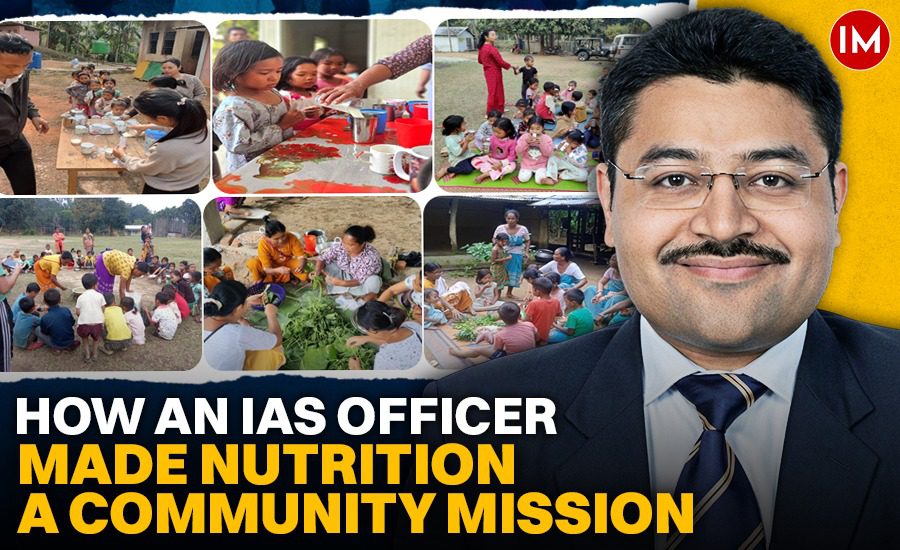
The most widely recognised initiative launched under his leadership was Red Food Day, a weekly nutrition campaign organised across Anganwadi Centres.
“The idea is simple—children and mothers should regularly get iron-rich food in their diet. Red signifies iron-rich foods,” says Dr. Saini.
Every week, village communities gather at Anganwadi Centres where parents, SHG members and frontline workers contribute locally available nutritious foods including green leafy vegetables, eggs and other iron-rich ingredients. Many centres also supplement these meals using produce from their own kitchen gardens.
One of the defining features of the programme is that it does not require additional government funding.
“The community here is strong. People come together for the good of the children,” Dr. Saini says.
Instead of financial incentives, the programme depends on collective ownership. SHG members participate in cooking alongside Anganwadi helpers, transforming the weekly activity into a community event rather than a routine meal distribution exercise.
By December 2025, the initiative had expanded to 289 villages, benefiting more than 8,800 children across North Garo Hills. Several schools also began adopting similar practices, extending the campaign beyond Anganwadi Centres.
The programme has also changed the atmosphere inside these centres, encouraging parents to participate more actively in discussions around child nutrition.
Training Women to Become Nutrition Champions
While improving food availability was one objective, Dr. Saini believed that knowledge about nutritious cooking was equally important.
His administration partnered with Tura Community College to train Community Gender Health Activists working under the Meghalaya State Rural Livelihoods Society (MSRLS).
These frontline workers learned how to prepare nutritious recipes using locally available ingredients such as moringa and other nutrient-rich foods that were both healthy and acceptable to local tastes.
“We tried to start a movement around healthy cooking and healthy nutrition,” Dr. Saini says.
After completing their training, these community health workers returned to their villages and trained SHGs and village organisations, creating a multiplier effect.
Rather than relying solely on government officials for awareness campaigns, local women themselves became nutrition educators within their communities.
This decentralised approach allowed nutrition awareness to spread naturally through village networks.
Addressing Milk Consumption Through Local Dairy Cooperatives
During his field visits, another pattern caught Dr. Saini’s attention.
He noticed that milk consumption among young children remained extremely low.
“We found that children consume very little milk. Since milk is a complete food, we wanted to see whether regular supplementation could improve nutritional outcomes,” he explains.
Instead of launching a district-wide programme immediately, the administration opted for a carefully monitored pilot.
Four Anganwadi Centres with nearly 100 children were linked to nearby dairy cooperatives.
Each child received 200 ml of milk every day for five days a week, in addition to the regular hot cooked meal already provided at the Anganwadi.
Before launching the programme, baseline measurements of children’s height and weight were recorded. The administration also screened children for lactose intolerance and allergies before gradually introducing milk into their diets.
“We didn’t start on a large scale immediately. We first observed whether children accepted it well and ensured there were no health issues,” Dr. Saini says.
Over the six-month pilot, officials observed improvements in children’s height and weight.
The programme also benefited local dairy cooperatives by providing them with a predictable source of income over the project’s duration.
Instead of importing supplies from outside, the initiative created a local supply chain that supported both nutrition and rural livelihoods.
Linking Women’s Livelihoods with Nutrition
Dr. Saini’s third intervention focused on connecting nutrition with women’s economic empowerment.
Using Meghalaya’s Chief Minister’s Catalytic Fund, his administration supported women-led low-cost poultry farms managed by Self Help Groups.
The model was straightforward.
SHG members contributed land, while the administration facilitated the construction of affordable poultry sheds. The Animal Husbandry Department supplied chicks, feed, and technical support.
Each group initially received around 100 chicks, enabling them to begin commercial egg production.
Once production started, the women sold eggs in local markets, generating a steady income.
“The idea was that later these poultry units could also supply eggs to nearby Anganwadi Centres, making the nutrition programme sustainable while creating livelihoods for women,” says Dr. Saini.
When he was transferred from North Garo Hills, many of these SHGs had already begun earning from egg sales, demonstrating that nutrition programmes can also become income-generating opportunities for rural communities.
Building Trust Before Expansion
Introducing dietary changes is not always easy, particularly when they involve new habits.
However, Dr. Saini says community acceptance was achieved through counselling rather than compulsion.
“There was a little hesitation initially, but people already understood the benefits. What was needed was counselling and gradual habit change,” he says.
Officials worked closely with village organisations and SHGs to explain the objectives of each programme.
The existing grassroots network of the Meghalaya State Rural Livelihoods Society proved particularly useful in mobilising communities.
Because village institutions were already well established, participation increased steadily with regular engagement.
Community Ownership Made the Difference
Perhaps the biggest strength of these initiatives was that they did not depend solely on government machinery.
Communities themselves supplied vegetables, prepared meals, participated in awareness activities and gradually took ownership of the programmes.
“The feedback has been very good. Children enjoy the day when everyone comes together, and the women from the community actively participate in preparing the meals,” Dr. Saini says.
Although some Anganwadi Centres initially recorded lower participation, the administration continued working to bring every centre into the programme through continuous follow-up and community mobilisation.
Taking the Model Forward
Now serving as the Deputy Commissioner of Ri Bhoi, Dr. Abhishek Saini intends to replicate similar community-led interventions in his new district.
His experience demonstrates that improving child nutrition does not always require expensive infrastructure or entirely new schemes. By strengthening community participation, encouraging behavioural change and connecting nutrition with local livelihoods, existing government programmes can become significantly more effective.
The three initiatives—Red Food Day, milk supplementation through dairy cooperatives and women-led poultry farming—illustrate how different sectors can work together to address a common challenge.
For districts seeking practical and scalable nutrition models, the approach developed by Dr. Saini offers an example of how administrative innovation, local partnerships and community ownership can translate policy into measurable improvements for children and rural families.