There are words we forget because they gradually disappear from everyday use. Then there are words we deliberately push aside because they make us uncomfortable. Accountability belongs to the second category. Forgetting means something has slipped out of memory. Forsaking, however, means deliberately setting something aside, overlooking it, ignoring it or choosing not to return to it. Accountability, therefore, has not merely been forgotten. Somewhere along the way, it has been forsaken.
In our personal lives, workplaces, institutions and public spaces, we speak constantly about responsibility. We are assigned responsibilities, given duties and expected to complete tasks. Yet somewhere between taking responsibility and delivering an outcome, a crucial element often disappears: the willingness to answer for what we have done and, more importantly, for what happened because of what we did. That missing element is accountability.
ACCOUNTABILITY BEGINS WITH A CHILD
The first lessons of accountability begin much earlier than we realise. A child learns it at home, often through the simplest of questions from parents: “What happened?” “Why did you do this?” or “Who did it?” Even when the child answers in broken sentences, something important is taking place inside the developing mind. The brain begins connecting memories of the past with events in the present and translating those connections into words. The child is slowly learning not only to act, but also to explain an action.
Education strengthens this ability over time. As children grow, they learn to understand consequences, distinguish between right and wrong, recognise the impact of their behaviour and respond to questions about their choices. The deeper lesson is not simply that they are responsible for something because it was assigned to them. It is that their actions have consequences and that they must eventually be able to answer for those actions.
That is where accountability begins to shape character.
Also Read – The Power of a Response: How a Simple Reply Can Bring Government Closer to People
RESPONSIBILITY IS ZIMMEDARI; ACCOUNTABILITY IS JAWABDEHI
The distinction between responsibility and accountability is often overlooked, even though the two are not identical. In simple terms, responsibility may be understood as zimmedari, while accountability is closer to jawabdehi.
When we accept a responsibility, our mind is often tuned towards completing an assigned job. We perform a task because it has been given to us, because it is expected of us, because there is a practical objective attached to it or because there is some reward or consequence involved. Responsibility can therefore become mechanical. A person may complete what was assigned without necessarily understanding the larger purpose, the people affected by it or the consequences of doing it poorly.
Accountability goes a step further. It demands ownership of the outcome. It requires a person to understand the intent behind an action, consider its consequences and remain answerable even when things do not go according to plan. In that sense, accountability transforms an ordinary responsibility into an intentional act. A task, a job, an errand, an endeavour, a remedy or even a simple message can become a reflection of one’s attitude and character when it is approached with accountability.
True responsibility, therefore, cannot exist in isolation. It becomes meaningful only when it is accompanied by accountability. One may be given responsibility by another person, but accountability ultimately has to be owned.
WHERE ACCOUNTABILITY ENDS, THE BLAME GAME BEGINS
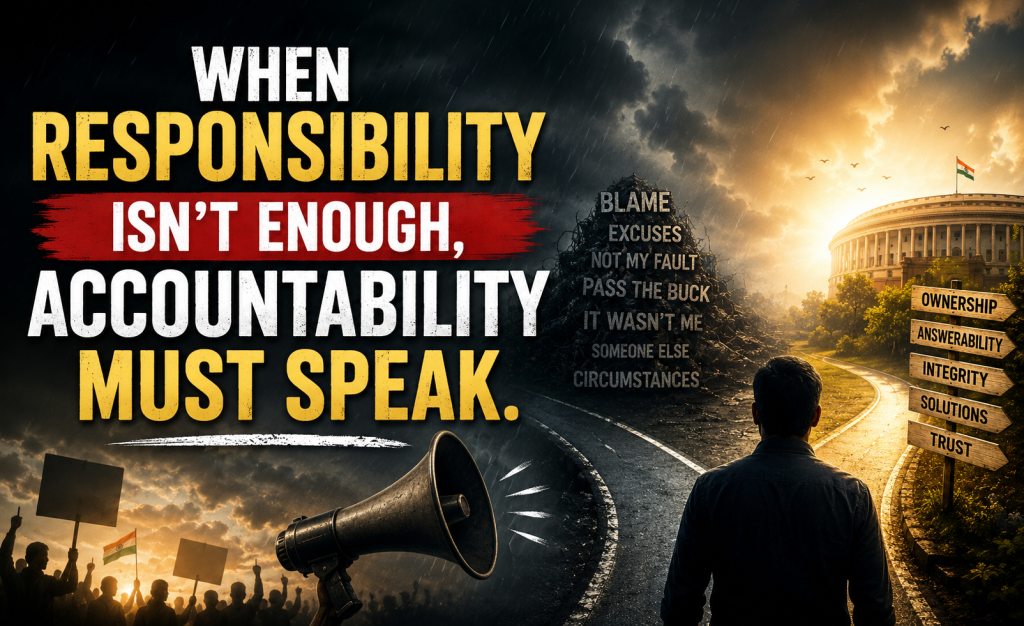
The difference becomes particularly visible when something goes wrong. When people operate only through responsibility, it becomes remarkably easy to pass the buck. “I only did what I was told.” “That was not my department.” “Someone else was supposed to check it.” “I had already informed them.” Such statements may establish that a person performed a particular part of a process, but they do not necessarily establish ownership of the final outcome.
This is where blame, excuses and pretence enter the picture. Responsibility can be conveniently divided among several people until no one feels responsible for the failure. Accountability, however, does not allow the same escape. It asks a much more uncomfortable question: who is willing to own what happened and work towards resolving it?
That is why accountability is not merely an administrative concept. It is a discipline of the mind and an important measure of character. A person who is accountable does not merely defend his or her actions. There is also a willingness to examine them, accept mistakes and correct them.
ACCOUNTABILITY: THE HIGHWAY TO SPIRITUALITY
The world today speaks extensively about spirituality. People search for answers through meditation, yoga, sadhna, seva and countless other practices. Yet perhaps one of the most fundamental forms of spirituality begins with something far simpler: the willingness to hold oneself accountable.
We are answerable not only for our visible actions but also for our words, thoughts and intentions. Spirituality can be understood as a process of looking inward, examining what we have done and recognising the karmas we have consciously performed, whether good or bad. It is about developing the courage to look at ourselves without the protective layers of excuses and justification.
The moment we become silent, close our eyes, rest or simply take a deep breath, the mind often brings back memories that we would rather avoid. Sometimes it is an unpleasant conversation. Sometimes it is a mistake. Sometimes it is a person we hurt or an action we continue to justify. That moment of discomfort can become a moment of introspection if we allow ourselves to confront it instead of pushing it away.
Perhaps that is when nature, the Divine or the Creator, according to one’s belief, expects something more from us than mere responsibility. It asks us to acknowledge what we have done and hold ourselves accountable for it. Responsibility without reflection can create confusion and even chaos, while accountability brings discipline because it forces us to examine the connection between our actions and their consequences.
SPIRITUALITY DOES NOT ALWAYS REQUIRE A RITUAL
We often imagine that becoming spiritual necessarily requires a particular practice or ritual. Yoga, meditation, sadhna and seva undoubtedly have their place, but perhaps spirituality can begin even before we enter any of these practices.
It can begin with introspection.
When we are willing to examine our own thoughts, words and actions, we begin taking ownership of our karmas. We stop blaming circumstances for everything that happens within and around us. We start recognising patterns in our behaviour and understanding why certain problems repeatedly return.
Accountability, in this sense, can become a highway towards inner transformation. It does not merely tell us that something went wrong; it encourages us to understand why it went wrong and what we can change within ourselves so that it does not happen again. The journey can gradually lead towards greater discipline, peace and happiness because the burden of constantly defending ourselves begins to disappear.
Perhaps liberation is not always about escaping from our past. Sometimes it is about having the courage to acknowledge it.
ACCOUNTABILITY SANS POLITICS
The idea of accountability becomes even more significant when we move from the individual to society. India has, in recent days, witnessed a significant coming together of ordinary citizens who have sought answers from those in positions of power. What is striking is that the demand at its core is not necessarily for money, gifts or even compensation. It is a demand for accountability.
The message is simple: accept what went wrong, acknowledge your role in what happened, take ownership of the consequences and provide a solution to the problem.
Such a demand should not be viewed merely through a political lens. Accountability is fundamental to any healthy democracy. Citizens have the right to question institutions and those who exercise authority over them. Likewise, those in positions of power have a corresponding obligation to answer.
Democracy cannot function effectively when authority is separated from accountability. Power without answerability creates distance between institutions and the people they are meant to serve. Over time, that distance can become distrust.
WHEN CITIZENS HAVE TO REMIND POWER OF ACCOUNTABILITY
India has completed 79 years of Independence. Yet if citizens still have to repeatedly protest, face lathis, tear gas, water cannons or the threat of false FIRs simply to remind those in authority of their constitutional rights, it forces us to ask a difficult question: how deeply have we internalised the meaning of freedom?
Political independence was the beginning of India’s journey, not its conclusion. Freedom also means that citizens can question authority, institutions can be held answerable and those entrusted with power understand that authority comes with responsibility towards the people.
Our freedom struggle was shaped by individuals who refused to accept authority without accountability. Bhagat Singh, Chandra Shekhar Azad and Subhas Chandra Bose belonged to different circumstances and followed different paths, but they shared a willingness to challenge systems that denied people their rights.
Today, we may not have to recreate their battles in the same form. But perhaps we need to rediscover the courage behind them: the courage to ask questions, demand answers and refuse to accept silence as a substitute for accountability.
BRINGING JAWABDEHI BACK
Perhaps the word we need to restore to our homes, classrooms, workplaces, institutions and public life is not responsibility alone. It is jawabdehi.
Responsibility tells us that a task belongs to us. Accountability asks us what we did with that task and whether we are willing to answer for its outcome. Responsibility can be assigned by someone else, but accountability ultimately has to be accepted by the individual.
This distinction matters because institutions do not become trustworthy merely because people perform their assigned duties. They become trustworthy when individuals within them are willing to own the consequences of their decisions. Likewise, a society does not become responsible simply because its citizens follow rules. It becomes mature when those citizens are willing to question wrongdoing and when those in power are willing to answer those questions.
Accountability is therefore much more than a word used in governance reports, corporate meetings or political speeches. It is a personal quality, a social responsibility and, perhaps, even a spiritual discipline.
The word may have been deliberately forsaken, but it does not have to remain so. We can bring it back by beginning with ourselves—by examining our thoughts, accepting our actions, acknowledging our mistakes and refusing to hide behind blame or excuses.
Because ultimately, the question is not merely whether we are responsible.
The more important question is whether we are willing to answer.
And perhaps that is where accountability begins—not with the person standing across from us, not with an institution, not with a government, but with the person we see when we look in the mirror.
About The Author – (Malviekaa S Babbar holds degrees in B.Com., M.A. in English Literature, and M.B.F., along with a Creative Writing Certificate from the Writers Bureau, Manchester, UK. She is a skilled bilingual writer with extensive experience in English and Hindi, including scripting and writing Hindi dialogues.)
Disclaimer – (The views and opinions expressed in this article are solely those of the author and do not necessarily reflect the views of Indian Masterminds. For feedback or queries, please write to [email protected].)
Also Read – A Rainy Mumbai, a Gentle Giant and Two Best Friends: The World of Rain Holiday