“As someone who was technically born in the rain, Mighty really does not like it. It’s cold, and in the nights when everyone hides inside their houses and closes their curtains and forgets to look outside, there’s still Mighty. He is in his house, which is right there on the road. Where is he supposed to go?”
Eleven-year-old Rekha, reluctant sixth-grader at the dubiously-named Holy Ghost Secondary School and creator of the road-dwelling-gentle-giant-guardian-Mighty, doesn’t like the rain either. Actually, the rain scares her a little bit. It’s one of those strange feelings which she doesn’t fully understand but knows how to name because of her mother Kaveri, who is an attending psychiatrist at the Narmada Specialty Hospital and therefore gives Rekha all kinds of homework: “She went and bought me a nice fancy diary with blue pages and told me I had to write in it every time I felt like my emotions were rising to the top. She calls it a Reflection Diary. I deeply dislike writing because my words go all over the page and it’s never neat and it takes so long. I express myself better visually or through the spoken medium. But Amma insists.”
Also Read – IRS Rohit Mehra’s 365 Quotes For Success Turns Every Day Into A Lesson
Back to rain: Mighty, the non-confrontational non-monster who cannot wear shoes because Bata doesn’t make any in his size, is born from the “little laughs of each person in the city, which fall from their balconies all the way onto the road. In our drawings (artwork courtesy of Latisha Fernandes),” records Rekha, “the laughs look like little drops of silver rain.” From a tiny blob, Mighty stretched elastically upwards to become as tall as a thirty-storey building in the imaginations of best-friends Rekhs and Latisha, who stay home from school on inevitable Mumbai monsoon Rain Holidays to “watch the rain and draw Mighty and sometimes we pretend we are crime fighters (nothing violent, we are experimenting with pacifism) and we usually eat popcorn or Maggi cakes (you make Maggi, put it in the fridge, then cut it up into little pieces) and hot chocolate. We look at the sea (sometimes it looks blue, mostly it looks grey and dark) from the huge windows in her room. Sometimes we act out scenes with Mighty, like Mighty in a hospital (he doesn’t fit in most ambulances) or Mighty getting a passport (it’s tough for him because he doesn’t have parents).”
Rekha has parents, both, but it’s tough for her anyway. Her Dad Pradeep is an orthopaedic doctor in Chennai who treats sports injuries, especially knees. He’d met her mother in tutorials for medical college and then they’d gone to the same medical college. Rekhs used to love “looking at all the old diagrams in Amma’s medical textbooks and one of the first monsters I drew was an Inside-Out Man, all his muscles and tendons and sockets on the outside (but waterproof, so he could still go around).” Over the years, Kaveri and Pradeep maintained their medical careers but couldn’t sustain their marriage across a map of distance.
Some of the magic Rekha ponders bequeathing unto Mighty-the-kindly-caretaker-beast includes the power to skip time at will, because this is an ability she wishes she could have in order to avoid unpleasant situations like dinners with her estranged Dad who asks lots of questions but doesn’t really seem to listen to any of the answers. She’s a bit suspicious of him. In general, Rekha doesn’t trust boys much. But Mighty is an exception, of course, and so is Himmat Uncle (the security guard doing duty at Latisha’s building Sea Breeze) and surprisingly so is Faiz (classmate and another resident of Sea Breeze) who turns out to be helpful when Latisha is mysteriously absent from school. Even Raji, who has glossy hair and lives in an even fancier building than Sea Breeze, is relatively nice to Rekha when it comes to Latisha, because that’s just the kind of person Latisha is. Without Latisha, Rekha documents in her Reflection Diary that her mood is “- Stressed,… – Disappointed,… – Extremely agonized.” With Latisha, Rekha knows that even the unexpected inclusion of Faiz and Raji in their kindred bond of two would be acceptable—justice and victory naturally align when one’s very best friend is by one’s side.
Rekha’s articulation at her age, both natural and nurtured, may perhaps seem amusing or ‘precocious’ to adults who have forgotten how irksome it is to have a coherent internal sense of self which may not necessarily align with common external Outside-In perception of a child’s self-hood. Amma knows, though—she is wise about little girls who speak first and think later; wise about the fact that if you can name a feeling like despair or anger correctly and squeeze it up in your fist then it can be handled and rolled up into a laddoo or thrown away entirely. The Reflection Diary, Amma knows, will hold up a mirror to an enigmatically bright young child about the rewards we receive from the patient recognition of our weather-like moods (and the behaviours they engender) in different seasons of our-selves.
From Latisha’s diary is an entry about Mighty’s shadow becoming taller than Mighty himself. Mighty wants to be smaller so that his shadow will be smaller too: “He tries squeezing himself even flatter against the window, tilting against the ceiling, even curling around the water pipe on the outside of the building, since he is a rain-proof monster. (Not really a monster.) But the shadow won’t leave him, it’s as big as three streets, and it’s everywhere he turns.” Over sixteen stormy days of investigation and clue-seeking and note-taking, Latisha and her Four Find-Outers discover the constitutions and amendments of their own Inner and Outer Mighties.
Back to reflections: friendship can reveal what we hesitate to identify and help us through transformation. Rekha and Latisha’s mothers, Kaveri and Freda, rely on each other for practicalities which do not require acknowledgement to confirm appreciation. Between their daughters is a bond so familiar and true that they communicate conversations through quick glances and long silences. And there is Mala Akka, who had moved as housekeeper with Kaveri from Chennai to look after baby Rekha, and at thirty years old believes she might still have time to become a millionaire. When Mala Akka was eleven years old, she too had imagined a childhood creation with her older-sister-best-friend Devi Akka: Kokku and Bokku, whose world-spanning wings would form one perfect heart-shape when they were together.
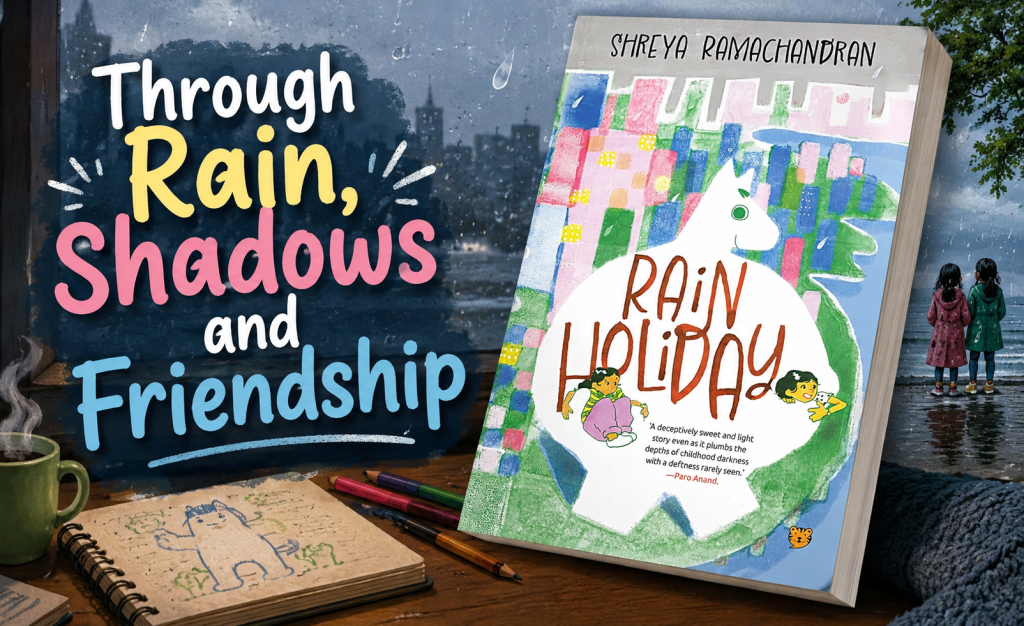
To learn to think outside one’s own insightful self and realize that everyone else has textures of inner life too — that their selfishnesses and selflessnesses are born of their own sadnesses — is one of the many silvery clarities of this gorgeous novel by Shreya Ramachandran. Once you open your eyes, you can never close them again — but everyone is one percent nicer than you think, and this truth is remembered through naps, and dreams, and the little laughs which come from books like Rain Holiday. Aindri C.’s delightful cover illustration evocatively captures Mighty-affectionate-blob-of-the-metropolis-Mumbai-coastline carrying in his pillowy arms two curious young best friends whose eyes are gazing beyond the horizon. There is a Mighty here in Dehradun valley too, and in your home and on the roads outside it and in forests and mountains and deserts and oceans, because this benevolent spirit born of innocent joy exists even when we forget to to check in on it: blinking through firefly sparks all the way to the furthest green-grass worlds of magnets and miracles and then all the way back to this beautiful green-grass Earth of our own.
Also Read – The Power of a Response: How a Simple Reply Can Bring Government Closer to People