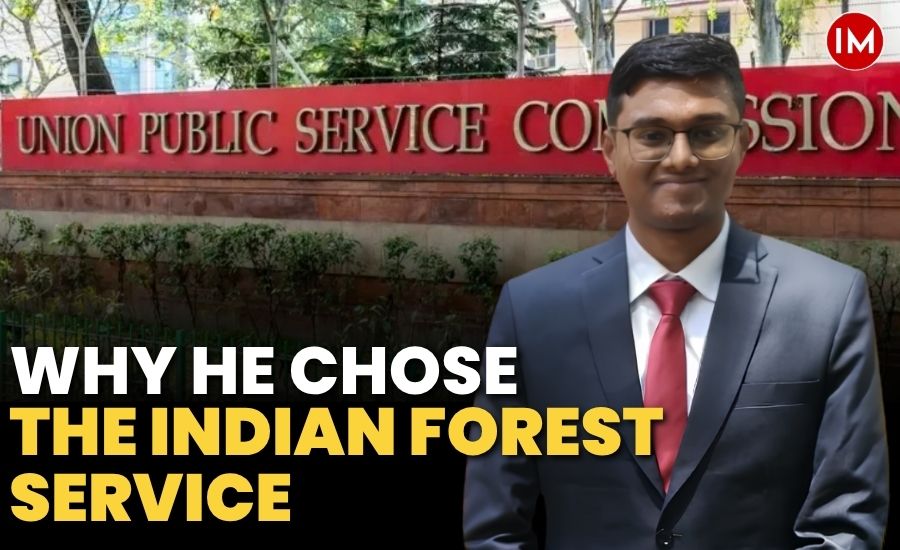
For many UPSC aspirants, the Indian Forest Service (IFS) is a career choice rooted in a love for nature. For Rakesh R, however, it was deeply personal.
Long before he opened his first NCERT textbook or solved previous years’ question papers, his journey had already begun on the flood-affected streets of Tuticorin, Tamil Nadu.
“Every year, as cyclonic rains lashed the coastal town, floodwaters entered homes, submerged roads, and disrupted daily life. As a school student, I often walked through waterlogged streets to attend classes,” Rakesh R shared in a conversation with Indian Masterminds.
Those experiences stayed with him.
As deforestation increased in and around his locality, he observed how environmental damage directly affected ordinary people. What began as childhood curiosity gradually transformed into a clear purpose—to work towards environmental conservation and sustainable development through public service.
Today, that purpose has translated into success. Rakesh has secured AIR 85 in the UPSC Indian Forest Service Examination 2025, marking the beginning of a journey that was shaped not only by disciplined preparation but also by years of lived experiences.
A Rank Dedicated to His Parents
Behind every competitive examination success lies a support system that often goes unnoticed.
For Rakesh, that support came from his parents.
Like many aspirants, he faced moments of uncertainty, setbacks and self-doubt during preparation. Whenever motivation dipped, he reminded himself of the sacrifices his parents had made to help him chase his dream.
The result day became an emotional milestone for the family.
“My mom was in tears of happiness. I had never seen her like that. My father hugged me and said, ‘Sabhash Rakesh.’ That moment is something I will cherish forever.”
Even after seeing his name in the official UPSC result PDF, Rakesh says the overwhelming feeling wasn’t excitement—it was gratitude.
Years of effort had finally culminated in a result that honoured both his parents’ faith and the town that had inspired his dream.
“AIR 85 is not just a rank. It is a tribute to my parents, the values they instilled in me, and the town that inspired my dream.”
Building a Strategy That Focused on Consistency
Success in the UPSC examination often comes down to disciplined execution rather than collecting endless study material.
Rakesh followed a preparation strategy that balanced flexibility with consistency.
Instead of frequently changing resources, he relied on a limited set of books and revised them multiple times.
For the prelims, his preparation revolved around three pillars:
- Thorough analysis of Previous Year Questions (PYQs)
- Multiple revisions of NCERTs and standard reference books
- Regular full-length mock tests
However, what made his preparation more analytical was his use of technology.
After every mock test, he maintained an Excel sheet to identify subjects where his scores consistently dipped. Rather than simply attempting more tests, he focused on improving weaker areas using data from his own performance.
For the Mains examination, answer writing became the centrepiece of his preparation.
Guided by his mentor, Sudhagaran, IRPS, Rakesh consciously avoided unnecessarily complicated language. Instead, he focused on presenting practical, easy-to-understand and structured answers that directly addressed the demand of each question.
Alongside this, he remained committed to reading one newspaper every day, ensuring consistency in current affairs preparation instead of depending on multiple sources.
An Interview That Tested Character More Than Knowledge
The UPSC Personality Test often evaluates far more than factual knowledge, and Rakesh experienced exactly that.
He recalls the interview as engaging and intellectually stimulating.
The Chairperson maintained a friendly atmosphere while asking questions on improving Tamil Nadu’s economy and understanding why wind energy generation remains concentrated in specific regions.
Then came the difficult phase.
One interview board member began asking detailed provisions and sections of the Indian Forest Act—questions that even well-prepared candidates may struggle to answer accurately.
When Rakesh admitted he did not know a particular provision, the member continued pressing him, even remarking that he seemed to know nothing.
Instead of becoming defensive or attempting to bluff, Rakesh chose honesty.
“I smiled and said, ‘Right now I don’t know, Sir. But as soon as I leave the building, it will be the first thing I learn.'”
His calm response appears to have left a positive impression on the board.
The result reflected that.
Rakesh secured 225 marks out of 300 in the personality test, earning the fourth-highest interview score in the country—an achievement that highlights how integrity and composure can matter just as much as knowledge during the UPSC interview.
Making Time for Life Beyond UPSC
Competitive examination preparation is mentally demanding, and Rakesh believes maintaining hobbies is essential for sustaining focus over a long period.
Whenever studies became overwhelming, he turned to two simple interests—reading fiction novels and watching anime.
Rather than seeing them as distractions, he considered them healthy breaks that helped him recharge before returning to his studies with renewed concentration.
His approach reflects an important lesson for aspirants: effective preparation is not about studying every waking hour but about maintaining consistency over several months without burning out.
A Message for Every UPSC Aspirant
Looking back at his journey, Rakesh believes that every UPSC aspirant undergoes a transformation during preparation.
The examination demands discipline, emotional balance, and the ability to continue despite uncertainty. While success may not arrive immediately, the process itself shapes a person’s outlook in lasting ways.
“UPSC is like a storm. You will face self-doubt, long study hours, and immense pressure every day. But when the storm is over, you are not the same person who walked into it. Embrace uncertainty and be true to yourself.”
As Rakesh prepares to join the Indian Forest Service, he carries more than an all-India rank. He carries memories of flooded roads that first awakened his environmental consciousness, the encouragement of parents who stood beside him through every challenge, and lessons learned through years of disciplined preparation.