A special write up by Saurabh Srivastava
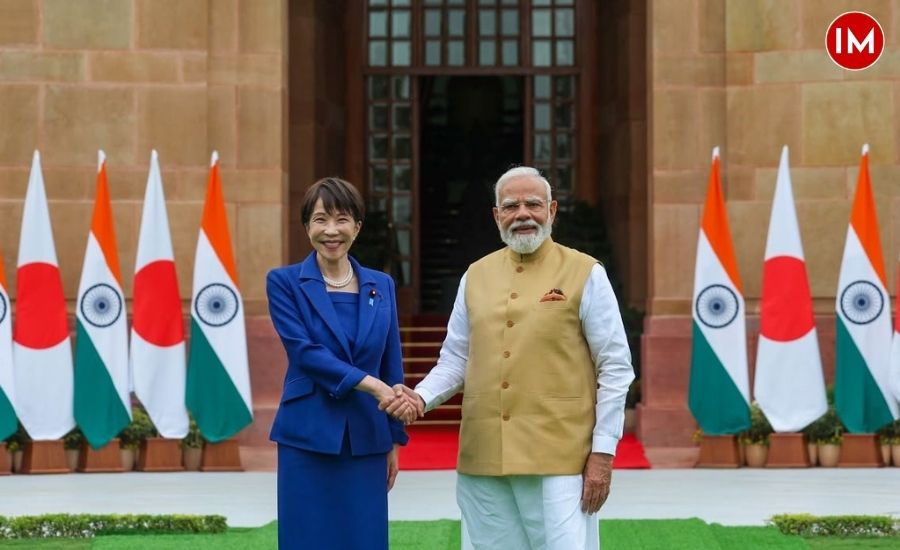
Sanae Takaichi stepped off the aircraft at Palam on Wednesday evening, and from that moment the photographs began telling one story while the arithmetic told another. The photographs are handsome enough. A first official visit to India by a new Japanese prime minister, the first woman ever to hold the office, received on the tarmac by a minister of state, welcomed with a guard of honour in the forecourt of Rashtrapati Bhavan on Thursday morning, then driven to Hyderabad House for summit talks with Narendra Modi.1
Both governments have spent weeks describing the sixteenth India–Japan Annual Summit in the careful, slightly weightless language of diplomacy. The arithmetic, sitting quietly behind the handshakes, is the part worth reading closely. Travelling with her is a delegation drawn from more than fifty Japanese companies and organisations, among them Suzuki, Toyota’s trading arm Toyota Tsusho, and the trading house Itochu. Some of them have not come to admire the scenery. They have come to sign.
That distinction, between ceremony and commitment, is the whole subject of this visit, and it is the lens through which India should watch the next two days.
There is a small irony in where it is happening. For weeks the summit was meant to take place in Guwahati, the capital of Assam, a deliberate and unusual choice that would have planted a high-profile bilateral meeting in India’s northeast rather than its political centre. The symbolism was hard to miss. Assam is the anchor state of a northeast that borders China, it is run by a confident BJP government, and its Morigaon district is home to India’s first indigenous semiconductor assembly and test facility.
Holding the summit there would have said something without anyone having to say it. In the end the meeting settled in Delhi, but the original intent lingers as a tell, and the northeast has not fallen off the agenda. Japan remains the only country with which India runs a dedicated institutional mechanism for developing the region, and the two sides are expected to push an industrial value chain linking the Bay of Bengal with the northeastern states.2 Japan and India are increasingly thinking about their relationship in terms of where things get built, and the map of where things get built is no longer confined to the usual corridors of Gujarat and Tamil Nadu.
To understand why a routine-looking summit carries this much freight, remember the number that underwrites it. During Modi’s visit to Tokyo in August 2025, Japan committed to channel ten trillion yen, roughly sixty-eight billion dollars, of private investment into India over ten years, double what it had promised only three years before.3
To grasp the scale of that promise, set it against the past. In the quarter-century from 2000 to the end of 2025, the entire stock of Japanese direct investment that actually reached India came to about forty-five billion dollars.4 Japan is now pledging to put more money into the country in a single decade than it managed across the previous twenty-five years. No government is writing that cheque. The pledge is a signal to Japanese boardrooms that India is now a place where capital is expected to go, and corporate Japan tends to move as a convoy rather than a fleet of independent ships.
THE INVESTMENT BET
| $68bn Japan’s private-investment pledge into India over the next decade, announced at the 15th Annual Summit, Tokyo, August 2025 | $45bn Total Japanese FDI equity that reached India across the entire quarter-century from 2000 to 2025 |
The next decade’s pledge exceeds twenty-five years of accumulated capital. Sources: Japan–India Joint Statement (MEA / MOFA); DPIIT FDI Fact Sheet.
When a prime minister travels with fifty company chiefs in tow, the message to the rest of corporate Japan is that the water has been tested and found warm. Takaichi said as much herself before boarding, naming collaboration between companies of the two countries, alongside strategic cooperation and economic security, as one of the three things she has come to Delhi to advance.5 This is how Japanese investment has always worked in India, from the moment Suzuki agreed to build small cars in a country that, in 1982, most of the world’s carmakers could not locate on a balance sheet.6 Maruti did not just make cars. It taught a generation of Indian suppliers how a Japanese company expects a factory to run, and the lessons compounded for forty years.
The conviction shows up in the numbers, though so does how early it still is. Some fourteen hundred Japanese companies operate in India today,7 which sounds like a crowd until you set it beside the fifteen thousand or more that Japan runs across South East Asia and the roughly thirty thousand establishments in China.8 By that measure the building has barely started. And yet, asked year after year where in the world they would most like to invest next, Japanese manufacturers name India their most promising market, ahead of China and everywhere else.9 The intent, in other words, is settled. What remains is the execution.
THE FOOTPRINT GAP
| ~1,400 Japanese companies operating in India today, roughly half of them in manufacturing | 15,000+ Japanese firms active across South East Asia, with some 30,000 establishments in China |
India ranks first in Japanese manufacturers’ own surveys of promising destinations, yet hosts a tenth of the regional footprint. Sources: Embassy of Japan / JETRO; JBIC survey 2024.
What is different now is the agenda, and this is where the meaning for India sharpens. The sectors on the table in Delhi read like a list of the things that will decide who is rich and who is secure in the 2030s. A joint declaration on economic security is expected, centred on resilient supply chains, with semiconductors and critical minerals at the top, followed by artificial intelligence, defence, upstream oil and gas, pharmaceuticals and next-generation mobility.10
There is talk of Japanese financial assistance to help India build strategic oil reserves, of naval maintenance work for Japanese vessels in Indian shipyards, and the long-running Mumbai to Ahmedabad bullet train, powered by Japanese rolling stock technology, remains a fixture of the conversation. Set against the older story of cars and consumer electronics, this is a relationship climbing the value ladder, with Japan offering to partner on the contested industries of the future rather than hand down the tail end of its industrial past. For India, which needs precisely these capabilities and has struggled to source them from anyone on trustable terms, that is a meaningfully different proposition.
Behind all of it stands a third country that is not in the room. China is the unstated organising principle of this summit, as it has quietly been of the entire Indo-Pacific architecture since the late Shinzo Abe first sketched the idea of a free and open Indo-Pacific, an idea he began articulating, fittingly, in a speech to the Indian Parliament in 2007.11
Takaichi inherited that worldview directly. She was Abe’s political protégée, and her instinct on China runs harder than her predecessors’, hard enough that her remarks last November about Japan’s possible defence response over Taiwan left relations with Beijing frozen. Before leaving Tokyo she spoke of an international situation growing more uncertain and of India as a partner sharing fundamental values and strategic interests.5
India arrives at this table from its own direction but with a complementary set of grievances, and the two countries find themselves wanting many of the same things. Both want supply chains that do not run through a single coercive bottleneck. Both want semiconductor capacity that is not hostage to one geography. Both want the sea lanes of the Indian Ocean and the western Pacific kept open and rules-bound.
The word for two countries that want the same things at the same moment is not friendship. It is alignment, and alignment is sturdier than affection because it survives changes of mood.
This is where it becomes tempting to declare the partnership a done deal, and where caution earns its keep. Writing Japan Builds in India, my account of four decades of this corridor, I kept circling one hazard above all the others, the one I came to call the blindness of proximity. The longer two partners work alongside each other, the more each assumes it already understands the other, and the less either troubles to check. Four decades of Japanese presence in India has bred exactly that kind of false familiarity. The gap between the memorandum of understanding and the working factory has stayed stubbornly wide, and the thing that falls into it is time. Japanese firms are deliberate to the point of frustration.
They study, they revisit, they send another delegation, they study again. Indian partners, working at a faster and more improvisational tempo, have often read that patience as hesitation or, worse, as a lack of seriousness. The misreading runs both ways, for Japanese executives have just as often mistaken Indian speed for carelessness. Both are wrong about each other, and the cost of being wrong is measured in deals that take five years to do what should have taken two.
Over time an invisible ledger builds up between the two sides. Every assumption left unspoken, every cultural shorthand that does not translate, every promise made in a language of politeness that one side hears as a commitment and the other as mere courtesy, is entered quietly against the partnership. This is the relationship ledger, and ventures collapse over its unpaid balance far more often than they collapse over money or markets. The ones that last are those where both partners keep settling the account, patiently, before it compounds. Maruti worked because Suzuki stayed long enough to clear it. A great many promising ventures since have failed because someone left before the books were straight.
There is a more measurable kind of imbalance too, and India should keep it in view before the summit language carries everyone away. Trade between the two countries remains strikingly lopsided. In the most recent full year for which figures are published, India bought nearly nineteen billion dollars of goods from Japan, mostly machinery, specialist steel and the high-value industrial inputs Japanese factories are known for, while selling barely six billion dollars back the other way.12
A relationship in which one partner supplies the sophisticated equipment and the other mostly supplies the market is a relationship with a great deal of room left to balance, and that rebalancing, more than any single document exchanged at Hyderabad House, is the real prize India is playing for.
THE TRADE IMBALANCE
| $18.9bn Goods India imported from Japan in FY2024–25: machinery, specialist steel and high-value industrial inputs | $6.3bn Goods India exported to Japan in the same year, a three-to-one deficit and the biggest structural prize left in the relationship |
Total bilateral trade reached roughly $27.5 billion in FY2025–26. Sources: Embassy of India, Tokyo; India Ministry of Commerce.
Which is why the ten-year framing of the Japanese commitment matters more than the headline number. Ten trillion yen over a decade is an admission, conscious or not, that this is slow money, patient capital betting on a slow return, and it pays a patience premium to the side willing to wait. India already has Japanese interest; the work of the coming decade is to convert it into operating capacity at a pace that exhausts neither Japanese patience nor Indian confidence.
That conversion will be settled less by the grand summits than by the unglamorous machinery beneath them, and Takaichi’s delegation will put its signatures to paper in Delhi this week knowing as much. Whether those agreements become anything will be decided in district offices and on factory floors that no prime minister will ever see.
For India the stakes of getting this right are unusually concrete. The pledge arrives at the precise moment the country is trying to industrialise the difficult things: chips, defence equipment, clean energy hardware, precision machinery. India needs exactly what Japan is good at, the disciplined, long-horizon, quality-obsessed manufacture of such things, together with the supplier ecosystems and shop-floor culture that come with it. Japan needs exactly what India offers, scale, a young workforce, a growing domestic market, and a strategic position athwart the Indian Ocean that no amount of capital could otherwise buy.
The exchange is not only of money: an ageing Japan has begun recruiting Indian workers in earnest, with individual Indian states already signing agreements to train and send thousands of young people to Japanese employers.2 So the bargain on offer is plain. India gains a partner able to build the difficult things and, at its best, willing to stay for decades, along with a real chance to narrow a trade gap that has long run three to one against it. What it must supply in return is the one thing no summit can deliver and no foreign investor can import: execution. Land that can actually be acquired, power that does not fail, regulators who answer the telephone, courts that resolve a dispute before the technology is obsolete.
That has always been the part the two countries find hardest together, and it now rests largely on India. Semiconductors are the clearest test. A Japanese firm bringing process discipline to an Indian fabrication plant, supported by Japanese equipment and Indian engineering talent, is exactly the sort of venture that could become a textbook success or a textbook cautionary tale, depending entirely on whether both partners treat it as a forty-year marriage or a five-year transaction.
There is a longer arc here too, one that reaches past this summit and even past Takaichi’s tenure. For four decades the story has been Japan building in India, the teacher and the apprentice. It is now maturing into something more interesting and more equal, in which Japanese firms stop merely operating in India and start rooting themselves as Indian enterprises, designing for Indian conditions, promoting Indian talent into the senior chairs, treating the market as a centre rather than an outpost. That passage, from operating in a country to operating as a company of that country, is what I call the second crossing, and it is the harder one. Daikin, the air-conditioning company, shows what it looks like.
It arrived as an importer, then put down roots: two plants at Neemrana and a third at Sri City, an Indian research centre with hundreds of engineers, Indian managers in charge, and products designed for Indian heat and Indian voltages. Today it is one of the leading air-conditioning brands in the country and ships from India to the Middle East and Africa. Somewhere along the way it stopped behaving like a Japanese company in India and began behaving like an Indian company that happened to be Japanese. That is the crossing the most successful foreign investors have always, in the end, had to make, and the firms travelling with Takaichi who understand it will outlast those still treating India as a market for Japanese industrial practice.
For the wider world, the meaning of this week is best understood as a quiet vote on the shape of the coming order. Two of Asia’s three largest economies are deciding, deliberately and over a long horizon, to weave their industrial futures together as a hedge against a third. They are doing it through cars and chips and oil reserves rather than through treaties and troop deployments, which is the way durable strategic relationships have usually been built.
If it works, the 2030s will feature an Indo-Pacific in which the most consequential supply chains in semiconductors, critical minerals and clean energy have a Tokyo to Delhi axis running through them, an axis that did not exist a generation ago and that Beijing cannot easily disrupt. If it stalls, it will stall for the reasons it has always stalled, in the gap between intention and execution where good summits go to be quietly forgotten.
Takaichi’s three days in Delhi will not settle that question. No summit does. What they have already done is mark the moment the bet was placed openly, on Indian soil, with fifty company chiefs as witnesses and a ten-year clock now visibly running. The forty years that came before were the lessons. This is the decade that decides whether the two countries learned them.
ABOUT THE AUTHOR
Saurabh Srivastava is the author of Japan Builds in India: Forty Years of Lessons. The Decade That Decides. He is Managing Partner and Chief Executive of Savant Solutions, a cross-border advisory firm working across the India–Japan and India–Middle East corridors, and a Designated Partner of ZenCap Fund I, a SEBI-registered alternative investment fund. He advises founders and foreign companies on market entry, capital structuring and the practical business of building across borders, and is based in Delhi.