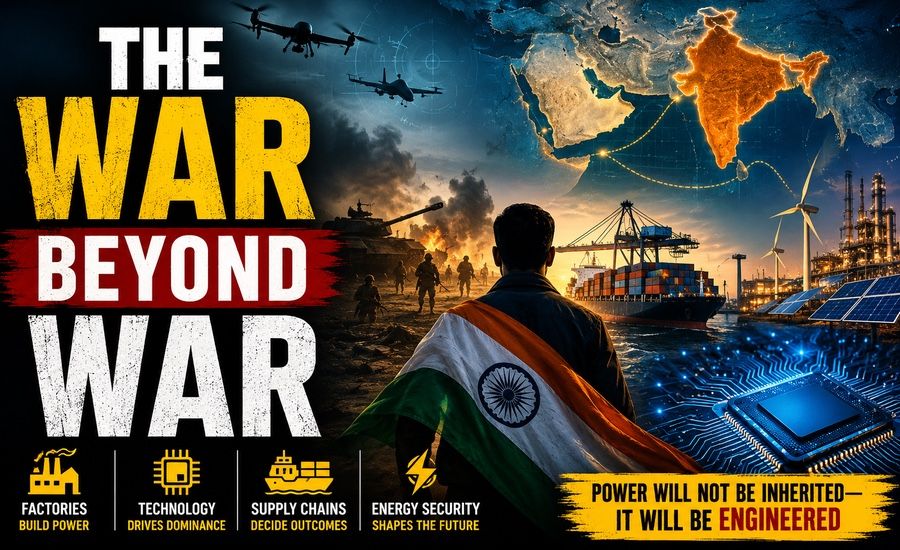
Wars are no longer won only at the front. They are decided well before that in factories, ports, semiconductor fabs, and energy corridors.
That is the single most important strategic lesson this week handed over to India. And frankly, it is one we cannot afford to keep filing away as ‘noted.’
Reading the Battlefield
The partial easing of tensions around the Strait of Hormuz following US–Iran back-channel engagement briefly steadied energy markets and the world is awaiting with bated breath the contours of Iran-US deal to be signed on 19 June. Markets exhaled. Oil prices have dipped. And most commentators have moved on.
But should India?
Absolutely not. Because the lesson here is not about one chokepoint reopening. It is about how dangerously dependent we remain on distant, fragile corridors for our energy, raw materials, and manufactured goods. A single maritime flashpoint, one we do not control can unsettle our inflation numbers, disrupt our industrial schedules, and constrain our strategic options overnight.
Meanwhile, the Russia–Ukraine conflict grinds on. Now well past its third year, it is delivering a masterclass in something military planners have always known but strategic managers often forget: wars are sustained not by courage alone, but by industrial depth, logistics, and institutional stamina.
India’s strategic challenge today is not motivation. It is not even ambition. We have those in abundance. The challenge and the hard truth — is execution.
The New Great Game — Supply Chains Are the New Silk Road
A direct consequence of the West Asia conflict disrupting component supply chains, India’s smartphone sector is projected to contract 18 per cent in 2026, with average prices up 40 per cent This is not a market story. But is a strategic vulnerability story.
The old Great Game was about territory. The new Great Game is about continuity. Who can produce? Who can sustain? Who can endure disruption?
And the world is watching India very closely on all three counts.
The ‘China Plus One’ narrative has been circulating in global boardrooms for a while now. But narrative is not strategy. Goodwill is not a supply chain. India has the demographic scale, the technological capability, and growing geopolitical credibility. The question is whether we can match that with the institutional speed and systems efficiency that global manufacturing demands.
Can our ports and industrial corridors operate at the pace that an iPhone supply chain requires? Can our regulatory machinery match the responsiveness of a defence-grade procurement system? Can our institutions act with urgency rather than protocol?
Hard questions. But necessary ones.
The Doctrinal Shift India Must Make — From Reactive to Resilient
The Army Technology Roadmap 2026 signals something significant. India is formally moving its land warfare doctrine from mass-troop deployments toward technology-driven, precision-oriented operations — drones, AI-enabled decision loops, loitering munitions, and what the roadmap calls ‘technological sovereignty.’
That is the right instinct. But it must extend beyond the battlefield.
India’s broader national security doctrine needs a parallel upgrade. We need to think of semiconductors, energy infrastructure, rare earths, maritime logistics, and critical manufacturing as strategic assets and not commercial conveniences. The Draft Defence Acquisition Procedure 2026, which proposes raising indigenous content requirements to 60 per cent in key procurement categories, is a step forward. But it must be matched by speed of implementation, not just ambition of intent.
Operation Sindoor validated something important. It demonstrated to the world, and to ourselves that indigenous platforms can perform under real-world conditions. That credibility is valuable. Defence exports have grown nearly 35 times over the past decade. The momentum is real. But momentum and sustained strategic depth are not the same thing.
India’s strategic depth today must be built on four pillars: energy diversification, semiconductor self-reliance, maritime resilience, and a manufacturing ecosystem that can sustain disruption. These are not aspirations for 2047. They are operational imperatives for right now.
Emerging Lessons for India — What Must Change
First: Infrastructure and logistics must stop being a talking point and become a performance metric. The world’s most competitive manufacturing destinations are not the cheapest,they are the most reliable. Reliability is a function of logistics, not aspiration.
Second: Energy security is non-negotiable. India’s continued dependence on imported energy through contested maritime corridors is a strategic liability. Accelerating the domestic renewable energy transition is not just an ESG priority, it is a defence priority.
Third: Semiconductor self-reliance must move from policy announcement to production reality. The global chip race is now inseparable from national security. A nation that cannot produce its own chips cannot, ultimately, protect its own systems.
Fourth: Technology sovereignty as articulated in the Army Technology Roadmap 2026 must be the operating principle across all critical sectors, not just defence.
“The strength of a nation derives from the integrity of the home. — Confucius”
Power Will Be Engineered, Not Inherited
India cannot hope that Hormuz stays open. Cannot hope that global supply chains remain stable. Cannot hope that geopolitical turbulence spares us.
What India can do, must do – is prepare. Systematically. Institutionally. Urgently.
The countries that dominate the coming decades will not necessarily be the loudest. They will be the most prepared. The nations that build, move, adapt, and endure. The ones that understand that power in the 21st century is not inherited by history — it is engineered by policy, executed by institutions, and sustained by strategic depth.
India has the opportunity. The demographic dividend. The technological capability. The growing global credibility from Operation Sindoor and the Atmanirbhar defence capability.
But what happens when preparation meets opportunity and what happens when it does not for:
The new Great Game will not be won in press conferences. It will be won on the factory floor, in the logistics chain, in the semiconductor lab, and in the boardroom that finally treats geopolitical risk as what it is — an existential operational reality.
India must decide and decide now whether we are going to be architects of this new order, or spectators to it.
The field is open. The play is ours to make.
(Mylapore Venkata Shashidhar is a military veteran (Colonel, Retd.), Certified Independent Director (IICA), ESG Advocate, and Defence & Strategic Affairs Analyst. He writes regularly for Indian Masterminds, Deccan Herald, DT Next, and Money Control.)