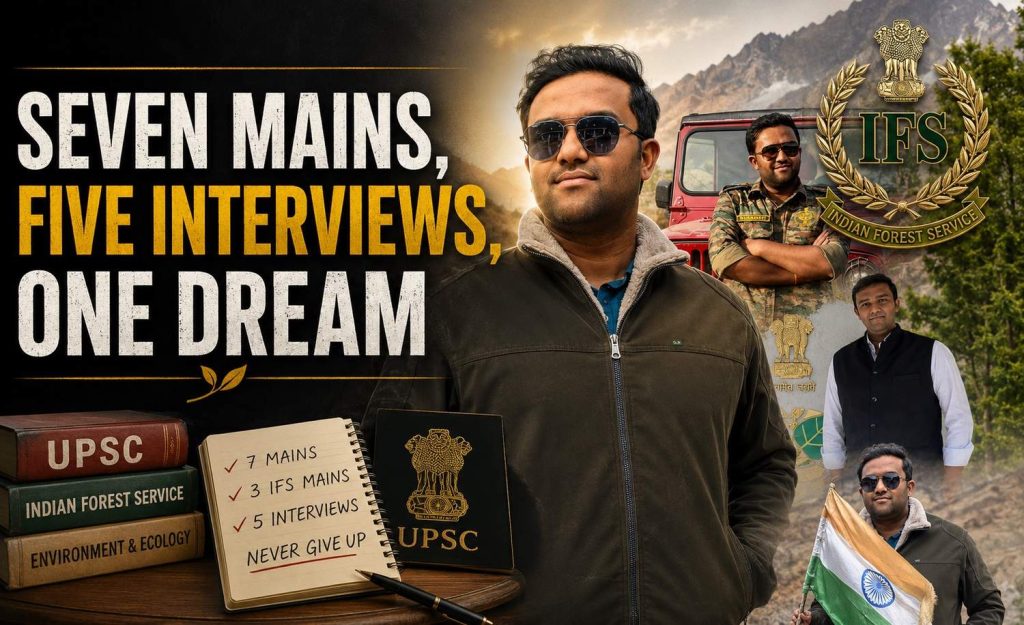
After seven UPSC Mains, three Indian Forest Service Mains, five interviews and years of setbacks, Pradip Babaso Bhandare refused to quit. Today, the 2025-batch Indian Forest Service officer of the Andhra Pradesh cadre says every failure prepared him for success.
There are some dreams that are born in comfort. And then there are dreams that are built on sacrifice.
For Pradip Babaso Bhandare, the journey to the Indian Forest Service (IFS) did not begin in a coaching institute or a city library. It began in Narwad, a small village in Maharashtra’s Sangli district, where every rupee mattered and every opportunity came with a price.
His father worked as a conductor in the Maharashtra State Road Transport Corporation (MSRTC). His mother managed the home while raising four children. Money was always tight. Paying school fees was difficult. During engineering, the family even pledged his mother’s gold ornaments so that he could continue his education.
Years later, that young boy from a Marathi-medium Zilla Parishad school would become an IFS officer of the 2025 batch, allotted to the Andhra Pradesh cadre.
Speaking to Indian Masterminds, Pradip looked back at a journey shaped not by easy success but by relentless determination.
“My humble beginnings never limited my aspirations. They became the foundation of my success.”
WHEN A DREAM FELT TOO BIG
Growing up in rural Maharashtra, Pradip never imagined that one day he would join one of India’s prestigious All India Services.
Like many students from villages, he studied in Marathi medium. English became his biggest obstacle when he entered engineering college to pursue a B.Tech in Electronics.
He often lacked confidence while speaking. Expressing his thoughts in English felt intimidating. But instead of accepting it as a permanent weakness, he worked on it every day.
The challenge was not only academic. Coming from a small village, even dreaming of becoming a civil servant felt unrealistic.
“There was always a fear,” he recalls. “Can someone like me really reach there?”
Instead of allowing that fear to stop him, he used it as motivation.
THE BROTHER WHO KEPT THE DREAM ALIVE
After completing engineering, Pradip made a risky choice. Rather than taking up a stable job, he decided to prepare full-time for UPSC. For a family already struggling financially, it was a difficult decision. That is when his elder brother, Sandeep, stepped in.
He financed Pradip’s preparation, supported him emotionally and stood beside him during every difficult phase. Whenever Pradip travelled for his UPSC interviews, his brother accompanied him. Whenever illness or disappointment struck, he was there.
“If there is one person who made this journey possible, it is my elder brother. He never stopped believing in me, even when I doubted myself.” His sisters also made silent sacrifices.
Despite having families of their own, they travelled to examination centres with home-cooked food so that their brother would not feel alone. His mother’s support came quietly. She saved small amounts from her tailoring work and festival gifts to help him.
His father, despite receiving a pension of less than ₹2,000 a month, always insisted that Pradip carry some money back whenever he visited home. Even today, Pradip has preserved some ₹500 notes given by his father before his final interview.
To him, they are priceless.
SEVEN MAINS. FIVE INTERVIEWS. COUNTLESS HEARTBREAKS.
Most aspirants would have stopped after repeated failures. Pradip did not.
He wrote seven UPSC Civil Services Mains, three Indian Forest Service Mains, and appeared in five UPSC personality tests. Several times, he missed the final selection by just a handful of marks. Those failures were painful. But he says something else hurt even more. It was opening the same books again.
Reading the same syllabus. Writing the same answers.
Beginning once more without knowing whether the result would ever change.
Watching friends settle into successful careers while he continued preparing made the uncertainty even harder. By 2023, he was mentally exhausted. He had almost decided to leave UPSC and join the private sector. Then he made one final promise to himself.
One last attempt. One hundred percent effort. That decision changed everything.
“Success is not decided by how many attempts you give. It depends on the energy and conviction with which you begin every new attempt.”
TURNING FAILURES INTO LESSONS
Looking back, Pradip admits he made mistakes during his early preparation. He believed studying longer automatically meant studying better. He ignored answer writing. He depended on too many books. He revised less.
He also overlooked something many aspirants ignore—physical health. Several times, he fell ill during the Mains examination. That affected his performance. Gradually, he realised that UPSC is not merely an examination of knowledge. It tests endurance, discipline and emotional resilience.
He changed his strategy completely. Instead of collecting more material, he focused on revising. Instead of studying endlessly, he analysed every mistake. Instead of worrying about results, he concentrated on improving every single day.
“Don’t count your attempts. Make every attempt count.”
THE INTERVIEW THAT CHANGED EVERYTHING
One area troubled Pradip throughout his UPSC journey. The interview. In his earlier personality tests, he consistently scored below average. His marks—123, 135 and 145—left him disappointed. But rather than blaming the system, he worked on himself.
He improved his communication. He became more confident. He developed clarity of thought. He treated every interview as practice for the next one. Finally, in his last attempt, everything came together. He scored 225 out of 300, one of the highest interview scores that year. The improvement reflected years of quiet effort.
“Weaknesses are never permanent if we are willing to improve continuously.”
WHY HE CHOSE THE INDIAN FOREST SERVICE
For many UPSC aspirants, the Indian Forest Service is seen as a second choice. Pradip disagrees completely. He believes the IFS is among India’s most important services, especially at a time when climate change, biodiversity loss and water scarcity are becoming national concerns. Growing up near the Western Ghats gave him a close connection with forests and nature. He realised early that forests are much more than trees. They protect rivers. They conserve biodiversity. They support millions of livelihoods. Today, that understanding has become his life’s purpose.
“The Indian Forest Service is not just about protecting forests. It is about protecting India’s future.”
A NEW BEGINNING IN ANDHRA PRADESH
As a 2025-batch IFS officer, Pradip has been allotted the Andhra Pradesh cadre.Instead of viewing it as a posting away from home, he sees it as an opportunity.He has already started learning Telugu.He is reading about the state’s forests, wildlife and conservation challenges.For him, becoming a good officer begins with becoming a good learner.
“Maharashtra will always be my birthplace,” he says. “But Andhra Pradesh is now my workplace.”
A LEGACY ROOTED IN TRUST
When asked how he wishes to be remembered decades from now, Pradip does not speak about awards or positions. He speaks about trust. He wants forests to be healthier than he inherited them. He wants wildlife to thrive.
Most importantly, he wants local communities to become partners in conservation rather than mere beneficiaries. For him, protecting forests also means protecting water, livelihoods and future generations.
“I want people to remember me as someone who built trust between forests and people. If I can leave our forests healthier than I found them, that will be my greatest achievement.”
Pradip Bhandare’s story is not simply about clearing one of India’s toughest examinations. It is about what perseverance looks like when success refuses to arrive for years. It is about a family that carried one dream together.
And it is proof that sometimes, the attempt you believe is your last becomes the one that changes your life forever.
Read Also: Why Sandeep Kumar Sahu Believed in Plan B Before Chasing Plan A