There are career decisions that promise security. And then there are decisions that demand courage.
For Arpita Rajput, the choice was never between a high-paying corporate job and a government position. It was between solving business problems inside boardrooms and solving people’s problems on the ground.
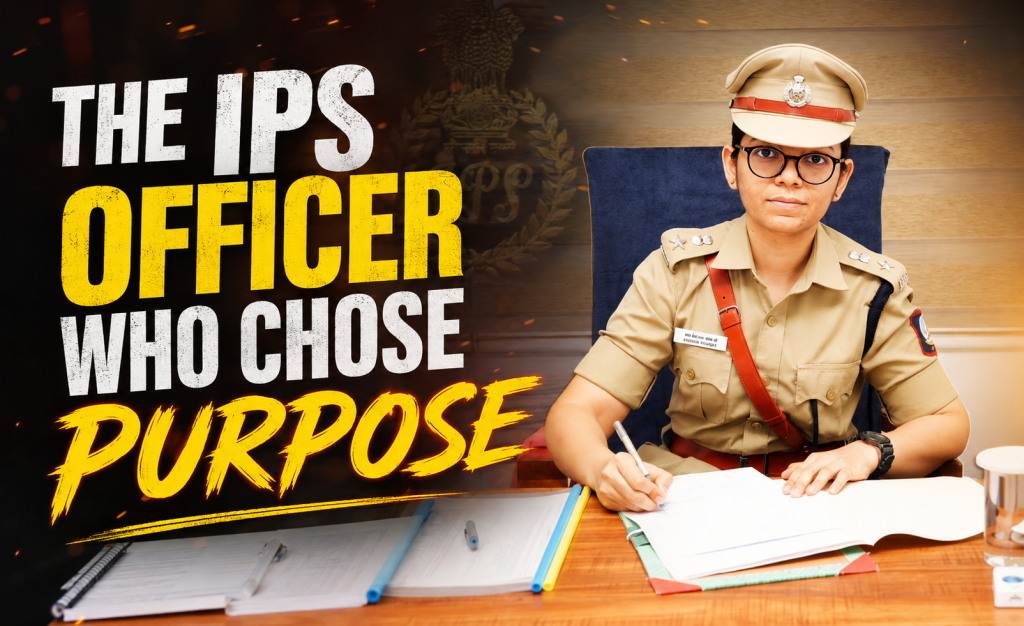
Today, as a 2022-batch IPS officer of the Tamil Nadu cadre serving as Superintendent of Police in the Crime Branch (CBCID), Chennai, she works at the heart of criminal investigations, where every decision carries consequences and every case demands precision. But just a few years ago, her life looked very different.
She was a Chartered Accountant working as a Management Consultant with PwC, helping organisations improve efficiency and tackle complex business challenges. It was the kind of career many aspire to build. Yet, somewhere along the way, she realised that professional success alone was not enough.
“Here we are constantly in touch with the public. We are working for solving the issues of the public directly, whereas in the private sector, you are just solving corporate-level issues. The scope of service is much wider in public service,” she shared in an exclusive conversation with Indian Masterminds.
That thought changed the course of her life.
Also read: Why Sandeep Kumar Sahu Believed in Plan B Before Chasing Plan A
A STRONG ACADEMIC FOUNDATION THAT OPENED MANY DOORS
Born and raised in Gurugram, Arpita studied at DAV Public School before pursuing B. Com (Honours) at Delhi University’s prestigious Lady Shri Ram College.
Her academic journey naturally led her towards Chartered Accountancy, one of the country’s most demanding professional qualifications. Soon after, she joined PwC as a Management Consultant, stepping into the corporate world with promising opportunities ahead.
For many young professionals, reaching that stage would have marked the destination. For Arpita, it became the starting point of a much bigger journey.
She wanted work where the impact could be seen not just in balance sheets or business reports, but in people’s lives. That desire eventually led her towards the Civil Services Examination.
STARTING FROM SCRATCH FOR UPSC
Leaving a stable corporate job for an examination known for its uncertainty is never an easy decision.
Arpita resigned from PwC towards the end of 2019 and began preparing for UPSC. The challenge was bigger than simply studying hard.
Her educational background had revolved entirely around commerce and accountancy. Subjects like history, geography and polity had long disappeared from her academic life.
“It was completely new for me because my entire study had been around commerce and accountancy. I had left history, geography and everything back in school. I picked it up again through self-study. I did not take any coaching,” she recalls.
Without classroom coaching, she built her preparation through disciplined self-study. The result surprised many.
In her very first attempt, she cleared the 2021 Civil Services Examination with an All India Rank of 229 and entered the Indian Police Service.
Behind that success was careful planning as much as confidence.
She had set a personal deadline. “I had restricted myself to two-and-a-half to three years for UPSC. Had it not worked out, I would probably have returned to my old field.”
It was a practical approach that allowed her to pursue her dream while remaining grounded. Throughout this journey, one factor remained constant: her family’s complete support. Whatever career decision she made, they stood firmly beside her.
LEARNING THE REALITIES OF POLICING
After joining the IPS, Arpita underwent Assistant Superintendent of Police training in Erode district.
Her first field posting followed as ASP in Tiruppur district, where she experienced the realities of policing firsthand: public interaction, law and order management, investigations and administrative responsibilities.
Recently, she earned her promotion and took charge as Superintendent of Police in the CBCID Crime Branch, Chennai.
Although she cannot discuss ongoing investigations because of confidentiality, she explains that policing remains interconnected across departments.
“Policing is very overlapping in every department. It is not completely different in the Crime Branch or in field policing. Investigations continue across both,” she told Indian Masterminds.
Her work now focuses on complex criminal investigations that require professional, evidence-based policing while strengthening the criminal justice system.
POLICING IN THE DIGITAL ERA
Crime today no longer resembles what it once did. Technology has transformed not only the way criminals operate but also the way investigators pursue them.
According to Arpita, modern policing demands continuous adaptation.
“Technology has completely changed how crimes are committed and how investigations are done. Criminals are also technologically very smart, which sometimes makes tracing them more difficult.”
Her observation reflects the rapidly evolving nature of law enforcement, where digital evidence, cyber trails and technology-driven investigations have become central to solving crimes.
A STORY ABOUT REINVENTION
What makes Arpita Rajput’s journey stand out is not simply that she became an IPS officer. It is that she chose to begin again.
She walked away from a successful corporate career, returned to textbooks that had little connection with her previous education, relied entirely on self-study and entered one of India’s most competitive services in her very first attempt.
Today, from handling responsibilities in Tamil Nadu Police to serving in the Crime Branch, her career reflects an ability to adapt, learn and embrace completely new challenges.
Her message is equally simple. No career path is permanent. No dream is out of reach when pursued with clarity and purpose.
Her story is proof that success is not about remaining in one profession forever. Sometimes, it begins the moment you decide to rewrite your own future.
Also read: IAS Gargi Jain’s ‘Collector in Classroom’ Is Transforming Tribal Girls’ Education in Gujarat