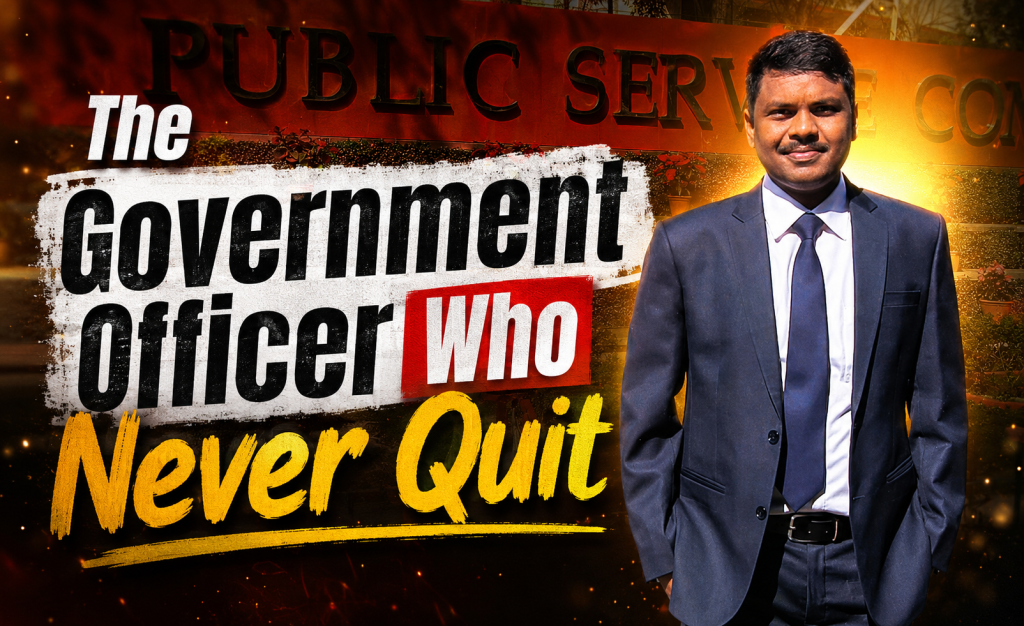
For years, Sandeep Kumar Sahu carried two identities.
By day, he was an engineer in the Madhya Pradesh Water Resources Department, overseeing public works and learning governance from the ground. By night, he remained a UPSC aspirant, chasing a dream that refused to fade despite repeated setbacks.
Seven attempts. Nine years of government service. Only one interview call. And finally, All India Rank 631 in the UPSC Civil Services Examination 2025.
His story is not about overnight success. It is about patience, practical choices and knowing when to pause, when to return and when to give everything to one final attempt.
Also read: Vishwajeet Gupta’s Grounded, Gritty Journey to AIR 67 in UPSC CSE 2025 | Exclusive
A FARMER’S SON WHO BECAME HIS VILLAGE’S FIRST ENGINEER
Sandeep comes from a farming family where education itself was a milestone. His father is a farmer. His mother is a homemaker. As the eldest among four siblings, responsibilities arrived much earlier than opportunities.
“I think I was the first engineering graduate in my whole village,” he shared in an exclusive conversation with Indian Masterminds.
That achievement alone changed expectations in his village. But for Sandeep, engineering was never the destination.
After completing Civil Engineering, he qualified the Madhya Pradesh Public Service Commission and joined the Water Resources Department in 2017. Financial stability came first because family responsibilities could not wait.
The UPSC dream, however, quietly stayed alive.
NINE YEARS OF GOVERNMENT SERVICE WHILE CHASING ANOTHER DREAM
Unlike many aspirants who dedicate several uninterrupted years to preparation, Sandeep chose a different path. He continued serving in the state government while attempting UPSC whenever circumstances allowed.
For nearly five to six years, he worked extensively in the field before moving to a desk posting during the last two years. That administrative posting eventually gave him something he had never truly enjoyed before: time.
Looking back, he admits he was never fully prepared during his earlier attempts.
“I didn’t prepare dedicatedly even for six to seven months in my earlier attempts. I was just going there and attempting the exam.”
Whenever he cleared Preliminary Examination, he would apply for leave and prepare for the next stage. If not, he returned to work.
It became a cycle that continued for years.
THE FINAL ATTEMPT THAT CHANGED EVERYTHING
At 31, Sandeep knew he was nearing the end of his UPSC journey. Instead of treating it like another attempt, he decided to treat it as his last serious opportunity.
“This was supposed to be my last attempt, so I thought, ‘Just give it your full shot.'”
His relaxed posting helped him devote five to six focused hours daily after work. There were no shortcuts, no expensive coaching programmes and no elaborate strategies.
Everything depended on self-study. He simply studied sincerely for the first time. That made all the difference.
ONE INTERVIEW WAS ALL HE NEEDED
Despite seven attempts, Sandeep reached the UPSC interview stage only once. That very interview converted into a rank.
One question from the board has stayed with him. Since he serves in the Water Resources Department, the panel asked him about the long-standing Narmada water-sharing arrangement involving Madhya Pradesh and Gujarat.
The chairman, himself from Gujarat, asked what Sandeep would do if Gujarat demanded more water because Madhya Pradesh had not fully utilised its allocated share.
His answer reflected administrative balance instead of regional loyalty.
“If the demand is genuine, then obviously it must be considered.”
It became one of the defining moments of his interview.
ANTHROPOLOGY WAS MORE THAN JUST AN OPTIONAL SUBJECT
Sandeep initially prepared with Geography as his optional subject. After returning to UPSC preparation following a five-year break, he switched to Anthropology.
The reason was personal.
He had always been fascinated by the relationship between government and society, especially tribal communities, caste structures and social interactions. His brother was also preparing with Anthropology in Delhi, making the transition smoother.
The subject matched both his curiosity and his preparation style, particularly because he enjoyed revising and understanding social processes.
BALANCING WORK, FAMILY AND PREPARATION
Preparing for UPSC while holding a full-time government job is difficult enough. Doing so while carrying family responsibilities adds another layer.
As the eldest sibling, Sandeep had responsibilities that could not be postponed. He never described them as obstacles. Instead, he accepted them as part of life.
“I could hardly dedicate five to six hours. Whatever time you are getting from the job, you need to dedicate it for the preparation,” he told Indian Masterminds.
Unlike many aspirants, he also recognised the advantage of financial stability. His government job removed uncertainty and allowed him to continue pursuing UPSC without placing additional pressure on his family.
WHY EVERY ASPIRANT NEEDS A PLAN B
Perhaps the strongest lesson from Sandeep’s journey has nothing to do with books. It is about planning life wisely.
Soon after graduating, he entered state government service instead of waiting indefinitely for UPSC. Nine years later, he was already a Class-I officer and was due for promotion.
Even if UPSC had not worked out, his career was secure. He believes every aspirant, especially those from middle-class and lower-middle-class families, should think practically.
“First execute the second option: the Plan B.”
He adds that those without financial backing should avoid spending years with no alternative career path.
For him, Plan B never weakened Plan A. It made pursuing it possible.
HONESTY BEFORE STRATEGY
When asked what advice he would give future aspirants, Sandeep did not speak about coaching institutes, expensive material or complicated preparation plans.
His advice was remarkably simple.
- Understand the syllabus.
- Prepare concise notes.
- Revise repeatedly.
- And above all, remain honest with yourself.
He believes sincerity matters far more than appearances. Because after seven attempts, nine years of work, countless compromises and only one interview call, sincerity was finally enough.
Sandeep Kumar Sahu’s journey reminds every aspirant that success does not always belong to the fastest. Sometimes, it belongs to those who quietly keep moving, fulfil their responsibilities, strengthen their foundations and recognise the moment when it is time to give everything they have.
Also read: The UPSC Strategy That Changed Everything for AIR 602 Deepak Baghel