By Rathhore Siddharth Singh
Climate change is no longer a future challenge that policymakers can afford to discuss in abstract terms. It is already reshaping Indian agriculture. Erratic rainfall, prolonged heatwaves, unseasonal storms, hailstorms and shrinking water resources are making farming increasingly unpredictable. For millions of farmers whose livelihoods still depend on open-field cultivation, every season now carries greater uncertainty than before.
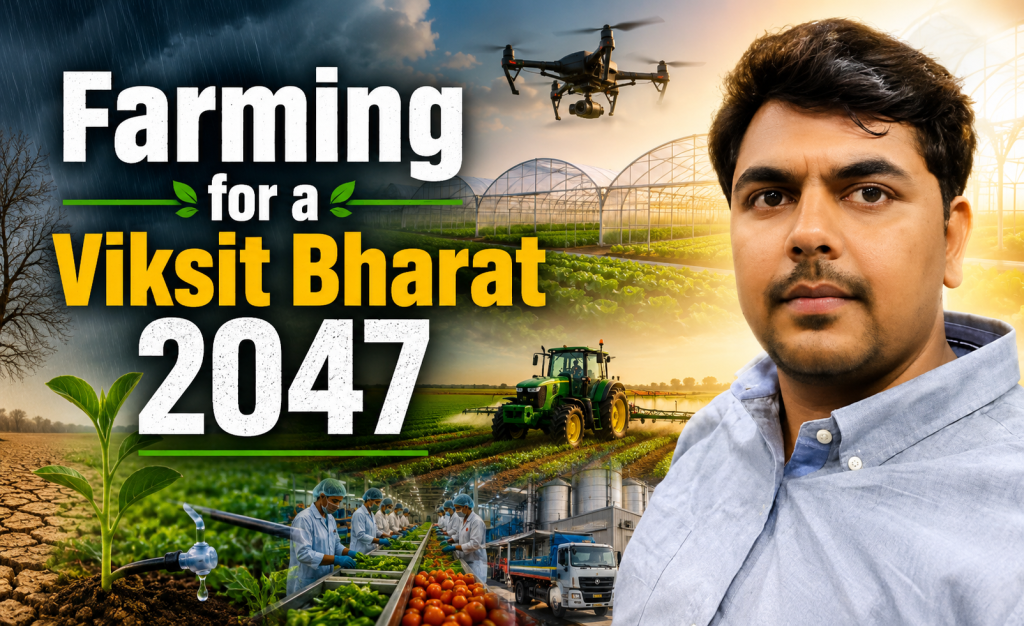
If India hopes to become a developed nation by 2047, improving agricultural productivity alone will not be enough. The country must gradually shift from weather-dependent farming towards climate-resilient protected cultivation on a national scale. This transition is no longer simply an agricultural necessity; it has the potential to become one of India’s most significant industrial and employment opportunities.
Imagine a national mission that develops two million hectares of protected polyhouse farms over the next two decades, between 2027 and 2047. Achieving such an ambitious target cannot remain the sole responsibility of the Ministry of Agriculture. The Ministry of Commerce & Industry must become an equal partner in designing the manufacturing ecosystem that would make this transformation possible.
A practical roadmap could target the development of one lakh hectares of protected cultivation every year for the next twenty years. While the numbers appear ambitious, they also reveal an extraordinary economic opportunity.
Every commercial polyhouse requires a substantial quantity of galvanized steel. On average, one acre consumes nearly 30 tonnes of galvanized steel pipes, meaning every hectare would require around 75 tonnes. Expanding protected cultivation by one lakh hectares annually would therefore generate demand for nearly 7.5 million tonnes of galvanized steel every year.
Also Read – When India’s Constitutional Guardians Speak, Why Does Nobody Listen?
Considering that India’s annual finished steel production stands at roughly 120 million tonnes, protected agriculture alone could account for nearly six percent of national output. Such sustained and predictable demand would encourage manufacturers to establish dedicated production facilities, invest confidently in capacity expansion and create thousands of new jobs across the steel value chain over the next two decades.
This illustrates an important point. Protected agriculture should not be viewed merely as a farming programme. It is equally an industrial growth strategy.
The employment potential is equally significant. If India enables one lakh agripreneurs every year to establish one hectare each under protected cultivation, the programme could directly and indirectly generate sustainable livelihoods for 10 to 20 lakh marginal and small farmers annually. Employment opportunities would emerge not only on farms but also through nursery operations, contract farming, post-harvest management, logistics and numerous allied rural enterprises.
Unlike many infrastructure projects that offer only temporary economic benefits, a well-designed polyhouse built using quality galvanized steel has an operational life of 20 to 30 years. These structures represent long-term productive national assets capable of generating income and employment over decades.
Currently, the National Horticulture Board provides financial assistance to farmers for establishing protected cultivation infrastructure. However, this support could be complemented by industrial policies that encourage domestic manufacturing of agricultural-grade galvanized steel components specifically designed for polyhouse construction.
Standardised manufacturing incentives could reduce production costs through economies of scale, improve quality consistency, encourage technological innovation and ultimately make protected cultivation more affordable for farmers across the country.
Steel, however, is only one part of a much larger industrial ecosystem.
Developing one lakh hectares of protected cultivation every year would generate sustained demand for UV-stabilised plastic films, shade nets, insect-proof netting, drip irrigation systems, fertigation equipment, climate control sensors, water storage infrastructure, nutrient solutions, cocopeat, growing media, nursery systems, cold chain facilities, export-quality packaging materials, food processing units and specialised agricultural machinery.
Each of these industries would require long-term investment, technology development, skilled manpower and quality standards. A clearly defined twenty-year national roadmap would give manufacturers the confidence to expand production capacities instead of responding to uncertain and fragmented demand.
The ripple effects would extend well beyond farm infrastructure.
As production of high-value fruits, vegetables and flowers increases, India would simultaneously require major investments in cold storage, refrigerated transportation, warehousing, export-oriented packhouses, food processing parks, fresh produce distribution networks, digital agricultural marketplaces and traceability systems that meet international export standards.
Taken together, a national protected cultivation mission has the potential to become one of the largest integrated agricultural, industrial and rural employment programmes in independent India’s history.
Such an ambitious transformation would require coordinated governance. One possible approach would be to establish a National Protected Agriculture Manufacturing Mission jointly led by the Ministries of Agriculture & Farmers’ Welfare, Commerce & Industry, Steel, Chemicals & Fertilizers, Food Processing Industries, Jal Shakti and MSME. Coordinated planning across ministries would ensure that manufacturing capacity grows alongside agricultural expansion rather than lagging behind it.
Digital infrastructure should become another pillar of this transformation.
Every protected farm established under government-supported programmes could be integrated into a National Digital Protected Farming Registry. Information relating to geographical location, structure specifications, crop plans, irrigation systems, expected production cycles, input requirements, harvest schedules and market linkages could be captured on a unified digital platform.
Such real-time data would enable policymakers to forecast production well in advance, prevent excessive cultivation of identical crops, improve price stability, optimise logistics, strengthen export planning and make evidence-based policy decisions. It would also significantly enhance India’s food security planning by providing visibility into national production capacity.
The experience of the Netherlands demonstrates what is possible when scientific farming, manufacturing support, logistics and digital planning work together. Despite its limited land area, the country has emerged as one of the world’s largest agricultural exporters through protected cultivation and integrated supply chains.
India possesses far greater land resources, a rapidly expanding manufacturing base, entrepreneurial talent and one of the world’s largest domestic markets. With coordinated planning and long-term policy commitment, the country can build a protected agriculture ecosystem suited to Indian conditions while emerging as a global leader in climate-resilient horticulture by 2047.
Ultimately, this vision extends far beyond agriculture. It is a national development strategy that brings together manufacturing, infrastructure, digital governance, rural entrepreneurship and environmental sustainability. If executed with the same scale and commitment that India has demonstrated in sectors such as renewable energy and digital public infrastructure, protected cultivation could become a defining pillar of the country’s journey towards a developed, climate-resilient and economically stronger India by 2047.
About The Author– (Mr. Rathhore Siddharth Singh is an engineer turned impact-focused communication professional, passionate about innovation, storytelling and nation-building. AI enthusiast exploring the intersection of technology, governance and public policy. He has experience in leading prestigious initiatives and driving strategic communication for meaningful impact.)
Disclaimer—(The views and opinions expressed in this article are solely those of the author and do not necessarily reflect the views of Indian Masterminds. For feedback or queries, please write to [email protected].)
Also Read – Why Sanjay Gahlot Left the Indian Army to Serve the Nation Through the IRS