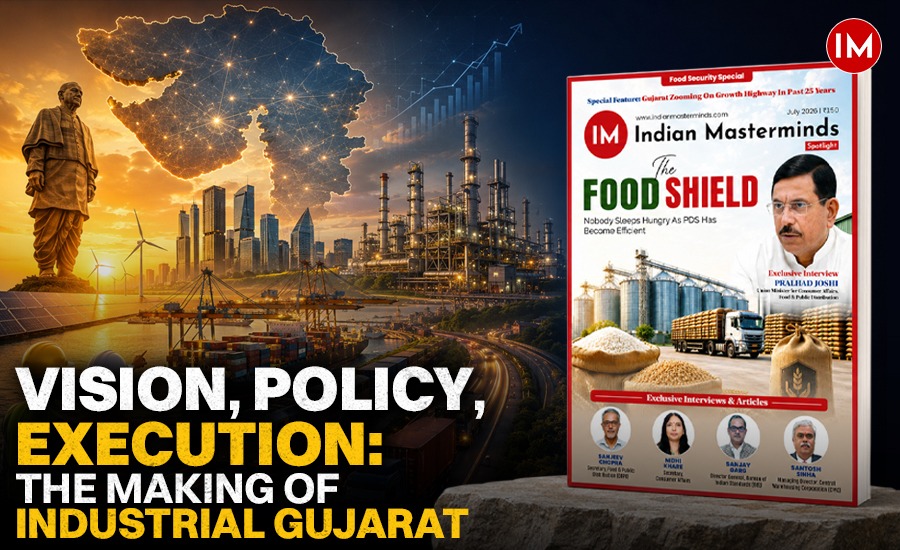
When the story of Gujarat‘s rise over the past 25 years is told, it almost always begins — and often ends — with industry. Petrochemicals, textiles, ports, and Vibrant Gujarat Summits dominate the narrative. But beneath that industrial gloss lies an equally impressive, and far less celebrated, transformation of the state’s fields, highways, heritage sites, and towns. Gujarat’s non-industrial growth since 2000 represents a comprehensive development story that deserves to be told on its own terms.
The Agricultural Revolution
At the turn of the millennium, Gujarat’s agriculture was largely subsistence-driven, volatile, and rainfall-dependent. Over the following two decades it shifted into a diversified, market-oriented sector — a transformation now held up nationally as a model. The numbers are decisive: cotton production rose from 11.6 lakh bales to 92.48 lakh bales — a jump of 696 per cent — while groundnut productivity improved from 398 kilograms per hectare to 2,740 kilograms. Gujarat was the first state to implement soil health cards, and the adoption of Bt Cotton sharply cut pesticide use in arid regions. In dairy, annual milk production reached 17.28 million metric tonnes in 2024, with per-capita availability rising from 291 grams per day in 2000-01 to 670 grams by 2022-23.
Read Also: Building a Quality Nation: How BIS Is Shaping Safe Products and Smarter Consumers
Dholavira and the Statue of Unity
Gujarat’s most dramatic cultural assertions of the past 25 years have come through two monuments separated by millennia but united in global ambition.
In 2021, UNESCO inscribed Dholavira in its World Heritage Sites list — Gujarat’s fourth such recognition. Occupied between approximately 3000 and 1500 BCE on the island of Khadir in the Rann of Kutch, the site features one of the best-preserved Harappan urban settlements in South Asia, with a fortified city, sophisticated reservoirs, and a large cemetery. From a remote desert site, Dholavira has been developed into a world-class archaeological destination drawing scholars and travellers from across the globe — its scale and complexity so vast that even the President of India, on her visit in early 2025, remarked it would take three to four days to fully explore.
The other monument is entirely modern but equally audacious. The Statue of Unity — a 182-metre tribute to Sardar Vallabhbhai Patel inaugurated in 2018 on the banks of the Narmada River near Kevadiya — is the world’s tallest statue, rising 54 metres higher than the previous record holder in China. It attracted 2.9 million visitors in its first year and had crossed 15 million cumulative visitors within five years of opening, drawing up to 30,000 visitors a day at peak season. The entire Kevadia township around it has been developed into an integrated tourism circuit, complete with a jungle safari, valley of flowers, tent city, and an evening laser show.
Festivals That Draw the World
No single development better captures Gujarat’s tourism transformation than its festivals — cultural properties built patiently into global events.
Rann Utsav began as a modest three-day gathering welcoming 3,000 visitors and has grown into a 100-day global extravaganza drawing over 1 million tourists in 2024-25. Set against the surreal white salt flats of Dhordo in Kutch, the festival has also put the region on the world map: Dhordo village was named one of 54 Best Tourism Villages by the United Nations World Tourism Organisation in 2023.
Then there is Uttarayan. Since 1989, the government has promoted the International Kite Festival as a global event, inviting flyers from around the world. What was once a regional celebration of Makar Sankranti has become one of Asia’s most spectacular open-air spectacles. In January 2026, the festival drew 135 international kite flyers from 50 countries, inaugurated by Prime Minister Modi alongside the German Chancellor at the Sabarmati Riverfront. An estimated 8 to 10 million people participate annually.
Urban Renaissance
At the heart of Ahmedabad’s reinvention is the Sabarmati Riverfront. By channelling the river to a constant width, the project reclaimed approximately 200 hectares of riverbed land, creating 11.25 kilometres of public riverfront along both banks. The city now has a 22.5-kilometre promenade walkway — recognised by KPMG as one of the 100 Most Innovative Projects in urban regeneration globally. It hosts kite festivals, cycling events, cultural programmes, and is being extended to 34 kilometres under Phase 3.
Sports Capital of India
Gujarat has staked a compelling claim as India’s sporting capital. The Narendra Modi Stadium in Motera, with a seating capacity of 1,32,000, is the world’s largest cricket stadium — having hosted the 2023 ICC World Cup final, multiple IPL finals, and the 2026 T20 World Cup final. In November 2025, Ahmedabad was officially declared host of the 2030 Commonwealth Games — the centenary edition — with events spread across Ahmedabad, Gandhinagar, Vadodara, and Ekta Nagar. A 350-acre Sardar Vallabhbhai Patel Sports Enclave is being developed around the Narendra Modi Stadium, featuring an aquatics centre, indoor athletics arena, and tennis courts on the banks of the Sabarmati. Gujarat is not merely hosting the Games; it is building a sporting legacy designed to last well beyond 2030.
The Bigger Arc
Tourism’s contribution to Gujarat’s GDP grew from around five per cent in 2015 to 10.2 per cent in 2022. By 2023, domestic visitor arrivals had reached 178 million. The factory floor will remain Gujarat’s most famous address. But the land, the sky, the river, and the ruins around it have quietly built a parallel story — one that now belongs to the world.
Read Also: How Regular Phone Calls and Home Visits Reduced Maternal Deaths in Shahdol by 50%