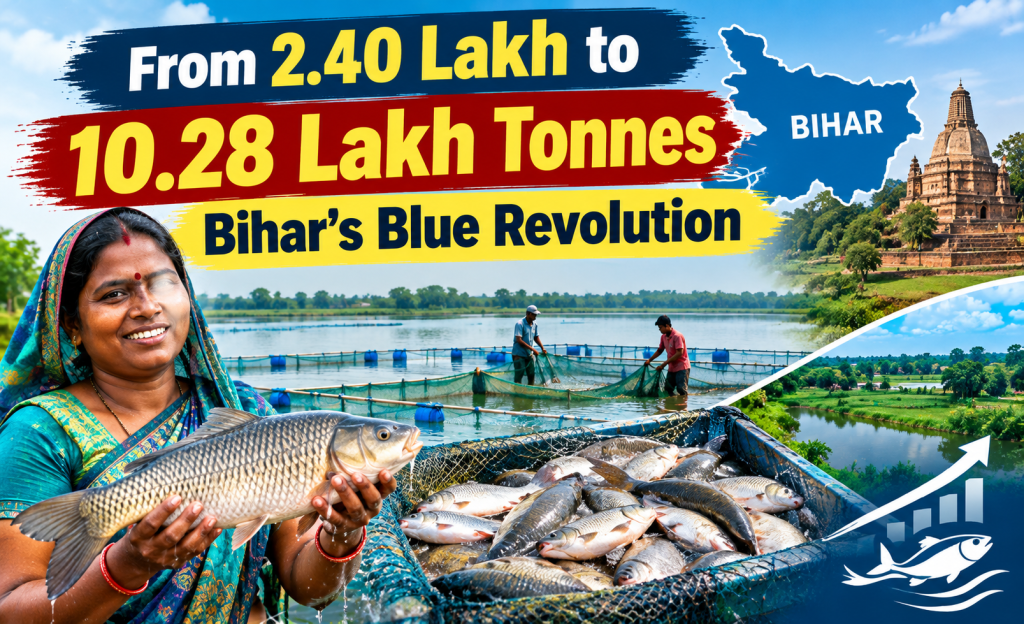
A state does not need a coastline to build a thriving fisheries economy. Bihar has proved that. Twenty-five years ago, Bihar produced only 2.40 lakh tonnes of fish and depended heavily on supplies from Andhra Pradesh and West Bengal. Today, the state produces 10.28 lakh tonnes, ranks fourth in India in fish production, and sends nearly 89,600 tonnes of fish every year to neighbouring states and other markets.
That is a 328 per cent rise in 25 years. The fishing and aquaculture sector now contributes more than ₹20,000 crore to Bihar’s economy. The transformation did not happen through one scheme or one intervention. It came from a chain of reforms. Bihar improved its ponds and reservoirs, strengthened fish seed production, introduced technology, changed administrative processes, built market infrastructure and invested in institutions.
At the centre of several of these reforms was Dr N. Vijaya Lakshmi, IAS, a 1995-batch officer. She is currently serving as the Additional Chief Secretary, Planning and Development Department, Government of Bihar. Earlier, she served as Principal Secretary, Dairy, Fisheries & Animal Husbandry Department, Government of Bihar, where she played an important role in shaping the state’s fisheries strategy.
FROM FISH IMPORTER TO NET SUPPLIER
Bihar has always had water. What it lacked was a system to turn that water into sustained economic opportunity. The state has more than 1.22 lakh hectares of tanks and ponds, around 9.5 lakh hectares of floodplain wetlands and derelict waters, 0.64 lakh hectares of reservoirs, and more than 21,354 kilometres of rivers and canals.
For a state with a strong fish-eating culture, this was a huge natural advantage. Yet much of it remained underused. Fish production increased slowly for many years. It rose from 2.40 lakh tonnes around the beginning of the century to 4.80 lakh tonnes by 2014-15. The real change came after the mid-2010s, when production began rising much faster.
Today, Bihar has not only become self-sufficient in fish production but also supplies fish to other states. Per-capita fish consumption has also reached nearly 13 kg a year, making fisheries relevant not only to incomes but also to nutrition.

THE FIRST CHANGE: BRINGING WATER BODIES INTO THE FISHERIES SYSTEM
One of Bihar’s biggest challenges was administrative. Fishing rights over reservoirs were with the Water Resources Department, while the Fisheries Department had the technical expertise to develop these resources. This limited the ability of the fisheries administration to plan and manage reservoirs as productive assets.
The Bihar State Reservoir Fisheries Policy, 2022 changed this arrangement by transferring reservoir fishing rights to the Fisheries Department. This opened the door to new methods such as cage and pen culture. More than 630 cages and 88 pens have since been supported across the state.
The state also launched the Mukhya Mantri Integrated Wetland Development (Chaur Vikas) Programme for floodplain wetlands and derelict waters. A separate Reservoir Fisheries Development component encouraged systematic fingerling stocking and better technologies. The idea was simple: use the water resources Bihar already possessed, but manage them scientifically.
MAKING SMALL PONDS MORE PRODUCTIVE
The transformation was not limited to large reservoirs. For thousands of small and marginal farmers, ponds are the heart of the fisheries economy. The Pond Fisheries Development scheme therefore became an important part of the strategy.
Mechanical aerators and solar pump sets were introduced to improve productivity and reduce dependence on unreliable electricity. This was important because productivity in Bihar’s reservoirs had once been extremely low. In the mid-2010s, some reservoirs produced barely 5 kg of fish per hectare. The focus was therefore not simply on increasing the area under fisheries. It was on producing more fish from existing water bodies.
QUALITY SEED WAS THE MISSING LINK
Fish production cannot improve without good-quality seed. For years, Bihar produced less than one per cent of India’s fish seed and depended on hatcheries outside the state. Building local capacity became a major priority. Today, Bihar has around 200 functional hatcheries and 121 fish farms.
The state also developed stronger links between local hatcheries, small nurseries, private hatcheries outside Bihar and institutions such as the National Fisheries Development Board. Improved varieties such as Jayanti rohu and improved catla were introduced in government-supported ponds.
The results were significant. Pond productivity increased by around 30 per cent, fisherfolk incomes by 25 per cent, fish mortality fell by 10 per cent, and growth rates improved by more than 25 per cent compared with conventional varieties. Bihar is now going one step further by building its own breeding capacity. Local hatcheries are being developed as brood-stock banks, while the state’s first Fish Brood Bank has been established at Raghopur Bakhri in the Dumra region of Sitamarhi.
FROM PRODUCING MORE FISH TO EARNING MORE FROM IT
Higher production alone does not guarantee better incomes. Farmers and fisherfolk also need markets. Bihar’s next phase therefore focuses on Market Infrastructure Development. Fish market shades are proposed at the block level, with a wider network planned at the panchayat level. The state is also moving beyond selling fresh fish.
Ready-to-Eat and Ready-to-Cook fish products are being promoted to create opportunities in processing and value addition. The Fish Waste to Wealth initiative aims to convert discarded fish waste into products such as fish silage, fish scales and isinglass. This approach ensures that more value stays within the local economy.
REWRITING THE PAPERWORK FOR SMALL FARMERS
Infrastructure was only one part of the reform. A major challenge was access to government schemes. Small farmers often struggled with cumbersome documentation, including Land Possession Certificates.
The system was changed to accept short-term lease agreements and land-tax receipts, helping thousands of small and marginal farmers access government benefits.
This is one of the less visible reforms behind Bihar’s fisheries growth. But for a farmer, simpler paperwork can be as important as a new hatchery or pond technology.
THE VISION BEHIND THE TRANSFORMATION
Dr N. Vijaya Lakshmi’s approach was to look at fisheries as a complete economic ecosystem rather than simply a department dealing with fish production. “Bihar’s natural water endowment and its long-standing fish-eating tradition made it a natural fit for aquaculture — and some years of focused state effort can turn that potential into a quantum jump in production,” she said.
Her career includes important assignments as District Collector, Secretary of the Agriculture Department, Principal Secretary of the Dairy, Fisheries & Animal Husbandry Department in Bihar, and a stint with the Union agriculture ministry. She holds a PhD in Management from IIT Delhi and has undergone public-policy training at ISB Hyderabad.
Today, as Additional Chief Secretary, Planning and Development Department, Government of Bihar, her current role places her in a wider position to contribute to the state’s development planning.
BUILDING INSTITUTIONS FOR THE NEXT PHASE
Bihar’s fisheries transformation has also been supported by sustained public investment. More than ₹902 crore from the Government of India has been invested in the state’s fisheries sector over the last decade, apart from state government spending. The state now has major assets such as the NFDB Regional Centre at Patna, the Vanasur Integrated Aqua Park in Bhojpur, and the Fish Brood Bank in Sitamarhi.
An integrated aquaculture complex is also being developed with carp and striped catfish hatcheries, brooder incubation facilities, biofloc tanks, Recirculatory Aquaculture System (RAS) units, fish-feed manufacturing facilities, and laboratories for water-quality and disease diagnosis.
Training has also become part of the strategy. Around 534 block-level fishermen cooperative societies have approximately 4.12 lakh fishermen associated with them, including nearly one lakh women fishermen. Fisherfolk are receiving hands-on training, while senior officials have studied aquaculture practices in countries such as Malaysia and Vietnam for possible adaptation in Bihar.
A ₹20,000-CRORE ECONOMY AND A BIGGER AMBITION
The economic impact is now visible in the state’s GSDP. The contribution of fishing and aquaculture rose from ₹11,540 crore in 2020-21 to more than ₹20,000 crore in 2024-25, a 73 per cent increase in four years. The sector has also outpaced the broader agriculture sector in three of the past five years.
Bihar’s fisheries story is therefore not just about fish. It is about what happens when natural resources, policy, technology and administration begin working together.
The state has moved from importing fish to becoming a net supplier. But the next challenge is larger — building stronger markets, adding value, improving skills, adopting technology and ensuring sustainability. Bihar had the water all along. What changed was the system built around it. And that may be the most important lesson from its ₹20,000-crore fish economy.
Also Read – How IFS Kritagya Kumar Helped Break a Multi-State Timber Smuggling Network