For years, illegal mining in the forests of Sarmathura was seen as a problem that was too deeply rooted to solve. Mining had been taking place for generations. Operators knew the hills, escape routes and forest tracks better than enforcement teams. Their local networks were strong, while forest staff often had limited manpower.
There was also a growing threat to wildlife. The affected landscape included areas in the buffer of the Dholpur-Karauli Tiger Reserve (DKTR), used by tigers, leopards, caracals, bears and other species.
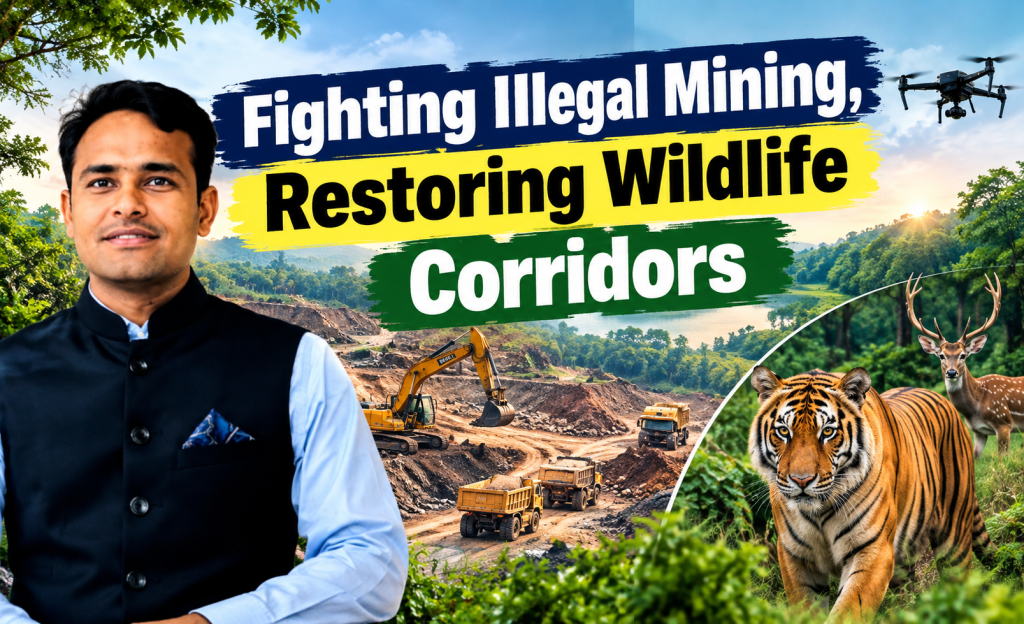
It was in this challenging landscape that Chetram Meena, RFS 2022, took on the fight against organised illegal mining. He is currently posted as ACF, Sarmathura, Dholpur. Instead of relying only on conventional raids and vehicle seizures, he combined technology, intelligence, night operations and coordinated field action.
The result was a sustained enforcement drive in which more than 70 vehicles and heavy mining machines were seized and nearly 12,000 hectares of forest were brought under effective protection. More importantly, wildlife began returning to areas that had once been heavily disturbed.
WHEN ILLEGAL MINING BECAME MORE THAN A FEW PITS
When Meena first examined the situation closely, he realised that the problem was much larger than a few illegal mining pits.
Mining had spread across a large forest landscape. It was damaging natural regeneration and plantations and disturbing wildlife movement. In Rijhoni, the situation was especially serious because a significant part of the area falls in the DKTR buffer.
Blasting, heavy machinery, noise, night-time movement and deep excavation pits had entered a landscape that should have remained relatively safe for wildlife.
There was also a personal reason that made the issue particularly important for the forest officer. Forest departments spend months and large sums of money raising plantations and protecting them. Seeing those plantations destroyed within days by mining was deeply frustrating.
The existing enforcement system was largely reactive. Teams would chase vehicles, catch them occasionally and compound them. But the same vehicles could return to the forest later.
“We could not keep doing the same thing and expect a different result. We had to understand the entire system — the pits, the machinery, the routes, the people involved and even how information was reaching the mining operators,” Meena told Indian Masterminds.
FROM REACTIVE RAIDS TO INTELLIGENCE-LED ENFORCEMENT
The first major change was to understand how the mining network worked. Mining operators knew the terrain well. Every pit could have several approach and escape routes. They also had information about the movement of forest personnel.
The challenge was therefore not simply to find a mining pit. It was to anticipate where mining activity would take place and make it difficult for operators to escape. Meena and his team began mapping the landscape using Google Earth imagery. Mining pits and approach roads were identified before field teams entered the area. Multiple routes around the pits were studied to determine where interception points could be placed.
Existing mining pits were also GPS-tagged, along with photographs and videos. Beat Guards were made responsible for these locations. Any fresh excavation or change could then be detected and accountability fixed.
WHEN DRONES CHANGED THE GAME
Technology became a crucial part of the enforcement strategy. The biggest change came through the use of thermal and night-vision drones. Earlier, illegal miners believed that once they entered deep inside the forest after dark, they would be difficult to locate. Drones changed that assumption. They allowed teams to scan large areas quickly, detect operating machinery and guide ground teams towards the location.
The impact was not only operational. It was psychological. “The biggest impact of the drone was psychological. People started feeling that even if they went deep into the forest and worked at night, they could still be seen,” Meena said. The team also strengthened its local intelligence network. Bagh Mitras, local volunteers and trusted local sources provided information that could not always be obtained through routine patrols. This combination of technology and human intelligence made the limited manpower more effective.
SEIZING THE MACHINES, NOT JUST IMPOSING FINES
Another important shift was the treatment of mining machinery. Earlier, vehicles could be caught and compounded, but this did not always stop the operators from returning. Where legally warranted, the team began confiscating vehicles and heavy machinery. For mining operators, losing an expensive excavator could be far more damaging than paying a routine fine.
The enforcement drive also received strong support from CCF P. Kathiervel, IFS 2004, who provided additional staff and a flying team from other divisions to remain stationed in Sarmathura. This ensured that ground teams could respond quickly whenever drone surveillance detected activity.
A NIGHT WHEN THE TEAM FACED A HOSTILE CROWD
One night operation became particularly challenging. During surveillance, a drone detected an excavation machine operating inside the forest. A ground team was immediately sent to the location and managed to intercept the machinery. But as the offenders tried to escape, resistance began.
While the team was taking the seized vehicle out, a group of local women surrounded them. The situation became tense and the vehicle was forcibly taken back. Some staff members were injured. There were also threats of serious allegations against the forest personnel. Additional police support, nearby range staff and personnel from DKTR had to be called in. Eventually, the situation was brought under control and the operation was completed.
For Meena, the incident highlighted the risks faced by frontline forest personnel. “As an officer, I feel that my role was to stand with them, take responsibility for the decision and ensure that they knew they were not alone in the field,” he said.
WHEN NATURE STARTED TAKING THE FOREST BACK
The real measure of success was not the number of machines seized. It was what happened after the mining pressure reduced. The area became quieter. Blasting stopped. Heavy machinery disappeared. Night-time human movement declined. Then the camera traps began recording wildlife in areas that had earlier been heavily disturbed.
Tigers, leopards, caracals, foxes and other animals were recorded using these areas. Some tigers began using them more freely as movement corridors. The repeated sighting of the elusive caracal was especially encouraging.
Even some abandoned mining pits began serving unexpected ecological purposes. Some provided temporary shelter for animals, while others filled with rainwater and became small water sources. Natural vegetation also began returning in some disturbed locations. For Meena, this was the most satisfying outcome.
PROTECTING CORRIDORS NEEDS MORE THAN ENFORCEMENT
Stopping illegal mining is only one part of protecting a wildlife corridor. A corridor is not simply vacant forest on a map. It is a route that allows animals to move between habitats, find food and shelter and maintain ecological connectivity.
Permanent disturbances such as mining can gradually take away this space. Technology can help monitor these landscapes through drones, camera traps, GPS-based patrolling, satellite imagery and Google Earth. But technology alone cannot protect a forest. Local communities and frontline staff remain equally important.
Meena believes people living around forests can become an early-warning network by reporting illegal activity. Genuine local conservation efforts should also be recognised and encouraged. The long-term solution, he says, lies in bringing all these elements together.
“For me, the long-term answer is strong enforcement, technology, motivated field staff, local intelligence, inter-departmental coordination and genuine community participation,” Meena told Indian Masterminds. The Sarmathura experience shows that organised illegal mining can be challenged when enforcement becomes smarter, faster and more persistent. But its biggest lesson lies beyond the seizures.
When the machines leave and the noise stops, the forest begins to reclaim its space — and wildlife follows.
Also Read – How IFS Kritagya Kumar Helped Break a Multi-State Timber Smuggling Network