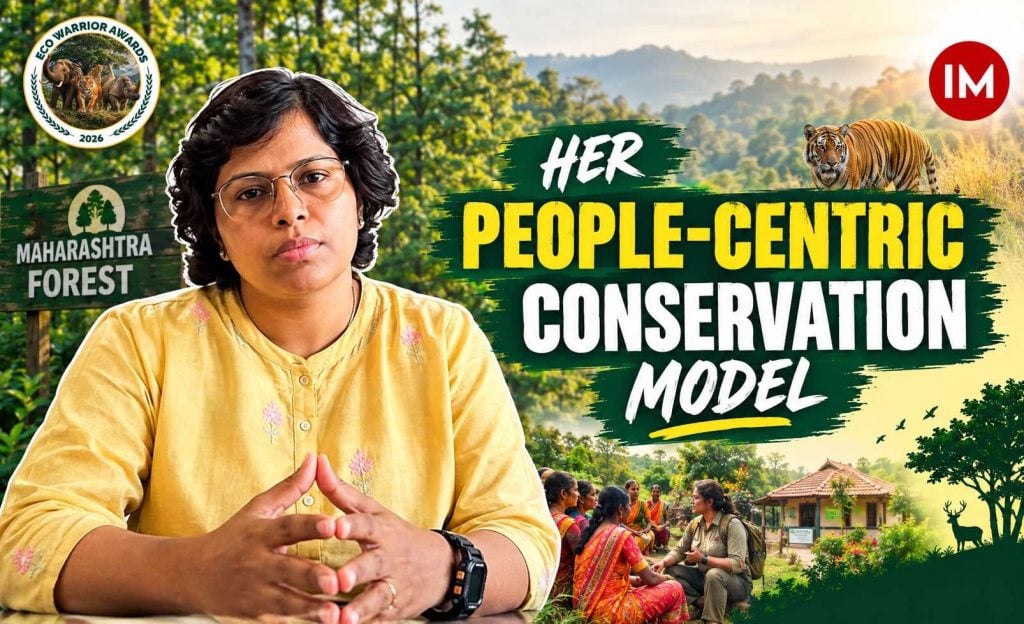
For many, the image of an Indian Forest Service (IFS) officer is associated with tiger sightings, wildlife rescues and long patrols through dense forests. But for Piyusha Jagtap, an IFS officer of the 2014 batch of the Maharashtra cadre, conservation is much larger than protecting animals.
Across her postings in Melghat Tiger Reserve (MTR), Tadoba–Andhari Tiger Reserve (TATR) and her present responsibilities in Navegaon–Nagzira Tiger Reserve (NNTR), Jagtap has worked at the intersection of wildlife, communities, livelihoods, forest administration and environmental awareness.
Her approach has been clear: forests cannot be protected through enforcement alone. Local communities must become partners, forest personnel must receive institutional support, and the younger generation must develop a lasting relationship with nature. Her work has therefore ranged from helping relocated families develop homestays and promoting community-based tourism to preventing forest fires, strengthening forest personnel and using art and storytelling to make conservation accessible.
“I always loved to paint and write… I wanted something that would keep me close to nature,” Ms Jagtap told Indian Masterminds, explaining how her personal interests eventually became an important part of her professional journey.
A Personal Choice to Work Close to Nature
Ms Jagtap’s entry into the Indian Forest Service was shaped by her personality and her love for the outdoors.
After joining the Indian Corporate Law Service following her first civil services attempt, she found the metropolitan, cubicle-oriented work environment less suited to her. She preferred outdoor movement, smaller towns and a profession that allowed her to remain connected with nature.
The IFS provided that opportunity.
But joining the forest service also changed her understanding of what forest administration actually involves. Behind the popular image of wildlife and safaris lies a demanding managerial responsibility involving production forestry, conservation, human-wildlife conflict, threats to forests and the safety of frontline personnel.
Ground staff, she points out, often work under considerable risk. Foot patrols and inspections can involve unpredictable encounters with wildlife, requiring both experience and constant alertness.
How Storytelling Became a Conservation Tool
During the COVID-19 lockdown, when movement was restricted and official activity slowed, Jagtap found another way to remain connected with the forest.
She began sketching from her office desk—one drawing every day.
Over 50 days, she created 50 sketches depicting the largely unseen world of forest personnel and their work. The drawings were later developed into leaflets and eventually a small book.
“There are so many things being done inside the forest, but people are not aware,” she said. “Forest staff work incredibly hard, but nobody really knows.”
What began as a creative exercise thus became a communication initiative. Through illustrations and simple narratives, she brought the work and dedication of forest personnel closer to the public.
This later evolved into “The Lesser Known Khakee”, an initiative that highlighted the often-unseen contribution of forest staff.
For Jagtap, communication is not an accessory to conservation. It is one of the ways of building understanding and appreciation for forests.
Bana: Giving the Forest a Local Voice
Her use of storytelling became particularly visible during her posting at Melghat Tiger Reserve.
There, she created Bana, a mascot inspired by the Korku tribe. The name “Bana”, meaning “bear” in Korku, gave the character a local identity and allowed ecological messages to be communicated through familiar cultural references.
Through illustrated narratives, Bana became a storyteller of the jungle, helping convey conservation messages to local communities and visitors at the Nature Interpretation Centre.
Her work at Tadoba took another creative form. She began pairing photographs with short reflective notes, documenting moments and experiences from the forest.
Her writing, largely in Marathi, has remained personal rather than academic.
“I write for my own enjoyment… it’s about my journey,” she said.
The same philosophy runs through her administrative work: connect with people in ways they understand rather than relying exclusively on official language and technical communication.
From Relocation to Livelihoods
At Melghat, Jagtap and her team worked with communities that voluntarily relocated from core forest areas.
But relocation, in her view, could not simply mean moving people away from the forest. The larger question was how families would sustain themselves after relocation.
This led to a focus on livelihood generation through homestays.
Families with limited income and small, unproductive landholdings were trained in hospitality and encouraged to develop homestays using their own resources and effort.
The model gradually began producing visible results.
“People who had one homestay now have five,” IFS Jagtap told Indian Masterminds. “That gives me immense happiness.”
Birdwatching and community-based tourism were also encouraged as ways of creating sustainable income opportunities while reducing dependence on forest resources.
The larger lesson was that conservation and livelihood security do not have to compete with each other. When communities benefit from a healthy natural landscape, they have a stronger reason to protect it.
Fighting Forest Fires Through Community Ownership
Forest fires are another major challenge in central Indian landscapes, where many fires are caused by human activities, including mahua flower collection.
For frontline personnel, firefighting can mean spending long hours in difficult terrain and physically beating flames.
“Day and night, we are in the field, beating fire with twigs… it is very risky,” she explained.
Instead of depending only on forest staff to control fires after they begin, Jagtap promoted a preventive, community-led approach through the “fire-free village” model.
Villages were encouraged to take responsibility for preventing fires by cleaning forest floors, planning controlled burning where required and collectively working towards zero forest fires.
The model also included incentives, with rewards reaching up to ₹5 lakh, creating a direct link between community participation and conservation outcomes.
The idea reflects Jagtap’s broader philosophy: people living around forests should not be treated merely as beneficiaries or potential threats, but as the first line of protection.
Conservation Begins in the Classroom
Ms Jagtap’s people-centric approach extends to children as well.
Rather than limiting nature education to one-day safari visits, she has experimented with a structured, long-term learning model for students of Classes 6 to 8.
The programme, “Chitampallinchi Nisarga Shala,” engages students over a period of 10 months through monthly sessions. An important component is the training of forest personnel as educators, allowing the department’s own frontline staff to become regular mentors and interpreters of nature.
“It’s my moral responsibility… if we want change, we need to start early,” she said.
The objective is not simply to make children aware of forests for a day, but to influence how they understand and relate to the natural world over time.
A Conservation Model Built on Trust
From Melghat to Tadoba and her work associated with Navegaon–Nagzira, Jagtap’s journey demonstrates a consistent philosophy.
Whether it is a homestay created by a relocated family, a village taking responsibility for preventing forest fires, a mascot explaining ecology to visitors, a sketch bringing the work of forest staff into public view, or a classroom programme helping children understand nature, the underlying principle remains the same – conservation becomes stronger when people feel connected to it.
Her own experiences in the field have reinforced that belief. During one inspection for a potential safari route in the Melghat buffer, she and a group of five to six people encountered a sloth bear with two cubs. The bear crossed their path at around 50 metres, leaving the group frozen in place.
Such encounters have also given her a deeper appreciation of the risks faced by frontline forest staff. The incident reinforced the importance of experience, preparedness and respect for wildlife.
For IFS Jagtap, therefore, conservation is neither about people alone nor wildlife alone.
It is about building a relationship between the two.
Her career reflects a form of forest administration in which community participation, institutional strengthening, creative communication and ecological protection move together. And perhaps that is the most enduring lesson from her work: forests are protected not merely when rules are enforced, but when people understand their value, communities see themselves as stakeholders, and those who silently guard the wilderness are finally given the recognition they deserve.
Read Also: How One Forest Officer Used Science, Cyber Intelligence and Law to Take on Tiger Poaching