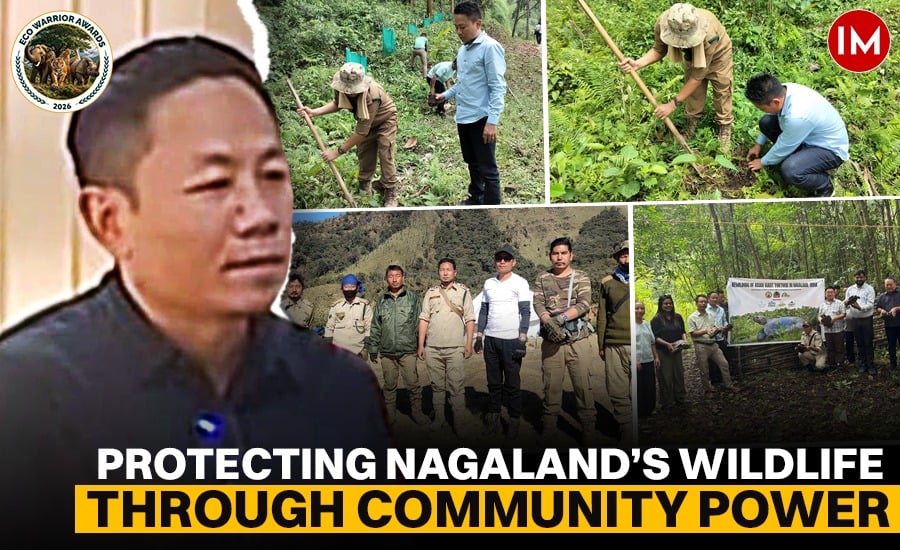
In Nagaland, protecting forests and wildlife often begins outside a traditional protected area. It begins in a village council meeting, with communities deciding whether a part of their own land should be protected.
For H Tokaho Kininmi, IFS, this understanding shaped eight years of work as a wildlife warden in Dimapur, from 2018 to 2026. A 2014-batch Nagaland cadre officer, he is currently serving as Divisional Forest Officer, Phek.
During his tenure as Wildlife Warden, Mr Kininmi worked across some of the most difficult aspects of wildlife protection in the state—from human-elephant conflict and illegal wildlife trade to hunting videos circulating on social media. But one of his most significant contributions was expanding Nagaland’s community reserve network by working with village councils and traditional institutions.
Thirty-four community reserves were notified during this period, bringing 63.81 sq. km of additional landscape under community-led conservation.
For Mr Kininmi, however, the numbers tell only part of the story.
Building Wildlife Protection Beyond Protected Areas
When Mr Kininmi took charge of the wildlife sector in 2018, he was moving from territorial divisions into a field that was relatively new to him.
“The wildlife sector was quite new to me because I had been serving mostly in territorial divisions. Taking charge of wildlife presented several challenges,” he shared with Indian Masterminds.
The wildlife wing itself needed strengthening. One immediate concern was the Wildlife Crime Control Unit, particularly as social media began creating new challenges for wildlife protection.
Hunting videos were increasingly being posted online, making it necessary for the department to monitor these platforms and respond to emerging threats.
At the same time, Nagaland was dealing with extensive human-elephant conflict. The problem was complicated by the state’s land ownership pattern, with much of the forest and land outside formal protected areas belonging to village communities.
Around 190 villages had a history of human-elephant conflict, according to the officer.
“The scale of the conflict was huge. Many districts and villages were affected,” he says.
Instead of treating individual incidents in isolation, Mr Kininmi and his team began working towards a more systematic understanding of the problem. They focused on creating a database documenting where conflicts occurred, who was affected, the movement of elephants and the support required by affected communities.
Elephant movements into areas where they had not previously been recorded also became an important area of study.
Why Community Reserves Became Central to His Conservation Strategy
Nagaland presents a distinctive challenge for conventional wildlife conservation. Its formal protected area network covers only a small portion of the state, while large stretches of forests and natural landscapes are owned and managed by communities.
That made community participation not merely desirable but necessary.
His approach was to engage rather than impose.
The department explained the concept of community reserves to village councils and communities, allowing them to decide whether they wanted to dedicate portions of their land to conservation.
Thirty-four such reserves were eventually notified, covering 63.81 sq. km.
The model also changed the conventional relationship between the Forest Department and local communities. Instead of taking over management, the department provided technical guidance while village institutions remained responsible for managing their reserves.
“We did not pressure them; we simply explained the concept, and they willingly set aside portions of their land for the declaration of community reserves,” he says.
Empowering Village Councils to Protect Their Own Forests
The community reserve model goes beyond simply marking an area as protected. It gives local institutions a direct role in deciding how their natural resources should be managed.
Village councils can frame their own rules and penalties for violations involving hunting, fishing and logging.
“When we declare these community reserves, we essentially empower the village councils and hand over the entire management to the communities. We provide only technical guidance,” Mr Kininmi says.
For the officer, connecting these community-managed landscapes is just as important as creating individual reserves.
“We work collectively to expand the protected area network and connect habitats across landscapes. Connecting habitats is the ultimate objective of community reserves,” he explains.
This landscape-level approach is particularly important in a state where wildlife does not necessarily remain within formally designated protected areas.
Tackling Wildlife Crime in a Porous Border Region
Dimapur’s location also brought another challenge: illegal wildlife trade and the movement of wildlife products through a porous region.
Mr Kininmi strengthened intelligence-based action by maintaining informant networks and monitoring social media platforms for potential wildlife crime.
Information received through the Wildlife Crime Control Bureau, police and other sources could then be developed into actionable intelligence.
“In this day and age, information is very important. People involved in wildlife trade are quite smart, so we have to stay alert,” he says.
Yet the officer acknowledges that gaps remain. Infrastructure and manpower need to be strengthened, particularly given the region’s geography and multiple routes that can be exploited by wildlife traffickers.
Technology, too, remains an area where the department faces limitations because of funding and security restrictions.
Mr Kininmi points out that forest departments in some other states have access to advanced technological tools and mobile network information during investigations, facilities that are not similarly available to them in Nagaland.
Keeping the Amur Falcon Conservation Story Alive
Another responsibility during his tenure was sustaining Nagaland’s successful Amur Falcon conservation efforts.
The annual migration of Amur Falcons brings thousands of these migratory birds to the region, making protection of their roosting sites critical.
For Mr Kininmi, conservation success cannot be treated as a one-time achievement. The work has to be renewed every migration season through continued monitoring and community participation.
The same principle runs through his wider conservation philosophy: protecting wildlife requires people living alongside forests to become active participants in the process.
Conservation Must Also Create Livelihoods
After years of working with communities, IFS H Tokaho Kininmi believes Nagaland’s conservation future must combine environmental protection with economic opportunities.
The state’s constitutional and customary land ownership patterns mean that communities will remain central to decisions about forests and natural resources.
“In a place like Nagaland, where the Constitution guarantees land and its resources to the people, and where most of the land belongs to the communities, the only sustainable way forward is direct community involvement in wildlife conservation,” he says.
But he adds an important condition: conservation must benefit communities economically.
“Conservation should also serve as a means of livelihood—through ecotourism and other related alternatives.”
For many communities, forests are among their most important available natural resources, while agriculture can be difficult because of the terrain. Linking conservation with sustainable livelihoods, therefore, could make protection economically meaningful as well as environmentally necessary.
Mr Kininmi’s work in Dimapur reflects this shift—from conservation as a department-led activity to conservation as a shared responsibility. Whether it is a village protecting its forest, communities responding to elephant movement, local institutions enforcing their own conservation rules or officials using intelligence to tackle wildlife crime, the larger objective remains the same: keeping people and wildlife connected to a landscape they both depend on.
For Nagaland, that community-led approach may prove to be one of the strongest foundations for protecting its forests and wildlife in the years ahead.