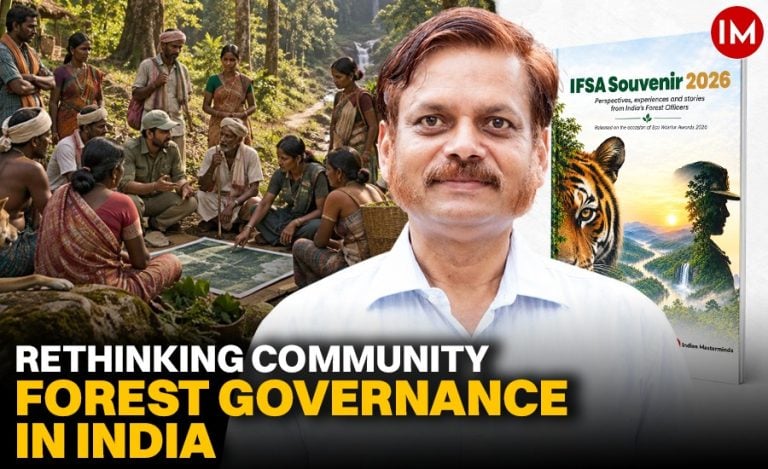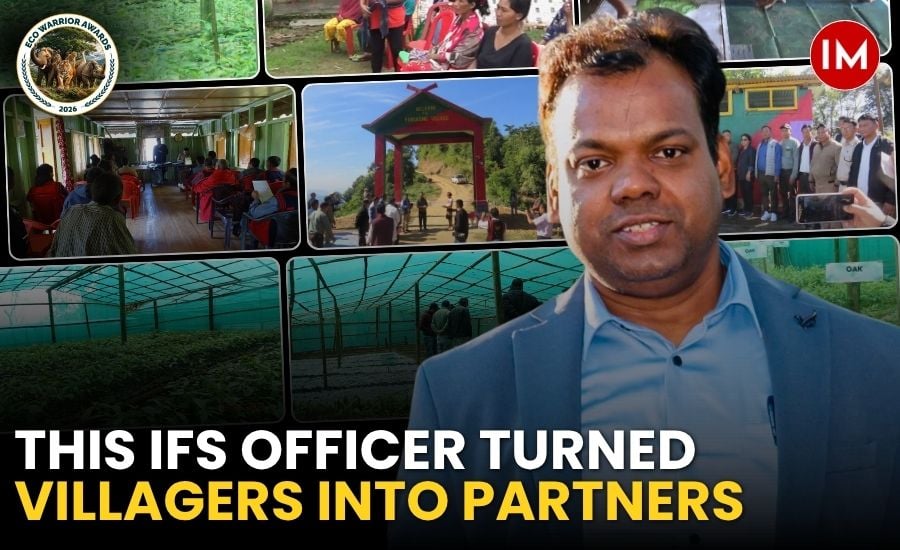
For IFS officer Rajesh Kumar, the forests of Nagaland taught him an important lesson: conservation works best when local communities are not treated merely as beneficiaries but as partners.
A 2013-batch Indian Forest Service officer of the Nagaland cadre, Rajesh Kumar spent nearly eight years serving in the remote districts of Kiphire and Mon. During his tenure, he was closely associated with the implementation of the Nagaland Forest Management Project (NFMP), also referred to as the Nagaland Sustainable Forest Management Project (NSMP), an initiative supported by Japan to promote sustainable forestry on community-owned land.
Now posted as Divisional Forest Officer (DFO), Mokokchung, Mr Kumar looks back at his years in eastern Nagaland as a period that changed both his understanding of forest management and his approach to working with communities.
Working in Nagaland’s Remote Eastern Districts
Kiphire and Mon are among the easternmost districts of Nagaland and some of the state’s most remote areas. Kiphire, in particular, was around a 13-hour road journey from Dimapur, the nearest railway station, when Mr Kumar served there.
The geographical isolation was only one part of the challenge. The bigger task was building trust with communities whose relationship with land is deeply connected to their social and cultural identity.
“These are the easternmost districts of Nagaland. Nagaland itself is in the eastern part of India, and these two are the easternmost,” IFS Rajesh Kumar explains.
He was the first Divisional Forest Officer posted in Kiphire when the forest management project was being initiated there. Under the project, 18 villages in Kiphire and 20 villages in Mon were selected for various forestry and conservation activities.
The project was different from conventional plantation programmes because it was designed specifically around community participation.
A Forest Project Built Around Community Ownership
Nagaland has a distinctive land ownership system, with Article 371A of the Constitution providing constitutional safeguards concerning land and its resources. Much of the forest land is community-owned, making conventional government-led plantation models unsuitable.
For the project to succeed, the Forest Department first had to convince villagers that plantation activities would not affect their ownership rights.
“The most challenging part was convincing the villagers to give land for project activities,” he shared with Indian Masterminds.
The department conducted extensive sensitisation programmes before beginning any work. Communities were informed that the project would not transfer ownership of their land to the government and that the benefits generated through the project would remain with the villages.
Prior informed consent was obtained from communities before project activities began.
This approach proved particularly effective in Kiphire. Despite villages dropping out of the project in some other parts of Nagaland, no village in Kiphire opted out.
The project eventually covered nearly 7,000 hectares across Kiphire and Mon, with plantation activities being carried out by villagers under the supervision of Forest Department staff.
From Jhum Fields to Village Nurseries
One of the project’s distinctive features was its approach to jhum cultivation.
Unlike conventional agricultural systems where the same land may be cultivated repeatedly with crop rotation, jhum cultivation involves shifting cultivation. A plot may be cultivated for one or two years before the community moves to another area as soil fertility declines.
The project sought to integrate forestry into this cycle by encouraging communities to plant fast-growing forest species in jhum areas during the cultivation cycle.
Rather than transporting saplings from government nurseries, the project trained villagers to establish nurseries within their own villages.
“This was the first time we raised the nurseries in the villages themselves, and the community was fully involved,” Mr Kumar recalls.
The approach created employment within villages while also developing practical knowledge about seed collection, nursery management, plantation and maintenance.
The choice of species was also left largely to communities. Instead of restricting plantations to a handful of commonly used species, villagers were encouraged to identify species naturally suited to their own landscapes.
Over six to seven years, more than 100 different species were planted across the 11 districts covered by the project.
Communities Continued Work During COVID
The project’s community-based structure was put to a major test during the COVID-19 pandemic.
When lockdowns began, villages across Nagaland became highly restrictive about outside movement. Village gates were closed, and outsiders, including officials, often could not enter.
The Forest Department relied on the Joint Forest Management Committees (JFMCs) established at the village level to keep project activities moving.
Officials communicated with communities through phone calls and videos, encouraging them to continue nursery activities even when regular field visits and financial transfers were disrupted.
One village reportedly raised nearly 50,000 saplings without receiving any money from the project during that period.
“For me, it was very satisfying because we never expected villagers to do such a thing without any financial help,” Mr Kumar says.
The experience demonstrated that the capacity-building work carried out before the pandemic had created a level of ownership that allowed communities to continue independently.
From Kitchen Gardens to Technical Forest Management
According to IFS Rajesh Kumar, the project did not introduce the idea of growing plants to villagers from scratch. Most households already had experience raising plants through kitchen gardens and traditional practices.
What changed was the scale and scientific organisation of those practices.
The project trained villagers in collecting seeds and seedlings, raising nursery stock, maintaining plantations and understanding the growth requirements of different species.
The impact is visible in the way communities now discuss forestry.
“Now they talk knowledgeably about the growth habits of different species,” Mr Kumar says.
He has also seen this evolution in Mokokchung, where communities have progressed beyond basic plantation activities and begun discussing technical aspects of silviculture and plantation management.
At review meetings, some village groups have even presented PowerPoint presentations documenting the progress of their plantations.
GIS Monitoring Added a New Layer
Community participation was complemented by a technology-driven monitoring system.
The project introduced GIS-based monitoring and trained Forest Department staff to collect field-level information digitally. In a geographically challenging state like Nagaland, this was a significant shift from conventional monitoring practices.
The system also improved accountability by making it possible to track plantation activities and verify claims from the field.
“The villagers were also aware that they could not make any false claims about project implementation,” Mr. Kumar explains.
For Forest Department personnel, the system became a learning opportunity as well, exposing officers and field staff to GIS-based monitoring and digital data collection.
For Rajesh Kumar, the most important outcome of the project goes beyond the hectares planted or the number of saplings raised.
It lies in the relationship built between the Forest Department and the communities that own and manage the land.
As he puts it, “The first major objective of the project was capacity building of community members through raising nurseries at the village level.”
That philosophy continues to shape Kumar’s approach as he serves as DFO, Mokokchung, carrying forward lessons from nearly eight years in some of Nagaland’s most remote districts.