A mobile phone today is rarely just a phone. It holds our money, identity, photographs, passwords, conversations and access to some of the most important services in our lives. So when a mobile number is misused, a SIM card is forged or a phone is stolen, the damage can travel much further than the device itself.
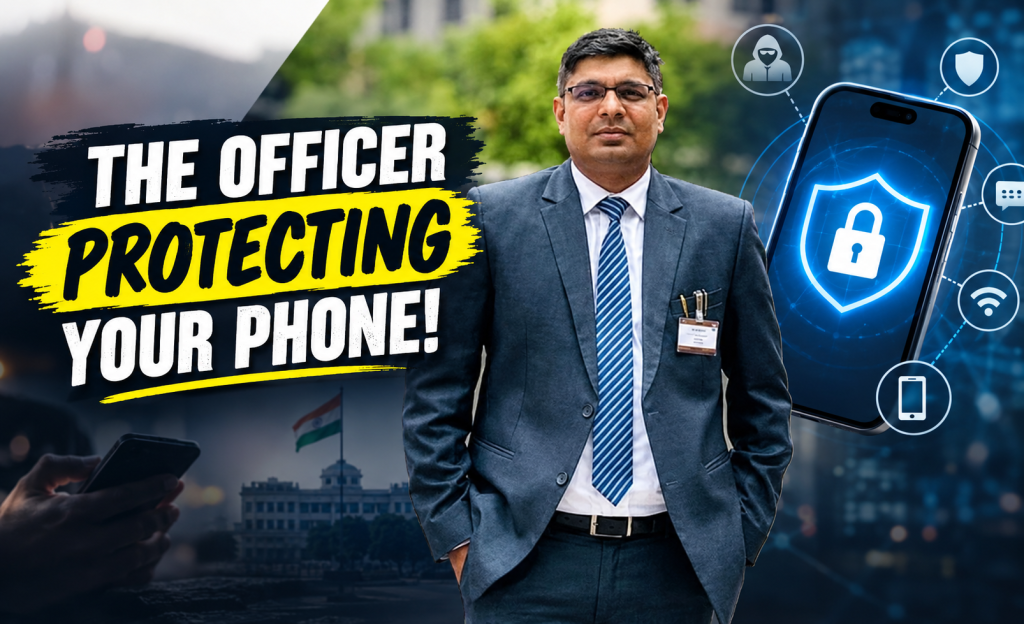
This is where the work of Naveen Jakhar, an Indian Telecommunications Service (ITS) officer of the 2014 batch, becomes significant.
As Director, AI & Digital Intelligence Unit at the Department of Telecommunications (DoT), Jakhar is working at an unusual intersection: telecom, artificial intelligence, cybersecurity, financial fraud prevention and public administration.
But the interesting part is not simply that he uses technology. It is how he uses it. His approach is built around a deceptively simple question: What if the government could detect a threat before an ordinary citizen became its victim?
That question has led to systems now operating at a scale few people ever see, but millions of citizens benefit from.
Also read: Using Telecom Technology to Fight Coronavirus
From Managing Crisis to Preventing It
Jakhar’s technology-driven administrative journey took shape during one of the biggest crises of modern times: the COVID-19 pandemic.
When governments were struggling to manage movement, quarantine and medical logistics, technology became an essential part of the response.
Jakhar was involved in the COVID Quarantine Alert System (CQAS), a geo-fencing based system deployed across 18 States and Union Territories. It monitored around 37 lakh targets and detected more than 21 crore breach events.
Then came the oxygen crisis during the second wave. The Oxygen Digital Tracking System (ODTS) enabled real-time monitoring of around 42,000 oxygen carriers transporting 5.3 lakh metric tonnes of medical oxygen.
These projects offered an early glimpse of what would become a defining feature of Jakhar’s work: using technology not merely to digitise an existing process, but to fundamentally change how the government responds to a problem.
And after the pandemic, the problem changed. The threat moved from crowded streets and overwhelmed hospitals to something far less visible: the digital space.
The SIM Card That Could Become a Cybercrime Weapon
A fake SIM may look like an administrative irregularity. In the hands of a cybercrime network, it can be much more.
The challenge was enormous: how do you identify suspicious mobile connections among millions of legitimate users? The answer was ASTR, an AI-powered system developed to detect suspected fraudulent and forged SIM connections.
Instead of waiting for a crime to happen and then tracing the number involved, ASTR looks for suspicious patterns and anomalies across massive datasets.
The scale is striking.
The system has enabled the disconnection of 88 lakh-plus suspected fraudulent mobile connections. The significance of ASTR lies not just in the number of SIM cards it has helped disconnect, but in the way it has changed the approach to telecom-related fraud.
Traditionally, authorities would often have to wait for a crime to occur, receive a complaint and then begin tracing the number or connection involved.
ASTR turns that approach on its head. By analysing patterns and identifying suspicious connections at scale, it allows authorities to spot potential threats much earlier, before a fraudulent mobile connection can be used to cause harm.
That shift, from responding to fraud after the fact to identifying risks before they become crimes, is what makes ASTR particularly significant.
When Government Technology Reached the Citizen’s Phone
If ASTR works largely behind the scenes, Sanchar Saathi brought telecom security directly into the hands of citizens. The platform allows people to check mobile connections issued in their name, report suspected fraudulent communications through Chakshu, report lost or stolen handsets and verify the genuineness of mobile devices.
Suddenly, something that once belonged almost entirely to telecom regulators became something a citizen could interact with personally. And citizens responded.
The platform has recorded 29 crore visits and more than 2.6 crore app downloads, while contributing to the recovery of 13 lakh-plus lost or stolen mobile handsets.
Think about what that means in ordinary terms. Someone loses a phone containing years of photographs and personal information. Instead of simply accepting the loss, there is now a digital pathway to report, block, trace and potentially recover it.
Technology, in this case, is no longer an abstract government project. It becomes useful precisely when someone is having a very bad day.
From Lost Phones to Lost Money
The next challenge was even more consequential. Money.
As digital payments exploded, telecom numbers increasingly became linked to financial fraud. A suspicious mobile number could be an early warning sign of something much bigger.
This led to the Financial Fraud Risk Indicator (FRI) and the wider Digital Intelligence Platform (DIP). DIP connects intelligence across telecom, banking, fintech, law enforcement and other stakeholders, with a network spanning around 1,600 organisations.
FRI takes this one step further by providing actionable risk intelligence to financial institutions.
The objective is straightforward: identify the warning signs before money disappears. The system has helped prevent financial fraud estimated at ₹5,000 crore-plus over the last 15 months.
It is perhaps here that the larger picture becomes clear. A telecom network is no longer merely carrying calls and messages. It can also become an intelligence layer helping protect a person’s digital identity and financial life.
The Officer Is Only One Part of the Story
There is, however, another important part of this story. None of this is the work of one officer sitting behind a computer.
The Digital Intelligence Unit is a multidisciplinary ecosystem of officers, technologists, analysts, cybersecurity professionals, telecom specialists and operational teams.
They work with telecom service providers, banks, UPI players, police forces, government departments and other stakeholders.
That coordination is itself an achievement. Because technology may build the platform, but government machinery has to make hundreds of institutions work together for that platform to matter.
Jakhar’s role lies at precisely that intersection: understanding the technology, navigating the machinery of government and turning an idea into something that can work across a country of India’s scale.
A Different Idea of What a Civil Servant Can Be
Jakhar has authored 34 research papers, articles and white papers spanning digital governance, AI, telecom, cybersecurity, IoT, VLSI and ICT innovation.
His work has received recognition including the Innovation in Public Administration 2023 recognition from the Capacity Building Commission, multiple National e-Governance recognitions and the NCRB Cyber Challenge Award 2022 for ASTR.
But perhaps the more revealing measure is what happens when the systems he helped build encounter an ordinary citizen.
A fraudulent SIM is disconnected. A suspicious call is reported. An unauthorised mobile connection is discovered. A stolen phone is recovered. A potentially fraudulent transaction is flagged before the money is gone.
These may look like separate incidents. They are actually pieces of the same idea.
Government should not always arrive after the damage. Sometimes, it should arrive before it happens. That is the larger story behind Naveen Jakhar’s work.
As technology changes the nature of crime, identity and everyday life, administration too has to change with it. And somewhere between an AI algorithm, a telecom network, a police database and a citizen holding a smartphone lies a new kind of public service; one that does not merely govern the digital world, but quietly builds a shield around the people living in it.
Also read: Ritesh Randhir: The CRPF Officer Who Faced Bullets, a Venomous Snake and the Unpredictability of the Jungle