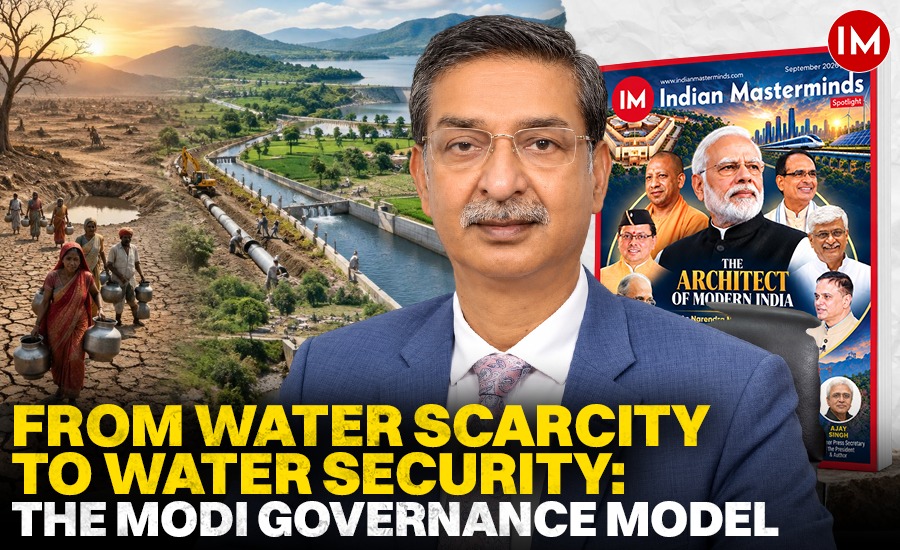
On 7 October, 2026, Shri Narendra Modi completes 25 years in the government, first as Chief Minister of Gujarat and thereafter as the Prime Minister of the country. While driving the development agendas for the state and central government, he has provided a transformative approach to governance in improving the quality of life of people, facilitating the ease of living while ensuring that no one is left behind on the road to progress. Focussed on providing basic amenities, like housing, clean tap water, toilets, electricity, cooking gas, internet connectivity, and access to healthcare, education and skilling to all, his governance model has delivered change in the lives people. In this endeavour, water security has occupied the centre stage, demonstrating the prime minister’s key governance style of solving, instead of merely managing a problem.
As Chief Minister of Gujarat, Narendra Modi took oath 25 years ago on 7 October 2001 amidst challenging circumstances. The state was reeling under prolonged droughts, slow rehabilitation and reconstruction work in earthquake-affected areas and ensuing financial crisis. However, for him, this was an opportunity to transform the development agenda. He prioritised water management to transform the state from water scarce to water secure Gujarat.
A reliable, safe and sustainable water supply is fundamental not only for sustaining life but also for improving socio-economic conditions and developing human capital. However, globally, water security is under immediate risk, with declining availability of freshwater owing to population growth, rapid urbanisation, industrial activities and resultant pollution, and climate change. As per one estimate, India is also facing an acute water crisis with 600 million people impacted due to extreme water stress. Altered rainfall patterns with increased frequency of droughts and floods, owing largely to climate change, threaten agriculture, especially in arid and semi-arid regions. Groundwater contamination as well as its overexploitation, pollution of rivers, and uneven distribution of water resources between different regions intensifies the crisis.
The provision of assured supply of water to every citizen has therefore been a core pillar of the Prime Minister’s mandated focus on inclusive development and high economic growth. During his two and a half decades in the Government, Shri Narendra Modi has provided policy-driven leadership to assure water security to citizens.
Gujarat: From managing water scarcity to ensuring water security
Over the past two decades, the state of Gujarat has emerged as one of the states with highest growth in India. In 2023-24, it contributed 8.05% to India’s GDP. But back in 2002, the state was in poor economic shape. During 1999–2000, the Gross State Domestic Product (GSDP) grew by a mere 1.2%. Following the devastating earthquake in the state in 2001, the growth rate turned negative at 4.89%. Between 1997 – 2002, the GSDP growth rate of Gujarat was merely 2.8%. This was also a period when the state faced severe water crisis. The state’s 70% land area is arid/ semi-arid or desert and many regions in the state suffer from water deficit. By 2000, 27% of the groundwater resources in Gujarat were depleted. Rainfall deficits led to recurrent droughts, that led to conflicts over water scarcity and resulted in heavy dependence on water trains and tankers to fulfil drinking water needs of people in many districts. This had a cascading effect on crucial sectors, like agriculture, dairy, and industry, resulting in substantial economic losses.
The rehabilitation efforts, post the 2001 earthquake, provided an opportunity to relook at water service delivery across the state. The Narendra Modi-led government placed water conservation, augmentation and distribution at the heart of Gujarat’s development strategy. Investments were made in creating futuristic water infrastructure, including water storage, inter-basin water transfer, water treatment plants, rainwater harvesting, check dams, and wastewater recycling. A statewide water supply grid was built to enable inter-basin transfer of water from water abundant South Gujarat to water scarce and water quality-affected regions of North Gujarat, Saurashtra and Kutch. In this endeavour, community mobilisation became critical in restoring water bodies, recharging of aquifers, de-silting tanks, and reservoirs, and tapping new water catchment areas.
The Gujarat governance model was distinctive not merely because of the physical infrastructure created, but also because of the institutional architecture built around it. The creation of the Water and Sanitation Management Organisation (WASMO) in 2002 added the social and institutional dimension to the water security agenda. WASMO introduced a decentralised, demand-driven and community-managed model for rural drinking water supply. Instead of treating village communities merely as passive beneficiaries, it sought to make Gram Panchayats and village-level Pani Samitis with more than 50% women members responsible for planning, approving, implementing, operating and maintaining water supply systems, local water sources and improved sanitation.
The infrastructure, policy and social investments made in improving the water security of Gujarat paved the way for improvement in public health, education, social equity, and resulted in economic transformation of the state making it a model for development for the rest of the country.
National water security: At the centre of development
In 2014, after Shri Narendra Modi became Prime Minister, efficient water management, improved sanitation and access to clean tap water to every citizen became a key objective of the government’s development agenda. True development cannot take place until time-assured, clean piped water and improved sanitation is assured to every household, irrespective of geographical remoteness, area sensitivity, or socio-economic situation.
In India, with limited number of rain days, 18% of world’s population’s and only 4% of global freshwater resources, it is important that rainwater is cleanly harvested and stored. This requires the earth’s surface be made open-defecation free. The flagship Swachh Bharat Mission, launched in October 2014, in the first year of his prime ministership, focussed on ensuring access to toilets and improved sanitation, thus making India an Open Defecation Free (ODF) country. This was a deliberate strategy. Before providing clean drinking water to every home, surrounding environment had to be rid of contaminated human waste. Between 2014 and 2019, over 100 million household toilets were constructed in rural India to end open defecation. Improved sanitation coverage resulted in avoiding nearly 300,000 deaths due to diarrhoea during this period, as per government records.
A distinctive feature of the water security approach of the Prime Minister has been the effort to make water conservation a people’s movement. The Jal Shakti Abhiyan, launched in 2019 with its Catch the Rain campaign, started in 256 water-stressed districts, promotes rainwater harvesting, rejuvenation of water bodies, and afforestation in the whole country. Similarly, Mission Amrit Sarovar, launched in April 2022, sought to create or rejuvenate at least 75 water bodies in every district. The programme was designed around convergence of existing schemes and Jan Bhagidari, rather than relying solely on a new standalone funding stream. Atal Bhujal Yojana was planned and implemented to improve ground water management through community-led initiatives in 80 water-stressed districts of 7 states.
Jal Jeevan Mission: Clean tap water to every household
The Jal Jeevan Mission (JJM) – Har Ghar Jal, announced by the Prime Minister on 15 August 2019, aimed to provides every rural Indian household with a functional tap water connection by 2024. The initiative focusses on delivering prescribed quality with adequate quantity and sufficient pressure on a long-term basis. At the time of its launch, only 3.23 crore (less than 17%) of rural households had tap water connections, but by August 2026, this number increased to over 15.92 crore, covering nearly 82.25% of total rural households. The scope, scale and speed have been unparallel not only in India but anywhere in the world. By prioritising piped water service delivery, JJM has improved health outcomes, enhanced the overall quality of life and unlocked the potential of millions of rural residents especially women and girls, and making them stakeholders in India’s growth story.
Making water everyone’ business
The community-led approach of WASMO provided an important institutional precedent for JJM. Traditionally women carry the burden of collecting water for their households, but JJM emphasised on increased participation and leadership of women in the decision-making processes related to water access and use. The formation of Village Water and Sanitation Committees (VWSC)/ Pani Samitis shifted decision-making power to women. Following the ‘bottom-up’ approach, the village action plans (VAP) included water budgeting, sourcing and infrastructure planning, including managing water supply finances and determining and collecting water supply service delivery charges for financial sustainability.
Jal Jeevan Mission along with Swachh Bharat Mission became a model for community mobilisation. Over 5.3 lakh VWSCs have been formed in 5.86 lakh villages across India and over 5.2 lakh VAPs have been prepared. More than 24 lakh women have also been trained in water quality testing under JJM.
The social significance of such an initiative has been substantial. Providing household tap water drastically reduces the daily burden of collecting water, allowing women and girls to redirect their time towards education and generating livelihoods. Lack of hygienic sanitation practices, sanitary facilities, and access to clean drinking water impact the health of children. During the COVID–19 pandemic, a 100-Day Campaign was launched in October 2020 as a focused effort to ensure that all schools/ ashramshalas and anganwadis across the country had access to safe piped drinking water within a short timeframe. As a result, 91% schools and more than 86% aanganwadi centres have provision of potable tap water, handwashing facilities and piped water in toilets. Nobel laureate Prof. Michael Kremer observed in his study of JJM that provision of safe drinking water to 50% households prevented around 1,36,000 under-5 deaths annually.
Road ahead: Consolidation of early gains
The next phase of this journey is already visible in JJM 2.0. In March 2026, the Union Cabinet approved restructuring and extension of JJM up to December 2028, with an enhanced total outlay of ₹8.69 lakh crore. More importantly, in states and at the ground level, the now the focus in on service delivery, institutional reform and sustainability. It envisages a greater responsibility for Gram Panchayats and VWSCs, and sustainable O&M systems.
The enduring lesson of the past 25 years is that a nation’s water security is built through the convergence of infrastructure, institutions, technology, conservation, and above all, its people. Prime Minister brought a change in mindset of policymakers that fund utilised for water and sanitation is not an expenditure, but investment for the future. By his sustained advocacy, he ensured that water becomes everyone’s business. At a time when India is aiming to be a Viksit Bharat or a developed economy by 2047, water security will be the key driver of this great leap forward.
(Mr. Bharat Lal has worked for a long time in water sector. He is the founder of WASMO in Gujarat as well as Founder Mission Director of National Jal Jeevan Mission. He has worked as Secretary General, National Human Rights Commission (NHRC), Director General of National Centre for Good Governance (NCGG) and Secretary, Lokpal of India.)
Read All: How Modi’s governance journey mirrors an ancient Indian test of leadership and dharma